The question asks to identify the district in Western India that recorded a specific low temperature on a particular date. This requires knowledge of geographical locations and recent weather events, often covered in current affairs or general knowledge sections of competitive exams.
C) Churu is located in Rajasthan, which is part of Western India. It is well-known for its extreme climatic conditions, including very low temperatures during winter. On December 18, 2021, Churu indeed recorded a minimum temperature of 1.1 degrees Celsius, making it one of the coldest places in the region on that day.
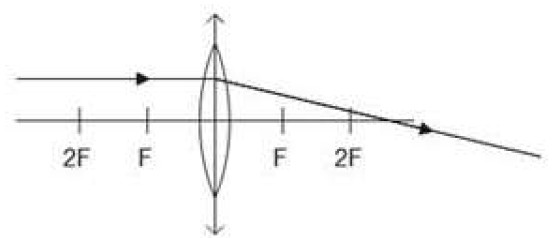
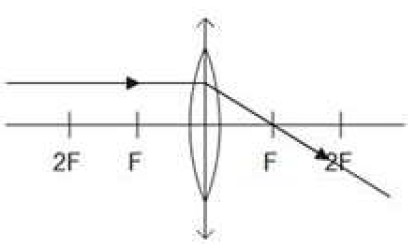
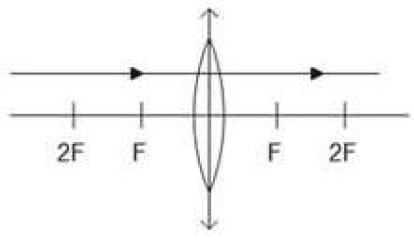
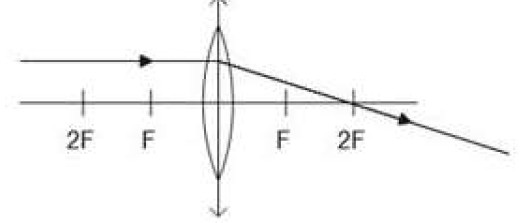
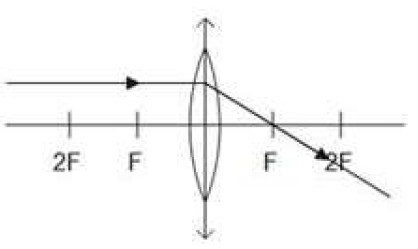
Which of the following diagrams correctly represents the path of a light ray incident parallel to the principal axis after refraction through the lens?
When a light ray is incident parallel to the principal axis of a lens, it refracts and passes through the focal point on the other side of the lens. This principle is crucial for understanding how lenses focus light.
Correct Option: B) The diagram correctly shows the refracted ray passing through the focal point on the opposite side.
To solve this problem, we need to identify pairs of letters in the given word "LOVABLE" that have the same number of letters between them as they do in the English alphabetical order. This check must be performed in both forward and backward directions.
Correct Option: D) 1. The only pair of letters that satisfies the condition is (A, B). In the word LOVABLE, 'A' and 'B' are adjacent, meaning there are 0 letters between them. In the English alphabet, 'A' and 'B' are also adjacent, meaning there are 0 letters between them. This condition holds true in both forward and backward directions (A-B and B-A).
Refer to the following letter and symbol series and answer the question.
(Left) E # R & H & @ J & M N # B & V && D # P @ W % & Q & A % & # E & (Right)
If all the symbols are dropped from the series, which of the following will be third from the left?
The problem asks us to identify the third element from the left in a given series after all symbols are removed. We need to first filter out the symbols and then count the remaining elements from the left.
Therefore, 'H' is the third element from the left after removing all symbols.
Correct Option: D) H
Let 0° < θ < 90°. \(\mathrm{\sqrt{\frac{\sec^{2}\theta+\mathrm{cosec}^{2}\theta}{\tan^{2}\theta-\sin^{2}\theta}}\times\frac{(1+\tan^{2}\theta)\sin^{2}\theta}{(\mathrm{cosec}\theta-\cot\theta)(1+\cos\theta)}}\) is equal to:
The problem requires simplifying a complex trigonometric expression. The strategy involves using fundamental trigonometric identities to simplify each part of the expression step-by-step, converting terms into sine and cosine where helpful, and then multiplying to get the final simplified form.
Let the given expression be \(E\). We will simplify the first part of the expression:
\[ \sqrt{\frac{\sec^{2}\theta+\mathrm{cosec}^{2}\theta}{\tan^{2}\theta-\sin^{2}\theta}} \]Using identities \(\sec^2\theta = 1+\tan^2\theta\) and \(\mathrm{cosec}^2\theta = 1+\cot^2\theta\), and \(\tan\theta = \frac{\sin\theta}{\cos\theta}\), \(\cot\theta = \frac{\cos\theta}{\sin\theta}\):
\[ \sec^{2}\theta+\mathrm{cosec}^{2}\theta = \frac{1}{\cos^2\theta} + \frac{1}{\sin^2\theta} = \frac{\sin^2\theta + \cos^2\theta}{\sin^2\theta\cos^2\theta} = \frac{1}{\sin^2\theta\cos^2\theta} \] \[ \tan^{2}\theta-\sin^{2}\theta = \frac{\sin^2\theta}{\cos^2\theta} - \sin^2\theta = \sin^2\theta\left(\frac{1}{\cos^2\theta} - 1\right) = \sin^2\theta\left(\frac{1-\cos^2\theta}{\cos^2\theta}\right) = \sin^2\theta\left(\frac{\sin^2\theta}{\cos^2\theta}\right) = \frac{\sin^4\theta}{\cos^2\theta} \]Substitute these back into the square root:
\[ \sqrt{\frac{\frac{1}{\sin^2\theta\cos^2\theta}}{\frac{\sin^4\theta}{\cos^2\theta}}} = \sqrt{\frac{1}{\sin^2\theta\cos^2\theta} \times \frac{\cos^2\theta}{\sin^4\theta}} = \sqrt{\frac{1}{\sin^6\theta}} = \frac{1}{\sin^3\theta} \]Now, simplify the second part of the expression:
\[ \frac{(1+\tan^{2}\theta)\sin^{2}\theta}{(\mathrm{cosec}\theta-\cot\theta)(1+\cos\theta)} \]Using the identity \(1+\tan^2\theta = \sec^2\theta\):
\[ (1+\tan^{2}\theta)\sin^{2}\theta = \sec^2\theta\sin^2\theta = \frac{1}{\cos^2\theta}\sin^2\theta = \tan^2\theta \]Simplify the denominator:
\[ (\mathrm{cosec}\theta-\cot\theta)(1+\cos\theta) = \left(\frac{1}{\sin\theta}-\frac{\cos\theta}{\sin\theta}\right)(1+\cos\theta) \] \[ = \frac{1-\cos\theta}{\sin\theta}(1+\cos\theta) = \frac{1-\cos^2\theta}{\sin\theta} = \frac{\sin^2\theta}{\sin\theta} = \sin\theta \]So the second part becomes:
\[ \frac{\tan^2\theta}{\sin\theta} = \frac{\frac{\sin^2\theta}{\cos^2\theta}}{\sin\theta} = \frac{\sin^2\theta}{\cos^2\theta\sin\theta} = \frac{\sin\theta}{\cos^2\theta} \]Multiply the simplified first and second parts:
\[ E = \frac{1}{\sin^3\theta} \times \frac{\sin\theta}{\cos^2\theta} = \frac{1}{\sin^2\theta\cos^2\theta} \]We know that \(\sin^2\theta\cos^2\theta = (\sin\theta\cos\theta)^2\). Also, \(\sin 2\theta = 2\sin\theta\cos\theta\), so \(\sin\theta\cos\theta = \frac{\sin 2\theta}{2}\).
\[ E = \frac{1}{\left(\frac{\sin 2\theta}{2}\right)^2} = \frac{1}{\frac{\sin^2 2\theta}{4}} = \frac{4}{\sin^2 2\theta} \]This does not match the options directly. Let's recheck the first part simplification. There was a common identity \(\sec^2\theta + \mathrm{cosec}^2\theta = \sec^2\theta \mathrm{cosec}^2\theta\).
Let's re-evaluate the first part using this identity:
\[ \sec^{2}\theta+\mathrm{cosec}^{2}\theta = \frac{1}{\cos^2\theta} + \frac{1}{\sin^2\theta} = \frac{\sin^2\theta+\cos^2\theta}{\sin^2\theta\cos^2\theta} = \frac{1}{\sin^2\theta\cos^2\theta} = \sec^2\theta\mathrm{cosec}^2\theta \]So the numerator is \(\sec^2\theta\mathrm{cosec}^2\theta\).
The denominator is \[\tan^2\theta-\sin^2\theta = \frac{\sin^2\theta}{\cos^2\theta} - \sin^2\theta = \sin^2\theta\left(\frac{1}{\cos^2\theta}-1\right) = \sin^2\theta\left(\frac{1-\cos^2\theta}{\cos^2\theta}\right) = \sin^2\theta\frac{\sin^2\theta}{\cos^2\theta} = \frac{\sin^4\theta}{\cos^2\theta}\].
Thus, the first part is:
\[ \sqrt{\frac{\sec^2\theta\mathrm{cosec}^2\theta}{\frac{\sin^4\theta}{\cos^2\theta}}} = \sqrt{\frac{1}{\cos^2\theta\sin^2\theta} \times \frac{\cos^2\theta}{\sin^4\theta}} = \sqrt{\frac{1}{\sin^6\theta}} = \frac{1}{\sin^3\theta} \]This result is consistent. Let's recheck the second part.
\[ \frac{(1+\tan^{2}\theta)\sin^{2}\theta}{(\mathrm{cosec}\theta-\cot\theta)(1+\cos\theta)} = \frac{\sec^2\theta\sin^2\theta}{\frac{1-\cos\theta}{\sin\theta}(1+\cos\theta)} = \frac{\frac{\sin^2\theta}{\cos^2\theta}}{\frac{1-\cos^2\theta}{\sin\theta}} = \frac{\frac{\sin^2\theta}{\cos^2\theta}}{\frac{\sin^2\theta}{\sin\theta}} = \frac{\frac{\sin^2\theta}{\cos^2\theta}}{\sin\theta} = \frac{\sin\theta}{\cos^2\theta} \]Multiplying them:
\[ E = \frac{1}{\sin^3\theta} \times \frac{\sin\theta}{\cos^2\theta} = \frac{1}{\sin^2\theta\cos^2\theta} \]We know that \(\sin 2\theta = 2\sin\theta\cos\theta\). Therefore, \(\sin^2 2\theta = 4\sin^2\theta\cos^2\theta\).
So, \(\sin^2\theta\cos^2\theta = \frac{\sin^2 2\theta}{4}\).
Substituting this into the expression for \(E\):
\[ E = \frac{1}{\frac{\sin^2 2\theta}{4}} = \frac{4}{\sin^2 2\theta} = 4\mathrm{cosec}^2 2\theta \]This result still does not match the options. Let's re-examine the expression, perhaps there is a simpler way or a common identity missed.
Let's simplify the expression again, being careful with each step.
First part: \[\mathrm{\sqrt{\frac{\sec^{2}\theta+\mathrm{cosec}^{2}\theta}{\tan^{2}\theta-\sin^{2}\theta}}}\]
Numerator: \[\sec^2\theta + \mathrm{cosec}^2\theta = \frac{1}{\cos^2\theta} + \frac{1}{\sin^2\theta} = \frac{\sin^2\theta + \cos^2\theta}{\sin^2\theta\cos^2\theta} = \frac{1}{\sin^2\theta\cos^2\theta}\]
Denominator: \[\tan^2\theta - \sin^2\theta = \frac{\sin^2\theta}{\cos^2\theta} - \sin^2\theta = \sin^2\theta \left(\frac{1}{\cos^2\theta} - 1\right) = \sin^2\theta \left(\frac{1-\cos^2\theta}{\cos^2\theta}\right) = \sin^2\theta \frac{\sin^2\theta}{\cos^2\theta} = \frac{\sin^4\theta}{\cos^2\theta}\]
So, the first part is: \[\sqrt{\frac{\frac{1}{\sin^2\theta\cos^2\theta}}{\frac{\sin^4\theta}{\cos^2\theta}}} = \sqrt{\frac{1}{\sin^2\theta\cos^2\theta} \times \frac{\cos^2\theta}{\sin^4\theta}} = \sqrt{\frac{1}{\sin^6\theta}} = \frac{1}{\sin^3\theta}\]
Second part: \[\mathrm{\frac{(1+\tan^{2}\theta)\sin^{2}\theta}{(\mathrm{cosec}\theta-\cot\theta)(1+\cos\theta)}}\]
Numerator: \[(1+\tan^2\theta)\sin^2\theta = \sec^2\theta\sin^2\theta = \frac{\sin^2\theta}{\cos^2\theta} = \tan^2\theta\]
Denominator: \[(\mathrm{cosec}\theta-\cot\theta)(1+\cos\theta) = \left(\frac{1}{\sin\theta}-\frac{\cos\theta}{\sin\theta}\right)(1+\cos\theta) = \frac{1-\cos\theta}{\sin\theta}(1+\cos\theta) = \frac{1-\cos^2\theta}{\sin\theta} = \frac{\sin^2\theta}{\sin\theta} = \sin\theta\]
So, the second part is: \[\frac{\tan^2\theta}{\sin\theta} = \frac{\frac{\sin^2\theta}{\cos^2\theta}}{\sin\theta} = \frac{\sin\theta}{\cos^2\theta}\]
Multiplying the two parts:
\[ E = \frac{1}{\sin^3\theta} \times \frac{\sin\theta}{\cos^2\theta} = \frac{1}{\sin^2\theta\cos^2\theta} \]This is equal to \(\mathrm{cosec}^2\theta\sec^2\theta\).
Let's check the options. Option C is \(\mathrm{cosec}^2\theta\sec^2\theta\).
This matches our simplified expression.
When a solid metallic object is melted and recast into smaller identical objects, the total volume of the material remains constant. Therefore, to find the number of small dice that can be made, we need to calculate the volume of the original cuboid and the volume of one small die, and then divide the total volume by the volume of one small die.
The dimensions of the cuboid are given as 4 cm \(\times\) 10 cm \(\times\) 15 cm.
\[ \text{Volume of cuboid} = \text{length} \times \text{width} \times \text{height} \] \[ V_{\text{cuboid}} = 4\ \text{cm} \times 10\ \text{cm} \times 15\ \text{cm} \] \[ V_{\text{cuboid}} = 600\ \text{cm}^3 \]The dimensions of one small die are given as 2 cm \(\times\) 2 cm \(\times\) 2 cm. Since all sides are equal, it's a cube.
\[ \text{Volume of one die} = \text{side} \times \text{side} \times \text{side} \] \[ V_{\text{die}} = 2\ \text{cm} \times 2\ \text{cm} \times 2\ \text{cm} \] \[ V_{\text{die}} = 8\ \text{cm}^3 \]The number of dice will be the total volume of the cuboid divided by the volume of one die.
\[ \text{Number of dice} = \frac{V_{\text{cuboid}}}{V_{\text{die}}} \] \[ \text{Number of dice} = \frac{600\ \text{cm}^3}{8\ \text{cm}^3} \] \[ \text{Number of dice} = 75 \]Correct Option: A) 75
This problem involves tracking movement in different directions. We can solve it by visualizing Sharad's path and calculating the net displacement in the east-west and north-south directions. Since all turns are 90 degrees, we can consider the movements along perpendicular axes.
B) 11 km is the correct answer. Sharad ends up 11 km to the west of his starting point.
This problem involves arranging people in a linear row based on given positional relationships. We will use a step-by-step approach to build the arrangement and then count the total number of people.
E _ _ _ BE _ _ _ B _ _ CA _ _ _ _ _ E _ _ _ B _ _ CA _ _ _ _ _ E _ _ _ B _ _ C _ _ DE _ _ _ B _ _ CE _ _ _ B _ _ C. If D is placed two positions to the left of C, it would be between B and C. This would mean D is one position to the right of B. This is a valid position.A _ _ _ _ _ E _ _ _ B D _ C (This contradicts the initial spacing between B and C, as it implies only one person between B and C, not two. So, D cannot be between B and C if there are two people between C and D.)...B _ _ C, then D would be at the position of the first underscore after B. This means D is immediately to the right of B. Let's check if this fits the condition "two persons between C and D". If D is immediately to the right of B, then the arrangement is ...B D _ C. Here, there is only one person between D and C, not two. Therefore, D cannot be to the left of C with two people between them in a way that maintains the existing structure. So, Case 2 is not possible.A _ _ _ _ _ E _ _ _ B _ _ C _ _ DE _ _ _ B (5 people)E _ _ _ B _ _ C (8 people)A _ _ _ _ _ E _ _ _ B _ _ C (14 people)A _ _ _ _ _ E _ _ _ B _ _ C _ _ DTo find the number of prime numbers between 20 and 80, we need to list all the prime numbers in this range and then count them. A prime number is a natural number greater than 1 that has no positive divisors other than 1 and itself.
B) There are 14 prime numbers between 20 and 80.
The question asks to identify which waste material cannot be degraded by bacteria or other saprophytes. This requires understanding the concept of biodegradability and the nature of different waste materials.
D) Plastic is a synthetic material that cannot be degraded by bacteria or other saprophytes due to its complex and stable polymer structure, which microorganisms lack the enzymes to break down effectively.