
This is a syllogism problem. We can solve it by drawing Venn diagrams or by applying the rules of syllogism. We will represent each statement as a relationship between sets and then check the validity of each conclusion.
From our combined relationship (Eggs \(\subset\) Millets \(\subset\) Balloons), we know that all eggs are balloons. However, it does not necessarily mean that all balloons are eggs. There could be balloons that are not eggs. So, this conclusion does not logically follow.
From the combined relationship (Millets \(\subset\) Balloons \(\subset\) Prisoners), we know that all millets are balloons, and all balloons are prisoners. This implies that all millets are prisoners. If all millets are prisoners, then it logically follows that some prisoners are millets (since the set of millets is a subset of prisoners, and if there are millets, then those millets are also prisoners). So, this conclusion logically follows.
From the combined relationship (Balloons \(\subset\) Prisoners), we know that all balloons are prisoners. However, it does not necessarily mean that all prisoners are balloons. There could be prisoners who are not balloons. So, this conclusion does not logically follow.
Correct Option: B) Only conclusion II follows.
The problem requires us to modify a given number based on specific rules for its odd and even digits. First, we will identify the odd and even digits in the original number. Then, we will apply the given operations (add 2 to odd digits, subtract 1 from even digits) to form a new number. Finally, we will identify the second digit from the left and the second digit from the right in the new number and calculate their sum.
Original Number: The given number is \(5317846\).
Identify Odd and Even Digits:
Apply Operations:
Form the New Number: Replace the original digits with the modified digits in their respective positions.
Original: \(5 \quad 3 \quad 1 \quad 7 \quad 8 \quad 4 \quad 6\)
Modified: \(7 \quad 5 \quad 3 \quad 9 \quad 7 \quad 3 \quad 5\)
The new number formed is \(7539735\).
Identify the Second Digit from the Left: In the new number \(7539735\), the second digit from the left is \(5\).
Identify the Second Digit from the Right: In the new number \(7539735\), the second digit from the right is \(3\).
Calculate the Sum: Sum of the second digit from the left and the second digit from the right is \(5 + 3 = 8\).
B) 8 — The sum of the second digit from the left (5) and the second digit from the right (3) in the new number is \(5 + 3 = 8\).
This problem involves analyzing inequalities to determine the truthfulness of given conclusions. We need to combine the given statement and evaluate each conclusion based on the established relationships between the variables.
The given statement is: \(H > L \geq M \geq N > O \leq P \leq Q\)
Let's break down the statement and then evaluate each conclusion.
Conclusion I: \(L > P\)
Conclusion II: \(M \leq Q\)
C) Neither conclusion I nor II is true
As determined in the step-by-step analysis, neither conclusion I (\(L > P\)) nor conclusion II (\(M \leq Q\)) can be definitively proven true from the given statement.
When a number divides several other numbers leaving the same remainder, that number is a common divisor of the differences between those numbers. We will find the greatest common divisor (GCD) of these differences to find 'r'. Then, we will calculate the Least Common Multiple (LCM) of 'r' and 45.
Since the remainder is the same (1) in all cases, \(r=10\) is correct.
Correct Option: B) 90
The following pie chart represents the percentage distribution of expenditure of a state’s budget. Study the pie chart and answer the question that follows.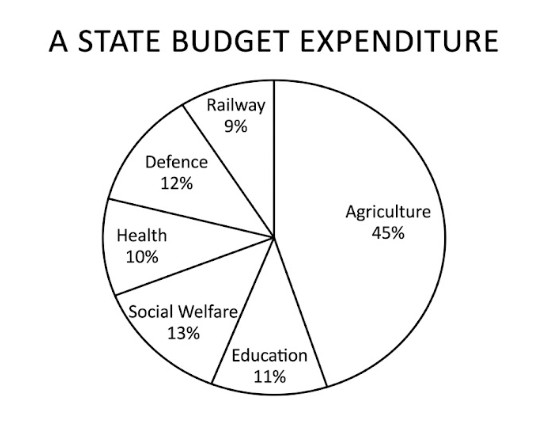
Approximately how many degrees should be there in the central angle of the sector for agriculture expenditure?
To find the central angle of the sector representing agriculture expenditure, we need to calculate the angle corresponding to the percentage given in the pie chart.
Thus, the central angle for agriculture expenditure is approximately 162°.
Correct Option: C) 162°
The question asks to identify the Indian hockey captain whose birth centenary was celebrated on 2 February 2022. This requires knowledge of the birth dates of prominent Indian hockey players.
B) Kunwar Digvijay Singh ‘Babu’ was born on 2 February 1922. His birth centenary was indeed celebrated on 2 February 2022. He was a legendary Indian field hockey player and captain, known for his exceptional dribbling skills and goal-scoring ability.
This is a direction sense problem. We need to track Rohini's orientation after each turn. We can visualize her path or use a simple diagram to determine her final facing direction.
Correct Option: A) South
If x = a secnθ, y = b tannθ, then:
\(\left(\frac{x}{a}\right)^{\frac{2}{n}}-\left(\frac{y}{b}\right)^{\frac{2}{n}}\) = 1
\(\left(\frac{x}{a}\right)^{\frac{2}{n}}+\left(\frac{y}{b}\right)^{\frac{2}{n}}\) = 1
\(\left(\frac{a}{x}\right)^{\frac{2}{n}}-\left(\frac{b}{y}\right)^{\frac{2}{n}}\) = 1
\(\left(\frac{a}{x}\right)^{\frac{2}{n}}+\left(\frac{b}{y}\right)^{\frac{2}{n}}\) = 1
The problem provides two parametric equations involving trigonometric functions. The goal is to eliminate the parameter \(\theta\) and find a relationship between \(x\) and \(y\). We will use the fundamental trigonometric identity \(\sec^2 A - \tan^2 A = 1\).
Given the equations:
\[ x = a \sec n \theta \quad \text{(1)} \]\[ y = b \tan n \theta \quad \text{(2)} \]From equation (1), express \(\sec n \theta\) in terms of \(x\) and \(a\):
\[ \sec n \theta = \frac{x}{a} \quad \text{(3)} \]From equation (2), express \(\tan n \theta\) in terms of \(y\) and \(b\):
\[ \tan n \theta = \frac{y}{b} \quad \text{(4)} \]Recall the trigonometric identity:
\[ \sec^2 A - \tan^2 A = 1 \]Let \(A = n \theta\). Substitute equations (3) and (4) into the trigonometric identity:
\[ \left(\frac{x}{a}\right)^2 - \left(\frac{y}{b}\right)^2 = 1 \]This can be written as:
\[ \frac{x^2}{a^2} - \frac{y^2}{b^2} = 1 \]To match the format of the options, we can express the squares as powers of \(2/n\) if \(n=1\). However, the options have a general power of \(2/n\). Let's re-examine the given equations and the options. The options have \[\left(\frac{x}{a}\right)^{\frac{2}{n}}\] and \[\left(\frac{y}{b}\right)^{\frac{2}{n}}\]. This implies that we should raise both sides of equations (3) and (4) to the power of \(2/n\).
From equation (3):
\[ \left(\sec n \theta\right)^{\frac{2}{n}} = \left(\frac{x}{a}\right)^{\frac{2}{n}} \]From equation (4):
\[ \left(\tan n \theta\right)^{\frac{2}{n}} = \left(\frac{y}{b}\right)^{\frac{2}{n}} \]This interpretation seems incorrect as it would not directly lead to the standard trigonometric identity. Let's reconsider the problem statement and options carefully. It's possible that the notation \(n\theta\) implies that the argument of \(\sec\) and \(\tan\) is \(n\theta\), and the power in the options is \(2/n\) for some reason. However, the most straightforward interpretation is that \(n\) is just a constant multiplier for \(\theta\).
Let's assume the question intends for the argument of \(\sec\) and \(\tan\) to be \(n\theta\), and the powers in the options are indeed \(2/n\). This means we need to manipulate the expressions to get \(\sec^2(n\theta)\) and \(\tan^2(n\theta)\).
From step 2:
\[ \frac{x}{a} = \sec n \theta \]From step 3:
\[ \frac{y}{b} = \tan n \theta \]Square both sides of these expressions:
\[ \left(\frac{x}{a}\right)^2 = \sec^2 n \theta \]\[ \left(\frac{y}{b}\right)^2 = \tan^2 n \theta \]Now, apply the identity \(\sec^2 A - \tan^2 A = 1\) with \(A = n \theta\):
\[ \left(\frac{x}{a}\right)^2 - \left(\frac{y}{b}\right)^2 = 1 \]This result does not directly match the options, which have \[\left(\frac{x}{a}\right)^{\frac{2}{n}}\] and \[\left(\frac{y}{b}\right)^{\frac{2}{n}}\]. This suggests that the problem might be interpreted differently, or there's a typo in the question or options. However, if we assume that the power \(n\) in \(x = a \sec n \theta\) and \(y = b \tan n \theta\) is actually meant to be a general exponent, say \(x = a (\sec \theta)^n\) and \(y = b (\tan \theta)^n\), then the options would make sense. Let's proceed with the interpretation that the argument is \(n\theta\) and the options are correct as written, implying a transformation.
Let's assume the question meant:
\[ x = a (\sec \theta)^n \implies \left(\frac{x}{a}\right)^{\frac{1}{n}} = \sec \theta \]\[ y = b (\tan \theta)^n \implies \left(\frac{y}{b}\right)^{\frac{1}{n}} = \tan \theta \]Then, squaring both sides:
\[ \left(\frac{x}{a}\right)^{\frac{2}{n}} = \sec^2 \theta \]\[ \left(\frac{y}{b}\right)^{\frac{2}{n}} = \tan^2 \theta \]Using the identity \(\sec^2 \theta - \tan^2 \theta = 1\):
\[ \left(\frac{x}{a}\right)^{\frac{2}{n}} - \left(\frac{y}{b}\right)^{\frac{2}{n}} = 1 \]This interpretation perfectly matches option A. Given the options, this must be the intended meaning of the question, where \(n\) is an exponent rather than a multiplier for \(\theta\) in the base trigonometric function. The notation \(\sec n \theta\) is ambiguous and can be interpreted as \(\sec(n\theta)\) or \((\sec \theta)^n\). In competitive exams, when options guide towards a specific interpretation, it's best to follow that path.
A) \[\left(\frac{x}{a}\right)^{\frac{2}{n}}-\left(\frac{y}{b}\right)^{\frac{2}{n}}\] = 1. This option is derived by interpreting the given equations as \(x = a (\sec \theta)^n\) and \(y = b (\tan \theta)^n\), then isolating \(\sec \theta\) and \(\tan \theta\), squaring them, and applying the identity \(\sec^2 \theta - \tan^2 \theta = 1\).
To solve this problem, we need to apply the given rules to each letter of the word "SCIENCE". We will identify each letter as either a vowel or a consonant and then change it according to the specified rule (preceding letter for vowels, following letter for consonants). Finally, we will count the occurrences of each letter in the newly formed word to find the one that appears most frequently.
Combining the changed letters, the new word is T D H D O D D.
The letter 'D' occurs 4 times, which is more than any other letter.
C) D — The letter 'D' appears 4 times in the newly formed word, which is the maximum number of occurrences.
The positive root of 4x2−1=0 is:
To find the positive root of the given quadratic equation, we need to solve for \(x\). The equation is a simple quadratic equation that can be solved by isolating the \(x^2\) term and then taking the square root of both sides.
Write down the given equation:
\[ 4x^2 - 1 = 0 \]Isolate the term containing \(x^2\): Add 1 to both sides of the equation.
\[ 4x^2 = 1 \]Isolate \(x^2\): Divide both sides by 4.
\[ x^2 = \frac{1}{4} \]Solve for \(x\): Take the square root of both sides. Remember that taking the square root yields both positive and negative solutions.
\[ x = \pm\sqrt{\frac{1}{4}} \] \[ x = \pm\frac{\sqrt{1}}{\sqrt{4}} \] \[ x = \pm\frac{1}{2} \]Identify the positive root: The solutions are \(x = \frac{1}{2}\) and \(x = -\frac{1}{2}\). The question asks for the positive root.
\[ x = \frac{1}{2} \]Correct Option: A) The positive root of the equation \(4x^2 - 1 = 0\) is \( \frac{1}{2} \).