
The question asks to identify the last Viceroy of India. This requires knowledge of the history of British rule in India and the individuals who held the position of Viceroy leading up to India's independence.
B) Lord Mountbatten was the last Viceroy of British India, serving from March 1947 to August 1947. He was instrumental in the process of India's independence and partition.
The question describes a chemical reaction involving sodium chloride, carbon dioxide, ammonia, and water. This combination of reactants is characteristic of the Solvay process (also known as the ammonia-soda process), which is an industrial method for producing sodium carbonate. However, the initial product formed in this process, before calcination, is sodium bicarbonate.
The Solvay process involves several steps. The first key step is the reaction of carbon dioxide with an ammoniated brine solution (sodium chloride dissolved in water with ammonia).
Ammonia (\(\text{NH}_3\)) reacts with water (\(\text{H}_2\text{O}\)) to form ammonium hydroxide (\(\text{NH}_4\text{OH}\)):
\[ \text{NH}_3 + \text{H}_2\text{O} ightleftharpoons \text{NH}_4\text{OH} \]Carbon dioxide (\(\text{CO}_2\)) then reacts with ammonium hydroxide to form ammonium bicarbonate (\(\text{NH}_4\text{HCO}_3\)):
\[ \text{NH}_4\text{OH} + \text{CO}_2 \rightarrow \text{NH}_4\text{HCO}_3 \]Finally, ammonium bicarbonate reacts with sodium chloride (\(\text{NaCl}\)) in a precipitation reaction. Sodium bicarbonate (\(\text{NaHCO}_3\)) is sparingly soluble in the presence of ammonium chloride (\(\text{NH}_4\text{Cl}\)), causing it to precipitate out:
\[ \text{NH}_4\text{HCO}_3 + \text{NaCl} \rightarrow \text{NaHCO}_3 \downarrow + \text{NH}_4\text{Cl} \]Therefore, the compound prepared when sodium chloride reacts with carbon dioxide in the presence of ammonia and water is sodium bicarbonate.
D) NaHCO₃ is sodium bicarbonate, which is the direct product of the reaction described in the Solvay process before further heating to produce sodium carbonate.
The question asks for the headquarters of the Zoological Survey of India (ZSI). This is a factual question requiring knowledge about the administrative structure of key scientific organizations in India.
Correct Option: A) Kolkata
To find the missing number in the series, we need to identify the pattern or relationship between the given numbers. We will examine if the numbers are squares, cubes, or follow an arithmetic or geometric progression.
Therefore, the number that replaces the question mark is 169.
Correct Option: C) 169
The question asks to identify the incorrect statement about metals. We need to evaluate each given statement based on the general properties of metals.
Based on the analysis, statement A is the incorrect one.
Correct Option: A) In general, metals form acidic oxides.
This problem involves setting up and solving a system of linear equations based on the given age relationships. We will define variables for the present ages of Roshan and Preethi, then translate the given conditions into algebraic equations.
Let \(R\) be the present age of Roshan.
Let \(P\) be the present age of Preethi.
"Five years ago, Roshan was three times as old as Preethi."
Five years ago, Roshan's age was \(R - 5\).
Five years ago, Preethi's age was \(P - 5\).
According to the problem:
\[ R - 5 = 3(P - 5) \] \[ R - 5 = 3P - 15 \] \[ R = 3P - 10 \quad \text{(Equation 1)} \]"The difference between their ages is 6 years."
Since Roshan was older than Preethi five years ago (three times her age), Roshan must be older than Preethi now. So, the difference is \(R - P\).
\[ R - P = 6 \quad \text{(Equation 2)} \]Substitute Equation 1 into Equation 2:
From Equation 1, we have \(R = 3P - 10\).
Substitute this into Equation 2:
\[ (3P - 10) - P = 6 \] \[ 2P - 10 = 6 \] \[ 2P = 6 + 10 \] \[ 2P = 16 \] \[ P = \frac{16}{2} \] \[ P = 8 \]Using Equation 2: \(R - P = 6\)
\(R - 8 = 6\)
\(R = 14\)
Check with the first condition: Five years ago, Roshan was \(14 - 5 = 9\) and Preethi was \(8 - 5 = 3\). Indeed, \(9 = 3 \times 3\).
The present age of Preethi is 8 years.
Correct Option: C) 8
To find the effective current in a series circuit, first calculate the total equivalent resistance of the resistors in series. Then, use Ohm's Law, which states that current is equal to voltage divided by resistance, to determine the total current flowing through the circuit.
When resistors are connected in series, the total resistance (\(R_{\text{total}}\)) is the sum of individual resistances.
\[ R_{\text{total}} = R_1 + R_2 \]Given resistors are \(R_1 = 6 \, \Omega\) and \(R_2 = 4 \, \Omega\).
\[ R_{\text{total}} = 6 \, \Omega + 4 \, \Omega = 10 \, \Omega \]Ohm's Law states \(V = I \times R\), where \(V\) is the voltage, \(I\) is the current, and \(R\) is the resistance. We need to find the current (\(I\)).
\[ I = \frac{V}{R_{\text{total}}} \]The battery voltage (\(V\)) is given as \(12 \, \text{V}\).
\[ I = \frac{12 \, \text{V}}{10 \, \Omega} = 1.2 \, \text{A} \]The effective current of the circuit is \(1.2 \, \text{A}\).
Correct Option: D) 1.2 Amp
Study the given line graph and answer the following question.
The given line graph depicts the number of pens and pencils sold by three shops (A, B and C).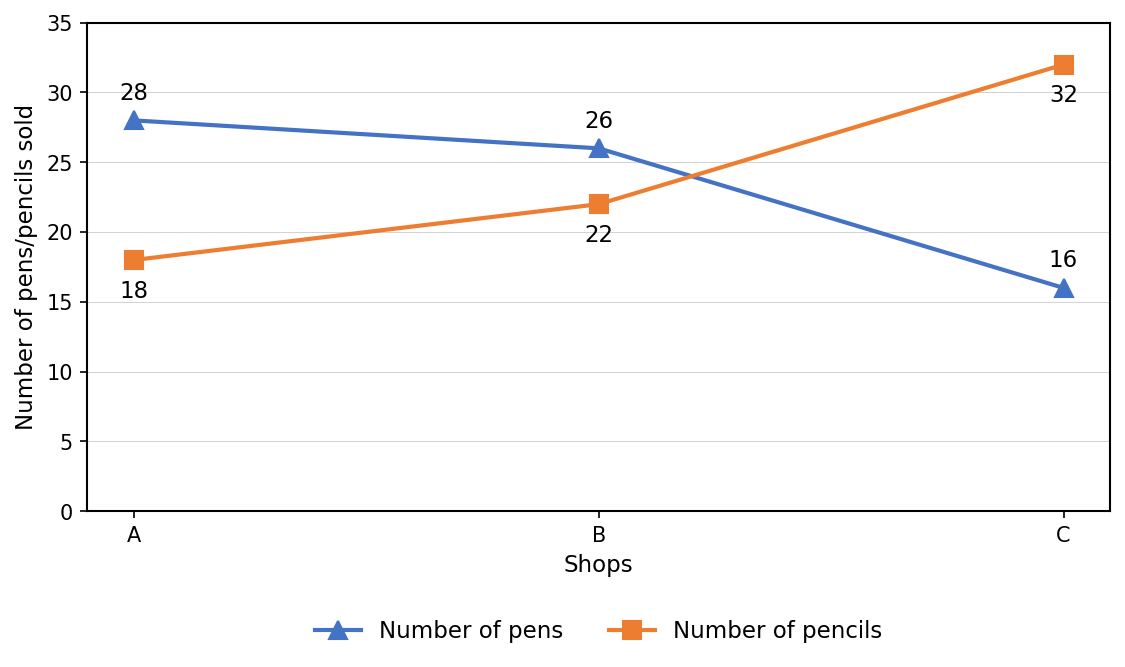
What is the difference between the total number of pens sold by shops A and B and the number of pencils sold by shop C?
To find the difference between the total number of pens sold by shops A and B and the number of pencils sold by shop C, we need to extract the relevant data from the line graph and perform the necessary calculations.
The difference is 22.
Correct Option: D) 22
The twinkling of stars is an atmospheric phenomenon caused by the Earth's atmosphere. We need to identify which property of the atmosphere, when continuously changing, leads to this effect.
D) change in the density of different layers of air causes change in refractive index continuously — This accurately describes the phenomenon. The varying density of atmospheric layers leads to continuous changes in the refractive index, which in turn causes the light from stars to bend erratically, resulting in their twinkling appearance.
One pipe can fill a tank three times as fast as another one. Both the pipes opened together can fill the tank completely in 36 minutes. In how many hours will the faster pipe alone fill the empty tank completely?
\( \frac{8}{5} \)
\( \frac{4}{5} \)
\( \frac{1}{2} \)
\( \frac{12}{5} \)
This problem involves the concept of work and time, specifically related to pipes filling a tank. We need to determine the individual filling rate of the faster pipe based on its relation to the slower pipe and their combined filling time.
Let the time taken by the slower pipe to fill the tank alone be \(x\) minutes.
The problem states that one pipe can fill a tank three times as fast as another one. This means the faster pipe takes one-third the time of the slower pipe to fill the tank. So, the time taken by the faster pipe to fill the tank alone will be \( \frac{x}{3} \) minutes.
In one minute, the slower pipe fills \( \frac{1}{x} \) of the tank.
In one minute, the faster pipe fills \[\frac{1}{\left(\frac{x}{3}\right)} = \frac{3}{x}\] of the tank.
When both pipes are opened together, they fill the tank completely in 36 minutes. This means in one minute, they fill \( \frac{1}{36} \) of the tank.
The combined work done in one minute is the sum of the work done by each pipe in one minute:
\[ \frac{1}{x} + \frac{3}{x} = \frac{1}{36} \]
Combine the terms on the left side:
\[ \frac{1+3}{x} = \frac{1}{36} \]
\[ \frac{4}{x} = \frac{1}{36} \]
Solve for \(x\):
\[ x = 4 \times 36 \]
\[ x = 144 \text{ minutes} \]
This is the time taken by the slower pipe alone.
We need to find the time taken by the faster pipe alone. The faster pipe takes \( \frac{x}{3} \) minutes.
\[ \text{Time for faster pipe} = \frac{144}{3} = 48 \text{ minutes} \]
The question asks for the time in hours. Convert minutes to hours:
\[ 48 \text{ minutes} = \frac{48}{60} \text{ hours} \]
\[ \frac{48}{60} = \frac{4 \times 12}{5 \times 12} = \frac{4}{5} \text{ hours} \]