
The problem presents a series of alphanumeric clusters, each consisting of three letters followed by a number. To find the missing cluster, we need to identify the patterns in both the letter sequence and the number sequence separately.
Let's look at the first letter of each cluster:
The pattern for the first letter seems to be: \(+1\), then a jump, then \(+1\), then a jump, etc.
So, the first letter of the missing cluster is M.
Now, let's look at the second letter of each cluster:
The pattern for the second letter is also \(+1\), then a jump, then \(+1\), then a jump, etc.
So, the second letter of the missing cluster is O.
Finally, let's look at the third letter of each cluster:
The pattern for the third letter is also \(+1\), then a jump, then \(+1\), then a jump, etc.
So, the third letter of the missing cluster is Q.
Combining these, the letters for the missing cluster are MOQ.
The numbers are: 9, 12, 27, 30, ?, 48, 63.
Let's find the difference between consecutive numbers:
The pattern for the differences is \(+3\), then \(+15\), then \(+3\). Following this pattern, the next difference should be \(+15\).
Let's verify the next step:
Thus, the number for the missing cluster is 45.
The missing alphanumeric cluster is MOQ 45.
B) MOQ 45 is the correct option as it matches both the letter and number patterns identified.
In the given figure line l is parallel to m and p is the transversal. Find the measure of angle 1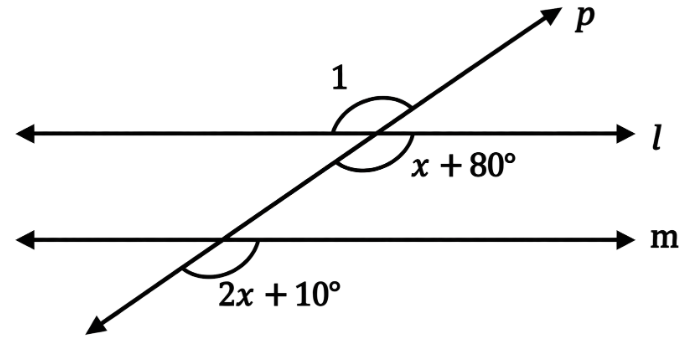
To find the measure of angle 1, we use the properties of parallel lines and transversals. Specifically, corresponding angles formed by a transversal are equal when the lines are parallel.
\[ \begin{align*} x + 80 &= 2x + 10 \\ 80 - 10 &= 2x - x \\ 70 &= x \end{align*} \]
\[ 70 + 80 = 150^\circ \]
Thus, the measure of angle 1 is \(150^\circ\).
Correct Option: A) 150°
To find the amount Ramesh will get after 3 years, we need to calculate the simple interest earned and then add it to the principal amount. The formula for simple interest is \(I = \frac{P \times R \times T}{100}\), where \(P\) is the principal, \(R\) is the rate of interest, and \(T\) is the time. The total amount is \(A = P + I\).
Identify the given values:
Calculate the Simple Interest (\(I\)):
Using the formula \(I = \frac{P \times R \times T}{100}\):
\[ I = \frac{1232 \times 5 \times 3}{100} \] \[ I = \frac{1232 \times 15}{100} \] \[ I = \frac{18480}{100} \] \[ I = 184.80 \]So, the simple interest earned is Rs 184.80.
Calculate the total Amount (\(A\)):
The total amount is the principal plus the interest:
\[ A = P + I \] \[ A = 1232 + 184.80 \] \[ A = 1416.80 \]Therefore, Ramesh will get Rs 1,416.80 after 3 years.
Correct Option: D) Rs 1,416.80
To find the share of Mr. Gupta in the total gain, we need to determine the ratio of the effective capital invested by each person. The effective capital is calculated by multiplying the amount invested by the duration for which it was invested. The total gain will be distributed among them in this ratio.
Correct Option: D) Rs 16,000
If 3x−2+3x=7290, then the value of x is:
The problem involves solving an exponential equation. We need to use the properties of exponents to simplify the given equation and then equate the bases to find the value of \(x\).
Write down the given equation:
\[ 3^{x-2} + 3^x = 7290 \]Apply the exponent rule \(a^{m-n} = \frac{a^m}{a^n}\):
\[ \frac{3^x}{3^2} + 3^x = 7290 \]Simplify the term \(3^2\):
\[ \frac{3^x}{9} + 3^x = 7290 \]Factor out \(3^x\):
\[ 3^x \left( \frac{1}{9} + 1 \right) = 7290 \]Simplify the expression inside the parenthesis:
\[ 3^x \left( \frac{1+9}{9} \right) = 7290 \]\[ 3^x \left( \frac{10}{9} \right) = 7290 \]Isolate \(3^x\):
\[ 3^x = 7290 \times \frac{9}{10} \]\[ 3^x = 729 \times 9 \]Calculate the product \(729 \times 9\):
\[ 3^x = 6561 \]Express 6561 as a power of 3:
We know that \(3^1 = 3\), \(3^2 = 9\), \(3^3 = 27\), \(3^4 = 81\), \(3^5 = 243\), \(3^6 = 729\), \(3^7 = 2187\), \(3^8 = 6561\).
So, we have:
\[ 3^x = 3^8 \]Equate the exponents:
Since the bases are the same, the exponents must be equal.
\[ x = 8 \]Correct Option: A) 8
To find the object distance for a concave mirror, we will use the mirror formula. We need to correctly apply the sign conventions for focal length, object distance, and image distance for a concave mirror and real image.
The mirror formula is given by:
\[ \frac{1}{f} = \frac{1}{v} + \frac{1}{u} \]The least common multiple of 20 and 60 is 60.
\[ \frac{1}{u} = -\frac{3}{60} + \frac{1}{60} \]\[ \frac{1}{u} = \frac{-3 + 1}{60} \]\[ \frac{1}{u} = \frac{-2}{60} \]\[ \frac{1}{u} = -\frac{1}{30} \]The negative sign for \(u\) indicates that the object is placed in front of the concave mirror, which is consistent with standard sign conventions.
Correct Option: C) -30
The question asks us to evaluate two statements related to washing soda: its production and its cleaning action. We need to determine if each statement is true or false and then select the correct option.
Washing soda is chemically known as sodium carbonate decahydrate (\(\text{Na}_2\text{CO}_3 \cdot 10\text{H}_2\text{O}\)). It is primarily produced by the Solvay process (also known as the ammonia-soda process). The raw materials for the Solvay process are sodium chloride (brine solution), limestone (calcium carbonate), and ammonia. Sodium chloride is a key starting material. The overall reaction for the Solvay process can be simplified as:
\[ 2\text{NaCl} + \text{CaCO}_3 \rightarrow \text{Na}_2\text{CO}_3 + \text{CaCl}_2 \]This shows that sodium chloride is indeed used in the production of sodium carbonate, which is then hydrated to form washing soda. Therefore, Statement-I is true.
Washing soda (\(\text{Na}_2\text{CO}_3\)) is an alkaline salt. When dissolved in water, it hydrolyzes to produce hydroxide ions, making the solution basic:
\[ \text{CO}_3^{2-} + \text{H}_2\text{O} \rightleftharpoons \text{HCO}_3^{-} + \text{OH}^{-} \]This alkalinity helps in the saponification of fats and oils (grease) present in dirt, converting them into water-soluble soaps. It also helps in emulsifying oily dirt. The resulting water-soluble products can then be easily rinsed away with water. This is the fundamental cleaning action of washing soda. Therefore, Statement-II is true.
D) Both the statements are true. As explained above, washing soda is produced from sodium chloride via the Solvay process, and its alkaline nature allows it to break down dirt and grease into water-soluble substances for easy removal.
Few birds (one each of Orange, Yellow, Black, Green, Grey, Red colour and three White coloured) were sitting in a row facing north. The black bird was an immediate neighbour of both the red and the grey bird. The yellow bird was sitting to the immediate right of the green bird. Only three birds were sitting between the orange and the red bird and all these three birds were white. The yellow bird sat third to the right of the black bird.
Which colour birds were sitting at the leftmost and rightmost ends of the row respectively?
Orange (Left) and Yellow (Right)
Grey (Left) and Red (Right)
White (Left) and Orange (Right)
Yellow (Left) and White (Right)
Kokborok is one of the state languages of Tripura. On 19th January 2022, Tripura celebrated which Kokborok day?
The question asks to identify which Kokborok Day was celebrated on January 19, 2022. To answer this, we need to know the year when Kokborok Day was first celebrated and then calculate the number of years passed until 2022.
Correct Option: D) 44 th
This is a syllogism problem. We need to determine which conclusions logically follow from the given statements. We can use Venn diagrams or the rules of syllogism to analyze the relationships between the categories.
A) Neither conclusion I nor II follows. Both conclusions are possibilities but not certainties based on the given statements. In syllogism, a conclusion must follow with 100% certainty.