
If ‘+’ means ‘÷’, ‘−’ means ‘+’, ‘×’ means ‘−’, and ‘÷’ means ‘×’, then what will be the value of the following expression?
This problem involves substituting given symbol transformations into a mathematical expression and then evaluating the expression using the order of operations (BODMAS/PEMDAS).
The original expression is: \(\{[( 12 \times 3 ) \minus ( 2 \div 3 )] + ( 1 \minus 4 )\} \div 4\)
Applying the transformations:
So, the new expression is: \(\{[( 12 \minus 3 ) \plus ( 2 \times 3 )] \div ( 1 \plus 4 )\} \times 4\)
First, evaluate the innermost parentheses:
Substitute these values back into the expression:
\[ \{[ 9 \plus 6 ] \div 5 \} \times 4 \]
Next, evaluate the brackets:
Substitute this value back:
\[ \{ 15 \div 5 \} \times 4 \]
Now, evaluate the curly braces:
Finally, perform the last multiplication:
\[ 3 \times 4 = 12 \]
A) 12 is the correct answer, as calculated by applying the given symbol transformations and then evaluating the expression using the correct order of operations.
The question asks to identify the main river to which Nubra, Shyok, and Hunza are tributaries. This requires knowledge of the major river systems in India and its neighboring regions, specifically the Himalayan rivers.
Correct Option: A) Indus — The Nubra, Shyok, and Hunza rivers are all well-known tributaries of the Indus River. The Shyok and Hunza are direct tributaries, and the Nubra is a tributary of the Shyok, making it part of the larger Indus basin.
The question asks for the year of India's first nuclear test in Pokhran. This is a factual question related to India's scientific and defense history. Recalling key historical events and their dates is crucial for such questions.
Correct Option: B) 1974 is the correct year when India conducted its first nuclear test, code-named "Smiling Buddha," in the Pokhran test range in Rajasthan.
Study the given diagram carefully and answer the question. The numbers in different sections indicate the number of persons.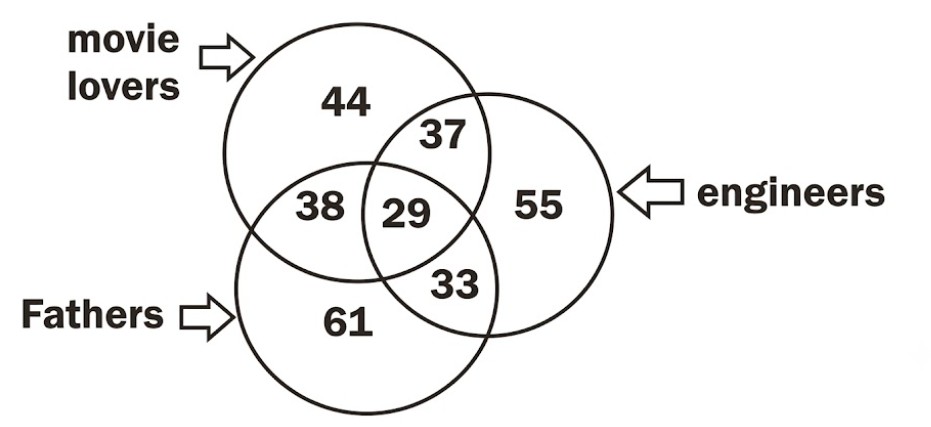
How many such fathers are there who are also movie lovers but NOT engineers?
The problem requires identifying the number of fathers who are also movie lovers but not engineers, using the provided Venn diagram.
Correct Option: C) 38
Two pipes A and B can fill a tank of 1000 litres in 5 hours and 6 hours, respectively. If they are opened together, how many hours will they take to fill an empty tank of 1800 litres?
\( \frac{25}{11} \)
\( \frac{54}{11} \)
\( \frac{45}{11} \)
\( \frac{52}{11} \)
This problem involves calculating the combined work rate of two pipes to fill a tank. We need to determine the individual filling rates of pipes A and B, add them to find the combined rate, and then use this combined rate to find the time taken to fill a tank of a different capacity.
Pipe A can fill 1000 litres in 5 hours. So, its rate is:
\[ \text{Rate of A} = \frac{\text{Volume}}{\text{Time}} = \frac{1000 \text{ litres}}{5 \text{ hours}} = 200 \text{ litres/hour} \]Pipe B can fill 1000 litres in 6 hours. So, its rate is:
\[ \text{Rate of B} = \frac{\text{Volume}}{\text{Time}} = \frac{1000 \text{ litres}}{6 \text{ hours}} = \frac{500}{3} \text{ litres/hour} \]When both pipes are opened together, their rates add up:
\[ \text{Combined Rate} = \text{Rate of A} + \text{Rate of B} \]\[ \text{Combined Rate} = 200 + \frac{500}{3} = \frac{600 + 500}{3} = \frac{1100}{3} \text{ litres/hour} \]Now, we need to find the time \(T\) to fill a tank of 1800 litres using the combined rate:
\[ \text{Time} = \frac{\text{Total Volume}}{\text{Combined Rate}} \]\[ T = \frac{1800 \text{ litres}}{\frac{1100}{3} \text{ litres/hour}} \]\[ T = 1800 \times \frac{3}{1100} \]\[ T = \frac{18 \times 3}{11} \]\[ T = \frac{54}{11} \text{ hours} \]B) \( \frac{54}{11} \) is the correct answer, as calculated in the step-by-step solution.
The question asks to identify the Indian state where the Bordoisila (Nor'wester) storm primarily arises. This requires knowledge of regional weather phenomena in India.
Correct Option: A) Assam is the Indian state where the Bordoisila (Nor'wester) storm is a significant and commonly observed pre-monsoon weather phenomenon.
This is a syllogism problem. We will use Venn diagrams to represent the given statements and then check which conclusions logically follow from these diagrams. We must assume the statements are true, even if they contradict common knowledge.
C) Only conclusion II follows
The question asks to identify the chairman of the First Finance Commission of India, constituted on November 22, 1951. This is a factual question related to Indian polity and economic history.
Correct Option: B) K. C. Neogy was the chairman of the First Finance Commission, constituted on November 22, 1951.
The question asks to identify the IIT that launched the Global Centre of Excellence in Affordable and Clean Energy (GCoE-ACE) in January 2022. This is a factual question related to current affairs and institutional developments in the field of clean energy.
C) IIT Dharwad — In January 2022, IIT Dharwad launched the Global Centre of Excellence in Affordable and Clean Energy (GCoE-ACE). This initiative aims to foster research, innovation, and entrepreneurship in clean energy technologies, particularly focusing on affordability and accessibility.
Six doctors, K, L, M, N, O and P, are sitting in a straight line. All are facing the north direction. Only O is sitting between N and L. Only P is sitting between L and K. K sits fifth to the right of M. Who is sitting to the immediate right of M?
This is a linear arrangement puzzle. We need to deduce the seating order of the six doctors (K, L, M, N, O, P) based on the given clues. All are facing North, which means right is to our right and left is to our left.
C) N — Based on the step-by-step deduction, the final arrangement is M N O L P K. Therefore, N is sitting to the immediate right of M.