
Study the given diagram carefully and answer the question. The numbers in different sections indicate the number of persons.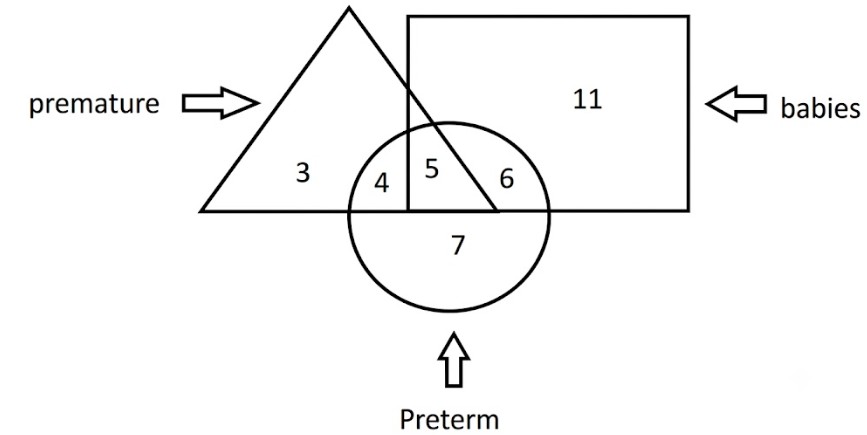
How many such babies are there who are NEITHER premature NOR preterm?
To determine the number of babies who are neither premature nor preterm, we need to analyze the given diagram carefully. The diagram consists of a triangle representing premature babies, a circle representing preterm babies, and a rectangle representing all babies.
Correct Option: D) 11
The direction of the force on a current-carrying conductor in a magnetic field is determined by Fleming's Left-Hand Rule. This rule relates the direction of the magnetic field, the direction of the current, and the direction of the force. The magnitude of the force is given by the formula \(F = BIL\sin\theta\).
D) Only (iii). Changing the direction of the current directly reverses the direction of the force experienced by the conductor, as dictated by Fleming's Left-Hand Rule.
The problem provides the average age of two individuals (Raj and his sister) and the age of one of them. We need to find the age of the other individual. The concept of average is used here, which is calculated by summing the ages and dividing by the number of individuals.
Correct Option: B) 6 years
The question asks to identify the university with which Jio signed a pact in January 2022 for research and standardization in 6G technology. This is a factual question related to current affairs and technological collaborations.
Correct Option: B) University of Oulu, Finland
In January 2022, Reliance Jio Infocomm Limited (Jio) and the University of Oulu, Finland, signed a memorandum of understanding (MoU) for a collaboration to develop 6G technology. This partnership aims to accelerate research and standardization in the field of 6G, focusing on areas like aerial and space communication, ubiquitous intelligent surfaces, and energy efficiency.
The problem asks us to evaluate how two given statements affect a decision made by Country W to promote tourism by declaring 20 cities as Heritage Sites. We need to determine if each statement strengthens, weakens, or is neutral to the decision.
B) Statement I weakens the decision and statement II strengthens the decision.
In this question, a group of letters is coded using numbers as per the table given below and the conditions which follow. The correct combination of codes following the conditions is your answer.
| Letter/Symbol | I | L | M | H | Y | O | C | E | R |
| Code | 4 | 5 | 9 | 1 | 2 | 3 | 6 | 7 | 8 |
Conditions:
(i) If the first element is a vowel and the last is a consonant, the codes for these two (the first and last elements) are to be interchanged.
(ii) If the first element is a consonant and the last is a vowel, the first and last elements are to be coded as 0.
(iii) If both the second and the fifth elements are vowels, the fifth element is to be coded as the code for the second element and vice-versa.
Question: EICHER
The problem requires us to code the word "EICHER" based on a given letter-to-number mapping and then apply a set of conditional rules to modify the coded sequence. We need to check each condition in order and apply it if applicable.
So, the initial code for EICHER is 746178.
Wait, there's a crucial point: the conditions are usually applied to the original letters, not the modified codes, unless specified. Let's re-evaluate based on the original letters and their positions.
Let's re-evaluate the conditions carefully. The conditions refer to the elements (letters) and then modify their codes. The order of application of conditions is important.
Re-evaluation:
This interpretation seems more standard for such problems where conditions act on the initial properties of the elements.
D) 876147 is the final code after applying the conditions as interpreted.
To solve this problem, we need to identify pairs of letters in the given word "ABILITY" that have the same number of letters between them as they do in the English alphabet. This needs to be checked in both forward and backward directions.
Therefore, there are 3 such pairs of letters.
Correct Option: C) 3
We are given information about four prime numbers in ascending order. We need to find these prime numbers using the given conditions: the product of the first three is 1771, and the sum of the last two is 82. Once we find the last two prime numbers, we can calculate their product.
Correct Option: A) 1357
Convert 0.2\(\overline{36}\) into a vulgar fraction
\(\frac{7}{33}\)
\(\frac{9}{44}\)
\(\frac{13}{55}\)
\(\frac{17}{66}\)
To convert a recurring decimal into a vulgar fraction, we use a standard algebraic method. We set the given decimal equal to a variable, multiply it by powers of 10 to shift the decimal point, and then subtract the equations to eliminate the recurring part.
Let the given recurring decimal be \(x\):
\[ x = 0.2\overline{36} \]This means \(x = 0.2363636...\)
Multiply the equation by a power of 10 such that the non-recurring part (if any) is to the left of the decimal point. Here, '2' is the non-recurring part.
\[ 10x = 2.\overline{36} \quad \text{(Equation 1)} \]Multiply the original equation by a power of 10 such that the recurring part starts immediately after the decimal point. Since there are two digits in the recurring block (\(36\)), we multiply by \(10^2 = 100\).
\[ 100x = 23.\overline{636} \]This is not correct. We need to multiply Equation 1 by \(100\) (since the recurring block is two digits long) to shift one full recurring block to the left of the decimal point.
\[ 100 \times (10x) = 100 \times (2.\overline{36}) \] \[ 1000x = 236.\overline{36} \quad \text{(Equation 2)} \]Subtract Equation 1 from Equation 2 to eliminate the recurring part:
\[ 1000x - 10x = 236.\overline{36} - 2.\overline{36} \] \[ 990x = 234 \]Solve for \(x\):
\[ x = \frac{234}{990} \]Simplify the fraction. Both the numerator and denominator are divisible by 2:
\[ x = \frac{234 \div 2}{990 \div 2} = \frac{117}{495} \]Both are divisible by 9 (sum of digits \(1+1+7=9\), \(4+9+5=18\)):
\[ x = \frac{117 \div 9}{495 \div 9} = \frac{13}{55} \]C) \(\frac{13}{55}\) is the simplified vulgar fraction for \(0.2\overline{36}\).
To find the quadratic equation given its roots, we can use the relationship between the roots and the coefficients of a quadratic equation. If \(\alpha\) and \(\beta\) are the roots of a quadratic equation \(ax^2 + bx + c = 0\), then the equation can be written as \(x^2 - (\alpha + \beta)x + \alpha\beta = 0\), or more generally, \(k[x^2 - (\alpha + \beta)x + \alpha\beta] = 0\) for some non-zero constant \(k\). We will calculate the sum and product of the given roots and then check which option matches this form.
Identify the given roots: Let the roots be \(\alpha = -2\) and \(\beta = 4\).
Calculate the sum of the roots: \[ \alpha + \beta = -2 + 4 = 2 \]
Calculate the product of the roots: \[ \alpha\beta = (-2)(4) = -8 \]
Form the general quadratic equation: The quadratic equation can be written in the form \(x^2 - (\alpha + \beta)x + \alpha\beta = 0\). Substituting the sum and product of the roots: \[ x^2 - (2)x + (-8) = 0 \] \[ x^2 - 2x - 8 = 0 \]
Compare with the given options: We need to find an option that is a multiple of \(x^2 - 2x - 8 = 0\). Let's check the options:
Correct Option: C) \(3x^2 - 6x - 24 = 0\)