
The question asks to identify the legendary wheat scientist who received the Padma Bhushan in 2022 in the Science and Engineering category. This requires knowledge of recent Padma Awards recipients and their fields of work.
Correct Option: A) Sanjaya Rajaram was a world-renowned wheat scientist of Indian origin. He was honored with the Padma Bhushan posthumously in 2022 for his exceptional contributions to science and engineering, particularly in the field of agriculture, where he developed numerous high-yielding, disease-resistant wheat varieties.
In a given reaction, which element acts as an ion?
Pb(s) + CuCl2(aq) → PbCl2(aq) + Cu(s)
To identify which element acts as an ion in the given reaction, we need to determine the oxidation states of each element in the reactants and products. An ion is an atom or molecule that has gained or lost one or more electrons, resulting in a net electrical charge.
Analyze the reactants:
Pb(s): Lead is in its elemental solid state. Elements in their elemental form have an oxidation state of 0. So, Pb is not an ion here.
CuCl\(_2\)(aq): Copper(II) chloride is an aqueous solution, meaning it dissociates into ions. Chlorine (Cl) typically forms a \(-1\) ion in compounds. Since there are two chloride ions, the total negative charge is \(2 \times (-1) = -2\). To balance this, Copper (Cu) must have an oxidation state of \(+2\). Thus, in CuCl\(_2\), Cu exists as Cu\(^{2+}\) ions and Cl exists as Cl\(^-\) ions.
Analyze the products:
PbCl\(_2\)(aq): Lead(II) chloride is also an aqueous solution. Similar to CuCl\(_2\), Cl is in the \(-1\) state. For the compound to be neutral, Pb must have an oxidation state of \(+2\). Thus, in PbCl\(_2\), Pb exists as Pb\(^{2+}\) ions and Cl exists as Cl\(^-\) ions.
Cu(s): Copper is in its elemental solid state. Its oxidation state is 0. So, Cu is not an ion here.
Identify the ions:
In the reactants, Cu is present as Cu\(^{2+}\) ions and Cl is present as Cl\(^-\) ions.
In the products, Pb is present as Pb\(^{2+}\) ions and Cl is present as Cl\(^-\) ions.
Re-evaluate the question: The question asks which element acts as an ion. Both Cu and Pb change their oxidation states (Cu from \(+2\) to \(0\), Pb from \(0\) to \(+2\)), but they are not always ions throughout the reaction. Chlorine, however, remains as Cl\(^-\) ions on both sides of the reaction (in CuCl\(_2\) and PbCl\(_2\)). The question asks which element acts as an ion, implying it is present in ionic form. Cl is present as an ion throughout the reaction.
Let's write the full ionic equation to clarify:
\[ \text{Pb(s)} + \text{Cu}^{2+}\text{(aq)} + 2\text{Cl}^-\text{(aq)} \rightarrow \text{Pb}^{2+}\text{(aq)} + 2\text{Cl}^-\text{(aq)} + \text{Cu(s)} \]
From this, we can see that Cl\(^-\) is a spectator ion, meaning it remains an ion throughout the reaction.
D) Only Cl\(_2\) - While the option states Cl\(_2\), which is elemental chlorine gas, the element chlorine (Cl) is present as Cl\(^-\) ions in the aqueous solutions of CuCl\(_2\) and PbCl\(_2\). Given the options, Cl is the only element that consistently exists as an ion (Cl\(^-\)) in the compounds involved in the reaction. The question is likely referring to the element chlorine being present in ionic form.
A) Only Cu — Cu is an ion (Cu\(^{2+}\)) in CuCl\(_2\) but becomes elemental Cu(s) in the product. So, it does not act as an ion throughout the entire process.
B) Only Pb — Pb is elemental Pb(s) in the reactant but becomes an ion (Pb\(^{2+}\)) in PbCl\(_2\). So, it does not act as an ion throughout the entire process.
C) Both Pb and Cu — As explained above, neither Pb nor Cu remains an ion throughout the entire reaction; they both change oxidation states and forms.
The question asks to identify the physical feature of India to which Bundelkhand and Baghelkhand belong. This requires knowledge of the major physiographic divisions of India and the geographical location of these regions.
Correct Option: C) Peninsular Plateau
Bundelkhand and Baghelkhand are distinct geographical regions located in central India. They are characterized by their plateau topography, ancient rock structures, and dissected landscapes, which are all defining features of the larger Peninsular Plateau of India. The Peninsular Plateau is one of the oldest and most stable landmasses in India, and these regions form part of its northern extensions, specifically the Central Highlands, which are a part of the Peninsular Plateau.
This is a logical reasoning question where we need to evaluate conclusions based solely on the given statement, even if the statement contradicts common knowledge. We must not introduce outside information. The task is to determine which conclusions logically follow from the provided statement.
A) Neither conclusion I nor conclusion II follows.
The problem asks us to find the length of a rectangle given a relationship between its length and breadth, and its perimeter. We will use the formula for the perimeter of a rectangle and the given relationship to set up an equation and solve for the dimensions.
Let the breadth of the rectangle be \(b\) cm.
According to the problem statement, the length of the rectangle is twice its breadth. So, the length \(l\) can be expressed as:
\[ l = 2b \]The formula for the perimeter \(P\) of a rectangle is:
\[ P = 2(l + b) \]We are given that the perimeter \(P = 42\) cm. Substitute the value of \(P\) and the expression for \(l\) into the perimeter formula:
\[ 42 = 2(2b + b) \]Simplify the equation:
\[ 42 = 2(3b) \] \[ 42 = 6b \]Solve for \(b\):
\[ b = \frac{42}{6} \] \[ b = 7 \text{ cm} \]Now that we have the breadth, we can find the length \(l\) using the relationship \(l = 2b\):
\[ l = 2 \times 7 \] \[ l = 14 \text{ cm} \]Correct Option: A) 14
The length of the rectangle is 14 cm.
Study the given line graph and answer the following question.
The given line graph depicts the number of sweatshirts in stores A, B and C.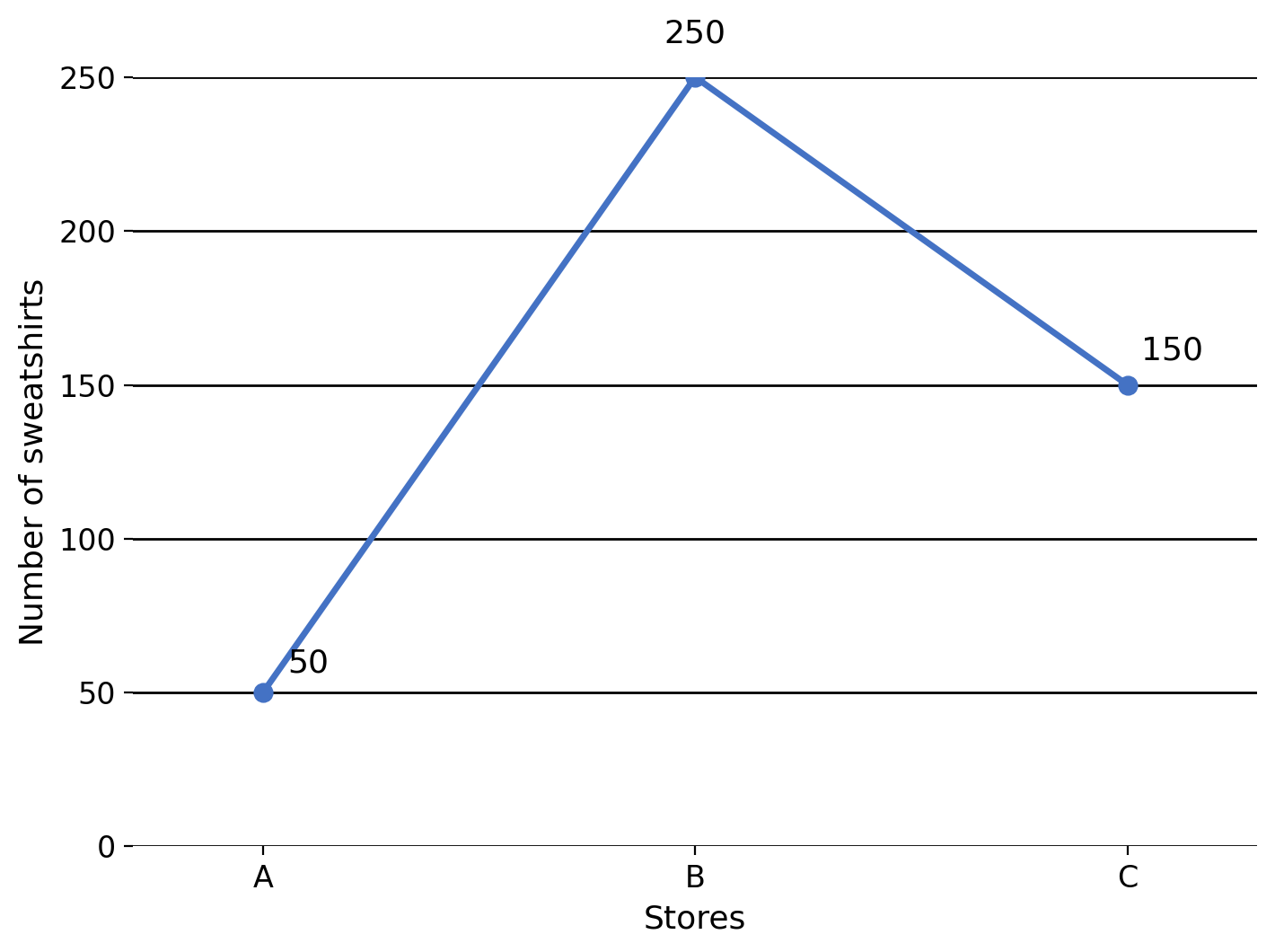
Out of the number of sweatshirts in stores A and B, 20% and 40%, respectively were sold. What is the total number of sweatshirts sold by stores A and B?
To find the total number of sweatshirts sold by stores A and B, we need to calculate the percentage of sweatshirts sold from each store and then sum these values.
For store A:
\[ \text{Sweatshirts sold by A} = 50 \times \frac{20}{100} = 10 \]For store B:
\[ \text{Sweatshirts sold by B} = 250 \times \frac{40}{100} = 100 \]Correct Option: D) 110
This problem involves solving an age-related word problem using ratios and differences. We will set up equations based on the given ratio of ages and the difference in their ages to find their current ages. Then, we will calculate Teja's age after 3 years.
Represent the present ages using the given ratio:
Let Teja's present age be \(7x\) years.
Let his mother's present age be \(11x\) years.
Formulate an equation based on the difference in ages:
The difference between their ages is 20 years. Since the mother is older, the difference is Mother's age - Teja's age.
Solve for \(x\):
\[ 4x = 20 \]\[ x = \frac{20}{4} \]\[ x = 5 \]Calculate their present ages:
Teja's present age \( = 7x = 7 \times 5 = 35 \) years.
Mother's present age \( = 11x = 11 \times 5 = 55 \) years.
Calculate Teja's age after 3 years:
Teja's age after 3 years \( = \text{Teja's present age} + 3 \)
Teja's age after 3 years \( = 35 + 3 = 38 \) years.
Correct Option: C) 38 years
Mr. Rao walks 45 minutes in a day. What fraction of a day does he walk per day, expressed as a fraction?
\( \frac{3}{4} \)
\( \frac{1}{80} \)
\( \frac{1}{24} \)
\( \frac{1}{32} \)
To find the fraction of a day Mr. Rao walks, we need to express the time he walks (45 minutes) as a fraction of the total time in a day. This involves converting all time units to a common base (minutes or hours) and then forming the ratio.
D) \( \frac{1}{32} \) is the correct fraction representing the portion of a day Mr. Rao walks.
The question asks for the term that represents the sum of average variable cost and average fixed cost. This is a fundamental concept in microeconomics related to cost analysis.
B) average cost. As derived above, average cost (or average total cost) is the sum of average fixed cost and average variable cost.
Refer to the following letter and symbol series and answer the question.
(Left) Z # U * Y S K W P Q @ G & A % J B L % & H E # V (Right)
How many such symbols are there in the series which are immediately preceded by a vowel and also immediately followed by a consonant?
To solve this problem, we need to identify symbols in the given series that meet two specific conditions: they must be immediately preceded by a vowel and immediately followed by a consonant. We will scan the series from left to right, checking each symbol against these conditions.
C) Three
There are three such symbols in the series: *, %, and #, which satisfy the given conditions.