
Study the given diagram carefully and answer the question. The numbers in different sections indicate the number of persons.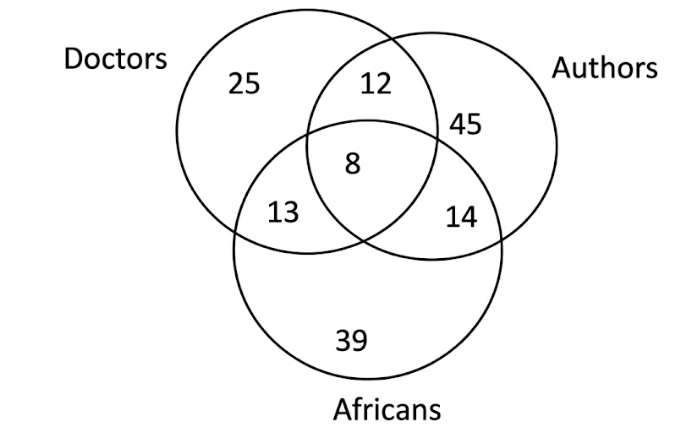
How many Africans are there who are also authors?
To determine how many Africans are also authors, we need to analyze the Venn diagram provided. The diagram shows overlapping circles representing Doctors, Authors, and Africans with numbers indicating the count of people in each section.
Correct Option: B) 22
The question asks about the location of the 'Urea Cycle' in the human body. This requires knowledge of human biochemistry and organ functions, specifically related to nitrogenous waste metabolism.
Correct Option: B) The 'Urea Cycle' takes place predominantly in the liver. The liver is crucial for detoxifying ammonia by converting it into urea, which is then transported to the kidneys for excretion.
The question asks for the year in which The Indian Toll Act was passed. This is a factual question requiring knowledge of specific historical legislation in British India.
The Indian Tolls Act was enacted in 1851. This Act provided for the levy of tolls on public roads and bridges in India, allowing the government to collect revenue for the construction and maintenance of infrastructure.
C) 1851 — The Indian Toll Act was indeed passed in the year 1851. This act was significant for establishing a legal framework for collecting tolls on public infrastructure like roads and bridges, a common practice during the British colonial administration to fund public works.
This question tests the understanding of image formation by a concave mirror, specifically when the object is placed between the pole (P) and the principal focus (F). We need to recall the ray tracing rules for concave mirrors or the mirror formula to determine the nature and position of the image.
C) behind the mirror, enlarged - When an object is placed between the pole (P) and the principal focus (F) of a concave mirror, the reflected rays diverge and appear to originate from a point behind the mirror. This forms a virtual, erect, and enlarged image.
The problem requires us to code a given sequence of numbers and symbols based on a provided coding table and a set of conditions. We need to first find the individual codes for each element in the sequence and then apply the conditions in the given order to determine the final coded output.
A) \(\emptyset\) F K W \(\emptyset\) is the correct code derived after applying the conditions.
The task is to evaluate how each argument relates to the given statement. We need to determine if an argument strengthens, weakens, or has no bearing on the statement. The statement claims that floods caused widespread damage to crops in Odisha this year.
A) Argument I weakens, while argument II strengthens the statement. This option correctly identifies the relationship of both arguments to the given statement.
To determine the nature of the image formed by a lens, we need to calculate its focal length and then use the lens formula to find the image distance and magnification. The sign conventions for object distance, image distance, and focal length are crucial.
Calculate the focal length (\(f\)) of the lens:
The power of the lens (\(P\)) is given as 4.0 D (dioptres). The relationship between power and focal length is:
\[ P = \frac{1}{f \text{ (in meters)}} \]So, the focal length is:
\[ f = \frac{1}{P} = \frac{1}{4.0 \text{ D}} = 0.25 \text{ m} \]Converting this to centimeters:
\[ f = 0.25 \times 100 \text{ cm} = 25 \text{ cm} \]Since the power is positive (+4.0 D), it is a converging lens (convex lens), and its focal length is positive, \(f = +25 \text{ cm}\).
Identify the object distance (\(u\)):
The object is placed at a distance of 30 cm from the lens. According to the sign convention, object distance is always negative.
\[ u = -30 \text{ cm} \]Use the lens formula to find the image distance (\(v\)):
The lens formula is:
\[ \frac{1}{v} - \frac{1}{u} = \frac{1}{f} \]Substitute the values of \(u\) and \(f\):
\[ \frac{1}{v} - \frac{1}{(-30 \text{ cm})} = \frac{1}{25 \text{ cm}} \] \[ \frac{1}{v} + \frac{1}{30 \text{ cm}} = \frac{1}{25 \text{ cm}} \] \[ \frac{1}{v} = \frac{1}{25 \text{ cm}} - \frac{1}{30 \text{ cm}} \]Find a common denominator (LCM of 25 and 30 is 150):
\[ \frac{1}{v} = \frac{6}{150 \text{ cm}} - \frac{5}{150 \text{ cm}} \] \[ \frac{1}{v} = \frac{1}{150 \text{ cm}} \] \[ v = +150 \text{ cm} \]Determine the nature of the image:
Calculate the magnification (\(m\)):
The magnification formula for a lens is:
\[ m = \frac{v}{u} \]Substitute the values of \(v\) and \(u\):
\[ m = \frac{+150 \text{ cm}}{-30 \text{ cm}} = -5 \]Conclusion: The image formed is real and inverted.
Correct Option: B) real and inverted
The problem asks us to evaluate two statements regarding the force on a current-carrying conductor in a magnetic field. We need to recall the principles governing this force, specifically the Lorentz force law and Fleming's Left-Hand Rule, to determine the correctness of each statement.
The force \(\vec{F}\) experienced by a current-carrying conductor of length \(\vec{L}\) placed in a magnetic field \(\vec{B}\) is given by the formula:
\[ \vec{F} = I (\vec{L} \times \vec{B}) \]Here, \(I\) is the current, and \(\vec{L}\) is a vector whose magnitude is the length of the conductor and whose direction is the direction of the current. The cross product \(\vec{L} \times \vec{B}\) indicates that the direction of the force is perpendicular to both the direction of the current (\(\vec{L}\)) and the direction of the magnetic field (\(\vec{B}\)).
If the direction of the current (\(\vec{L}\)) is reversed, the direction of the cross product \(\vec{L} \times \vec{B}\) will also reverse, meaning the direction of the force \(\vec{F}\) will reverse. This is also evident from Fleming's Left-Hand Rule, where the forefinger points to the magnetic field, the middle finger points to the current, and the thumb points to the force. Changing the direction of the current (middle finger) will change the direction of the force (thumb).
Therefore, statement (a) is incorrect.
As established above, the force is given by \(\vec{F} = I (\vec{L} \times \vec{B})\). The direction of the force is determined by the cross product of the current direction (\(\vec{L}\)) and the magnetic field direction (\(\vec{B}\)). If the direction of the magnetic field (\(\vec{B}\)) is reversed, the direction of the cross product \(\vec{L} \times \vec{B}\) will reverse, and consequently, the direction of the force \(\vec{F}\) will also reverse.
According to Fleming's Left-Hand Rule, if the direction of the magnetic field (forefinger) changes, the direction of the force (thumb) will also change (assuming current direction remains constant).
Therefore, statement (b) is correct.
C) Only (b) is correct because the direction of the force on a current-carrying conductor in a magnetic field is dependent on the direction of the magnetic field, as shown by the vector cross product \(\vec{L} \times \vec{B}\) and Fleming's Left-Hand Rule.
The problem requires us to modify a given number based on specific rules for its odd and even digits, and then find the sum of two specific digits in the resulting new number.
The sum of the digits that are second from the left and second from the right in the new number is 6.
C) 6
The question asks to identify the animal whose primary excretory product is uric acid. This requires knowledge of different types of nitrogenous waste products and the animal groups that excrete them.
Correct Option: B) birds