
First, we need to find the principal amount using the given information where interest is compounded 8-monthly. Once the principal is found, we will calculate the amount when the interest is compounded yearly for the same principal, rate, and time.
Given:
For 8-monthly compounding:
The formula for amount is \(A = P \left(1 + \frac{r}{100}\right)^N\).
Substituting the values:
\[ 98494 = P (1 + 0.10)^3 \] \[ 98494 = P (1.1)^3 \] \[ 98494 = P \times 1.331 \] \[ P = \frac{98494}{1.331} = 74000 \]So, the principal amount is Rs 74,000.
Now, we need to find the amount for the same principal, rate, and time, but with interest compounded yearly.
The formula for amount is \(A = P \left(1 + \frac{R}{100}\right)^T\).
Substituting the values:
\[ A = 74000 \left(1 + \frac{15}{100}\right)^2 \] \[ A = 74000 (1 + 0.15)^2 \] \[ A = 74000 (1.15)^2 \] \[ A = 74000 \times 1.3225 \] \[ A = 97865 \]The amount payable will be Rs 97,865.
Correct Option: A) 97,865
The question asks to identify the state government that organized rural sports events in 75 of its districts in September 2021. This requires knowledge of current affairs and specific government initiatives related to sports in Indian states.
Correct Option: A) Uttar Pradesh
In September 2021, the Uttar Pradesh government organized rural sports events, known as 'Khel Mahakumbh', in 75 of its districts. This was a significant initiative to promote sports and identify talent in rural areas, coinciding with the 'Azadi Ka Amrit Mahotsav' celebrations.
A trader gains 25% by selling an article after two successive discounts of 25% and 10% on its marked price. If the cost price of the article is increased by 30%, then what single discount should he now give on the same marked price to get the same profit percentage as earlier?
This problem involves calculating profit, cost price, marked price, selling price, and discounts. We need to work backward from the given profit and discounts to find the original cost price and marked price. Then, we'll adjust the cost price and determine a new single discount to maintain the same profit percentage.
First discount = 25%
Price after first discount = \(100 - 0.25 \times 100 = ₹75\)
Second discount = 10%
Selling Price (SP) = \(75 - 0.10 \times 75 = 75 - 7.5 = ₹67.5\)
The trader gains 25% on the Cost Price (CP).
So, \(\text{SP} = \text{CP} + 0.25 \times \text{CP} = 1.25 \times \text{CP}\)
Given \(\text{SP} = ₹67.5\), we have:
\[ 1.25 \times \text{CP} = 67.5 \]\[ \text{CP} = \frac{67.5}{1.25} = ₹54 \]The cost price is increased by 30%.
\[ \text{CP}' = \text{CP} + 0.30 \times \text{CP} = 1.30 \times \text{CP} \]\[ \text{CP}' = 1.30 \times 54 = ₹70.2 \]The profit percentage remains 25%.
\[ \text{SP}' = \text{CP}' + 0.25 \times \text{CP}' = 1.25 \times \text{CP}' \]\[ \text{SP}' = 1.25 \times 70.2 = ₹87.75 \]The Marked Price (MP) remains the same, i.e., \(₹100\).
The new Selling Price (SP') is \(₹87.75\).
Discount amount = \(\text{MP} - \text{SP}' = 100 - 87.75 = ₹12.25\)
Single discount percentage = \[\frac{\text{Discount amount}}{\text{MP}} \times 100\]
\[ \text{Single discount percentage} = \frac{12.25}{100} \times 100 = 12.25\% \]D) 12.25% is the single discount that should be given on the same marked price to get the same profit percentage.
The roots of the quadratic equation x2−4x+3=0 are:
To find the roots of a quadratic equation, we can use several methods: factorization, completing the square, or the quadratic formula. For the given equation, factorization is a straightforward method.
\(x^2 - x - 3x + 3 = 0\)
\((x^2 - x) - (3x - 3) = 0\)
\(x(x - 1) - 3(x - 1) = 0\)
\((x - 1)(x - 3) = 0\)
\(x - 1 = 0 \implies x = 1\)
\(x - 3 = 0 \implies x = 3\)
A) 1 and 3 is the correct option because, as derived above, the roots of the equation \(x^2 - 4x + 3 = 0\) are \(x=1\) and \(x=3\).
Study the following diagram and answer the question given below. The rectangle represents deodorants, the triangle represents soaps, and the circle represents perfumes.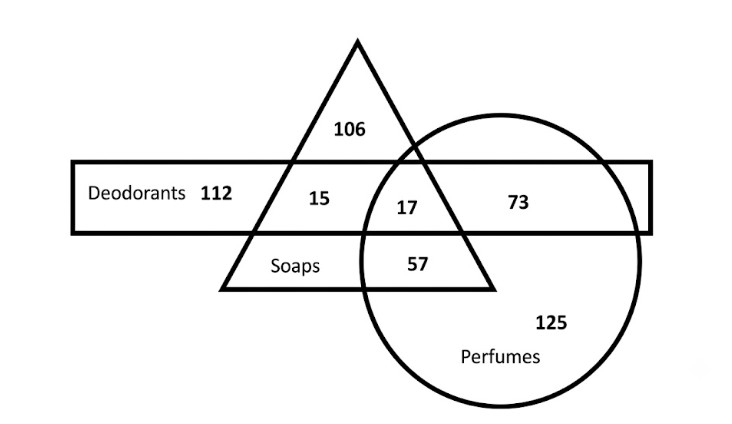
Question: How many perfumes are deodorants but not soaps?
To find the number of perfumes that are deodorants but not soaps, we need to identify the section of the diagram that represents the intersection of deodorants and perfumes, excluding soaps.
Correct Option: D) 73
Study the given pie-chart and answer the question that follows. The graph presents the income of the government (in Rs crore) through various sources.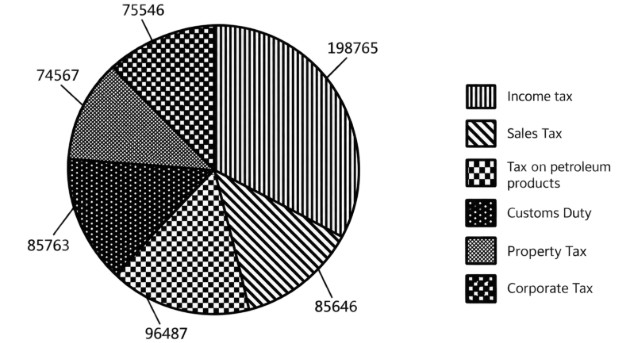
Through which source does the government receive near about 15% of the total income?
Corporate tax
Customs duty
Sales tax
Petroleum products
To determine which source provides near about 15% of the total income, we need to calculate the percentage each source contributes to the total income based on the values given in the pie chart.
Correct Option: D) Petroleum products
The values of potential drops across, and corresponding currents in, a resistor are given in the following table. If the resistor obeys Ohm’s law, then the values of X and Y are respectively:
| V (in volts) | 0.8 | 1.6 | X | 3.2 | 4.0 | 4.8 | 5.6 | 6.4 | 7.2 | 8.0 |
| I (in amperes) | 0.2 | 0.4 | 0.6 | 0.8 | 1.0 | Y | 1.4 | 1.6 | 1.8 | 2.0 |
The problem states that the resistor obeys Ohm's law. Ohm's law states that the voltage (\(V\)) across a resistor is directly proportional to the current (\(I\)) flowing through it, with the constant of proportionality being the resistance (\(R\)). This can be written as \(V = IR\). We can use the given data points to find the resistance of the resistor and then use this resistance to find the unknown values X and Y.
Calculate the resistance (R) using the given data points:
According to Ohm's Law, \(R = V/I\). Let's pick a few data points from the table to calculate \(R\).
The resistance of the resistor is constant and equal to \(4 \, \Omega\).
Find the value of X:
From the table, when \(I = 0.6 \, \text{A}\), the corresponding voltage is \(X\). Using Ohm's law \(V = IR\):
\[X = I \times R = 0.6 \, \text{A} \times 4 \, \Omega = 2.4 \, \text{V}\]Find the value of Y:
From the table, when \(V = 4.8 \, \text{V}\), the corresponding current is \(Y\). Using Ohm's law \(I = V/R\):
\[Y = \frac{V}{R} = \frac{4.8 \, \text{V}}{4 \, \Omega} = 1.2 \, \text{A}\]Conclusion:
The values of X and Y are \(2.4\) and \(1.2\) respectively.
Correct Option: C) 2.4 and 1.2
Express 0.9\(\overline{87}\) - 0.7\(\overline{56}\) in the \( \frac{p}{q} \) form, where p and q are integers and q ≠ 0.
\(\frac{88}{165}\)
\(\frac{164}{495}\)
\(\frac{229}{990}\)
\(\frac{219}{495}\)
To express the given recurring decimals in the \(\frac{p}{q}\) form, we first convert each recurring decimal into a fraction. Then we perform the subtraction of these fractions to get the final result in the \(\frac{p}{q}\) form.
Let \(x = 0.9\overline{87}\).
We can write this as \(x = 0.9878787...\)
Multiply by 10 to move the non-repeating part to the left of the decimal:
\[ 10x = 9.878787... \quad \text{(Equation 1)} \]Now, multiply by 100 (since there are 2 repeating digits) to shift the repeating block:
\[ 1000x = 987.878787... \quad \text{(Equation 2)} \]Subtract Equation 1 from Equation 2:
\[ 1000x - 10x = 987.8787... - 9.8787... \]\[ 990x = 978 \]\[ x = \frac{978}{990} \]Simplify the fraction by dividing the numerator and denominator by their greatest common divisor, which is 6:
\[ x = \frac{978 \div 6}{990 \div 6} = \frac{163}{165} \]Let \(y = 0.7\overline{56}\).
We can write this as \(y = 0.7565656...\)
Multiply by 10 to move the non-repeating part to the left of the decimal:
\[ 10y = 7.565656... \quad \text{(Equation 3)} \]Now, multiply by 100 (since there are 2 repeating digits) to shift the repeating block:
\[ 1000y = 756.565656... \quad \text{(Equation 4)} \]Subtract Equation 3 from Equation 4:
\[ 1000y - 10y = 756.5656... - 7.5656... \]\[ 990y = 749 \]\[ y = \frac{749}{990} \]Now, subtract \(y\) from \(x\):
\[ 0.9\overline{87} - 0.7\overline{56} = \frac{163}{165} - \frac{749}{990} \]To subtract these fractions, find a common denominator. The least common multiple of 165 and 990 is 990.
Convert \(\frac{163}{165}\) to an equivalent fraction with a denominator of 990:
\[ \frac{163}{165} = \frac{163 \times 6}{165 \times 6} = \frac{978}{990} \]Now perform the subtraction:
\[ \frac{978}{990} - \frac{749}{990} = \frac{978 - 749}{990} = \frac{229}{990} \]C) \(\frac{229}{990}\) is the correct result obtained after converting both recurring decimals to fractions and subtracting them.
The question asks to identify the INCORRECT statement regarding the process of excretion in plants. We need to evaluate each option to determine which one does not accurately describe a method of waste disposal in plants.
Correct Option: B) Waste product of photosynthesis is stored as starch.
This statement is incorrect. Starch is a primary storage carbohydrate in plants, synthesized during photosynthesis, and serves as an energy reserve. It is not a waste product. Waste products are typically substances that are toxic or no longer useful to the plant and need to be eliminated or sequestered.
To find the volume of a cube, we need to know the length of its edge. The formula for the volume of a cube is the cube of its edge length.
First, calculate \(8 \times 8 = 64\).
Then, calculate \(64 \times 8\):
So, the volume \(V = 512\text{ cm}^3\).
Correct Option: C) 512 cm³