
The problem presents a proportion in the form \(a : b :: c : d\), which means \[\frac{a}{b} = \frac{c}{d}\]. We are given the proportion \(48 : b :: b : 75\) and the condition \(b > 0\). We need to find the value of \(b\).
Understand the proportion: The given proportion \(48 : b :: b : 75\) can be written as an equation:
\[ \frac{48}{b} = \frac{b}{75} \]Cross-multiply: To solve for \(b\), cross-multiply the terms:
\[ 48 \times 75 = b \times b \]\[ 48 \times 75 = b^2 \]Calculate the product: Multiply 48 by 75:
\[ 48 \times 75 = 3600 \]Solve for \(b^2\): So, we have:
\[ b^2 = 3600 \]Find the square root: To find \(b\), take the square root of both sides:
\[ b = \sqrt{3600} \]Determine the value of \(b\): The square root of 3600 is 60. Since the problem states that \(b > 0\), we take the positive root.
\[ b = 60 \]B) 60 is the correct value for \(b\).
If 2 is multiplied to each odd digit and 1 is added to each even digit in the number 6311624, what will be the difference between the largest of the digits and the smallest of the digits thus formed?
The problem requires us to modify a given number based on specific rules for its odd and even digits and then find the difference between the largest and smallest digits in the newly formed number.
C) 5 — The largest digit formed is 7 and the smallest digit formed is 2. Their difference is \(7 - 2 = 5\).
This question asks about the negative impacts of large dams on downstream agriculture. We need to consider how altering a river's natural flow and sediment transport affects the fertility and water availability in areas further down the river.
Correct Option: B) blocking annual deposits of mineral rich sediment from floods. This directly explains how dams prevent the natural fertilization of downstream agricultural lands, leading to reduced productivity.
This problem involves setting up and solving a system of linear equations based on the given conditions. We need to represent the two parts of the sum using variables and then translate the word problem into algebraic equations.
Let the first part be \(x\) and the second part be \(y\).
The total sum is Rs 150. So, we can write the first equation:
\[ x + y = 150 \quad \text{(Equation 1)} \]The problem states that "The first part is Rs 2 more than thrice the second part." We can translate this into the second equation:
\[ x = 3y + 2 \quad \text{(Equation 2)} \]Now, substitute the expression for \(x\) from Equation 2 into Equation 1:
\[ (3y + 2) + y = 150 \]Combine like terms:
\[ 4y + 2 = 150 \]Subtract 2 from both sides:
\[ 4y = 150 - 2 \]\[ 4y = 148 \]Divide by 4 to find the value of \(y\):
\[ y = \frac{148}{4} \]\[ y = 37 \]So, the second part is Rs 37.
To find the first part, substitute \(y = 37\) back into Equation 2:
\[ x = 3(37) + 2 \]\[ x = 111 + 2 \]\[ x = 113 \]Check if the sum is 150: \(113 + 37 = 150\). The conditions are satisfied.
Correct Option: A) 37
The question asks to identify the statement that is NOT true regarding the concepts of short run and long run in production theory. We need to analyze each option based on the definitions of short run and long run.
Correct Option: B) A firm, in order to produce different levels of output in the long run may not vary one of the inputs.
This statement is incorrect because, by definition, in the long run, all factors of production are variable. A firm has the flexibility to adjust all its inputs (labor, capital, land, etc.) to produce different levels of output or to change its scale of operation. If a firm chooses not to vary one of its inputs, it is effectively operating under a short-run constraint for that particular input, which is contrary to the concept of the long run where all inputs are variable.
A show ticket costs Rs 7.50 for a parent and Rs 3 for a child. If a total of Rs 5,925 is collected by selling 952 tickets in all, then find the number of children’s tickets sold.
This problem can be solved using a system of two linear equations. We are given the total number of tickets sold and the total revenue collected. We also know the price of a parent's ticket and a child's ticket. We can set up equations based on these facts and solve for the number of children's tickets.
The number of children's tickets sold is 270.
C) 270
The question asks about the additional respiratory organs in frogs, besides lungs, that allow them to breathe. This requires knowledge of amphibian biology, specifically their respiratory adaptations.
C) slippery and moist skin — Frogs utilize their moist and slippery skin for cutaneous respiration. This method is crucial for gas exchange, especially when they are underwater or during periods of dormancy, supplementing their lung respiration.
Study the given pie-chart and answer the following question.
The given pie chart depicts the number of episodes watched of four different seasons (1, 2, 3 and 4). The total number of episodes watched of the four seasons together is 60.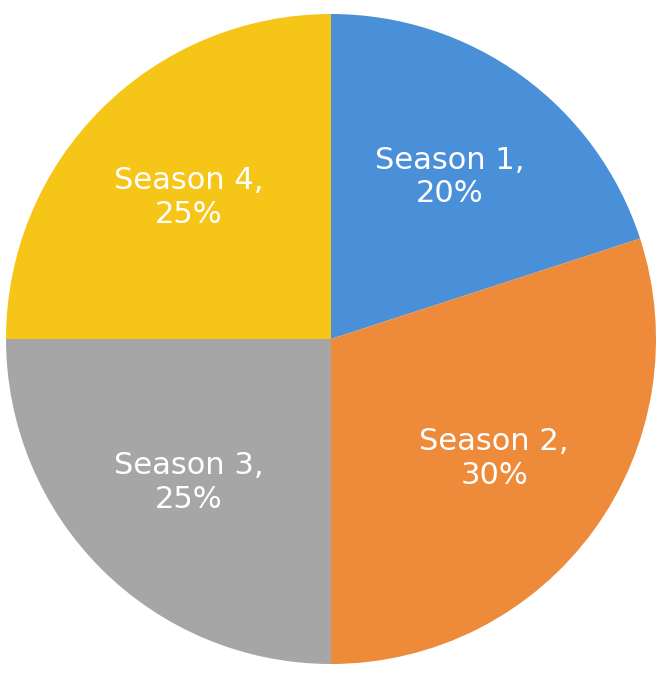
What is the central angle corresponding to the number of episodes watched of season 3?
The pie chart represents the percentage of episodes watched for four different seasons. To find the central angle for Season 3, we use the formula for calculating the central angle from the percentage of the total circle.
Central Angle = \[\frac{\text{Percentage of Sector}}{100} \times 360^\circ\]
Central Angle for Season 3 = \( \frac{25}{100} \times 360^\circ = 90^\circ \)
Thus, the central angle corresponding to Season 3 is \( 90^\circ \).
Correct Option: A) 90°
This is a Syllogism problem. We need to evaluate the given statements and determine which of the conclusions logically follow. We can use Venn diagrams or the rules of syllogism to solve this.
B) Both conclusions (I) and (II) follow.
The question asks to identify the incorrectly matched pair of a mountain and its corresponding state/Union Territory (UT) in India. This requires knowledge of the geographical locations of major Indian mountain peaks.
Based on the evaluation, the pair "K2 mountain – Himachal Pradesh" is incorrectly matched.
Correct Option: B) K2 mountain – Himachal Pradesh