
The given pie chart shows the percentage-wise distribution of the cost of items used in making 1 litre of strawberry shake. Study the chart and answer the question that follows.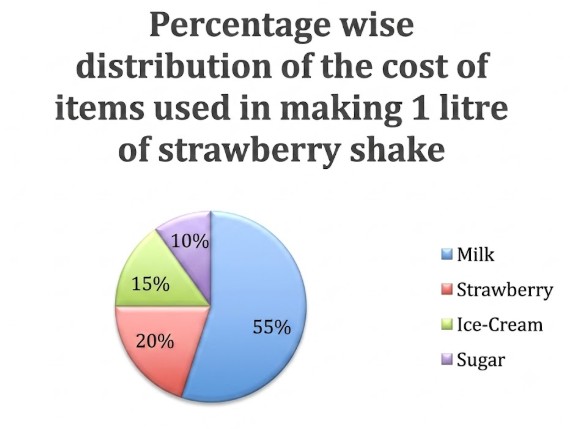
If the total cost in making 3 litres of strawberry shake is Rs 1,500, then what is the cost of strawberries in making 1 litre of strawberry shake?
To find the cost of strawberries in making 1 litre of strawberry shake, we need to use the percentage distribution given in the pie chart and the total cost for 3 litres.
Correct Option: C) 100
This question tests fundamental knowledge about the behavior of light rays when passing through a lens, specifically focusing on the path that results in no deviation. Understanding the principal rays for lenses is crucial.
Correct Option: A) optical centre — A light ray passing through the optical centre of a lens (the central point of the lens) does not undergo any deviation and continues along its original path. This is a standard rule used in ray tracing for lenses.
The median of the data 9, 12, 11, 8, 16, 18, 10, 14, 15, 13, 17, 20, 2, 24 is \( x \). If 2 and 8 are replaced by 21 and 18 in this data, respectively, then the median of the data so obtained is \( y \). What is the value of \( (3x - y) \)?
To find the median of a data set, first arrange the data in ascending order. If the number of observations (\(n\)) is odd, the median is the \(\left(\frac{n+1}{2}\right)^{\text{th}}\) observation. If \(n\) is even, the median is the average of the \(\left(\frac{n}{2}\right)^{\text{th}}\) and \(\left(\frac{n}{2}+1\right)^{\text{th}}\) observations. We will apply this rule to find \(x\) and \(y\) and then calculate \( (3x - y) \).
Calculate the initial median (\(x\)):
The given data is: 9, 12, 11, 8, 16, 18, 10, 14, 15, 13, 17, 20, 2, 24.
First, arrange the data in ascending order:
2, 8, 9, 10, 11, 12, 13, 14, 15, 16, 17, 18, 20, 24.
The number of observations (\(n\)) is 14, which is an even number.
The median is the average of the \(\left(\frac{n}{2}\right)^{\text{th}}\) and \(\left(\frac{n}{2}+1\right)^{\text{th}}\) observations.
\[\frac{n}{2} = \frac{14}{2} = 7^{\text{th}}\] observation.
\(\frac{n}{2}+1 = 7+1 = 8^{\text{th}}\) observation.
The \(7^{\text{th}}\) observation is 13.
The \(8^{\text{th}}\) observation is 14.
So, the median \[x = \frac{13+14}{2} = \frac{27}{2} = 13.5\].
Calculate the new median (\(y\)):
In the original data, 2 and 8 are replaced by 21 and 18, respectively.
The original sorted data was: 2, 8, 9, 10, 11, 12, 13, 14, 15, 16, 17, 18, 20, 24.
Replacing 2 with 21 and 8 with 18, the new data set (before sorting) is:
9, 12, 11, 21, 16, 18, 10, 14, 15, 13, 17, 20, 18, 24.
Now, arrange this new data set in ascending order:
9, 10, 11, 12, 13, 14, 15, 16, 17, 18, 18, 20, 21, 24.
The number of observations (\(n\)) is still 14.
The median \(y\) will be the average of the \(7^{\text{th}}\) and \(8^{\text{th}}\) observations.
The \(7^{\text{th}}\) observation is 15.
The \(8^{\text{th}}\) observation is 16.
So, the new median \[y = \frac{15+16}{2} = \frac{31}{2} = 15.5\].
Calculate \( (3x - y) \):
Substitute the values of \(x\) and \(y\):
\(3x - y = 3(13.5) - 15.5\)
\(3x - y = 40.5 - 15.5\)
\(3x - y = 25\).
B) 25
The question asks to identify the product formed during the electrolytic decomposition of brine. Brine is an aqueous solution of sodium chloride (\(\text{NaCl}\)). Electrolysis involves passing an electric current through this solution to cause a chemical reaction.
D) Sodium hydroxide is formed along with chlorine gas and hydrogen gas during the electrolytic decomposition of brine. This process is also known as the chlor-alkali process.
The tendency of an element to gain electrons is related to its electronegativity and electron affinity. Electronegativity is a measure of the tendency of an atom to attract a bonding pair of electrons. Electron affinity is the energy change that occurs when an electron is added to a neutral atom in the gaseous state to form a negative ion. Elements with high electronegativity and high electron affinity have a greater tendency to gain electrons. We need to compare the positions of the given elements in the periodic table to determine their relative tendencies.
B) Fluorine has the highest electronegativity and electron affinity among the given options, making it the element with the greatest tendency to gain electrons. It is the most electronegative element in the periodic table.
The question asks to identify a double displacement reaction from the given options. A double displacement reaction is a type of chemical reaction where two compounds react, and the positive ions (cations) and negative ions (anions) of the two reactants switch places, forming two new compounds. This typically involves the formation of a precipitate, gas, or water.
B) \( \text{CuSO}_4 + \text{H}_2\text{S} \to \text{CuS} + \text{H}_2\text{SO}_4 \). This is a double displacement reaction because the cations \( (\text{Cu}^{2+} \text{ and } \text{H}^{+}) \) and anions \( (\text{SO}_4^{2-} \text{ and } \text{S}^{2-}) \) of the two reactants exchange places to form two new products.
The question asks to identify the component of blood responsible for immunity and fighting germs. We need to recall the primary functions of each blood component listed in the options.
D) White blood cells (Leukocytes) are the key components of the immune system. They identify, engulf, and destroy pathogens (like bacteria and viruses) and foreign substances, thus protecting the body from infections and diseases.
The LCM of two numbers is 20 times their HCF and their HCF is 213. If one of the two numbers is divided by 225, the quotient is 4 and the remainder is 165. The other number is
This problem involves properties of LCM and HCF, specifically the relationship between them and the product of two numbers. We are given the HCF, the relationship between LCM and HCF, and information to find one of the numbers. We will use the formula: Product of two numbers = LCM \(\times\) HCF.
B) 852 is the other number, as calculated in the steps above.
This question tests understanding of basic cost concepts in economics, specifically distinguishing between fixed and variable costs, and total versus average costs. The key is to identify the cost associated with fixed inputs.
Correct Option: C) total fixed cost. This is the cost of all fixed inputs used in production. It remains constant regardless of the level of output in the short run.
Pipe A can fill a tank in 8 hours. Pipes B and C can empty the full tank in 20 hours and 15 hours, respectively. Pipes A and B are opened together for 5 hours, and then B is closed, and C is opened instantly. The tank will be full in a total time of
10 \( \frac{5}{7} \) hours
15 \( \frac{5}{7} \) hours
10 \( \frac{3}{7} \) hours
11 \( \frac{2}{7} \) hours
This problem involves calculating the work done by pipes (filling and emptying a tank) over time. We will determine the individual filling/emptying rates, then calculate the amount of tank filled/emptied in different phases, and finally find the total time required.
Calculate the individual rates of the pipes:
Calculate the net rate when A and B are open:
Since A fills and B empties, their combined rate is:
\[ \text{Rate}_{\text{A+B}} = \frac{1}{8} - \frac{1}{20} \]\[ \text{Rate}_{\text{A+B}} = \frac{5 - 2}{40} = \frac{3}{40} \text{ tank per hour} \]Calculate the amount of tank filled in the first 5 hours:
Pipes A and B are open for 5 hours. The amount filled is:
\[ \text{Volume filled in 5 hours} = \text{Rate}_{\text{A+B}} \times \text{Time} \]\[ \text{Volume filled in 5 hours} = \frac{3}{40} \times 5 = \frac{15}{40} = \frac{3}{8} \text{ of the tank} \]Calculate the remaining volume to be filled:
\[ \text{Remaining volume} = 1 - \frac{3}{8} = \frac{5}{8} \text{ of the tank} \]Calculate the net rate when A and C are open:
After 5 hours, B is closed and C is opened. So, A fills and C empties. Their combined rate is:
\[ \text{Rate}_{\text{A+C}} = \frac{1}{8} - \frac{1}{15} \]\[ \text{Rate}_{\text{A+C}} = \frac{15 - 8}{120} = \frac{7}{120} \text{ tank per hour} \]Calculate the time required to fill the remaining volume with A and C open:
\[ \text{Time}_{\text{A+C}} = \frac{\text{Remaining volume}}{\text{Rate}_{\text{A+C}}} \]\[ \text{Time}_{\text{A+C}} = \frac{5/8}{7/120} = \frac{5}{8} \times \frac{120}{7} \]\[ \text{Time}_{\text{A+C}} = \frac{5 \times 15}{7} = \frac{75}{7} \text{ hours} \]Convert the time to mixed fraction:
\[ \frac{75}{7} = 10 \frac{5}{7} \text{ hours} \]Calculate the total time:
Total time = Time (A+B) + Time (A+C)
\[ \text{Total time} = 5 \text{ hours} + 10 \frac{5}{7} \text{ hours} \]\[ \text{Total time} = 15 \frac{5}{7} \text{ hours} \]Correct Option: B) 15 \( \frac{5}{7} \) hours