
The total energy consumed for 30 days by an air cooler rated 300 watt operating 12 hours per day is _______.
To calculate the total energy consumed, we need to multiply the power rating of the appliance by the total operating time. The power is given in watts, and the time needs to be converted appropriately to match the desired energy unit, which is kilowatt-hour (kWh) in this case.
Total operating time \(T = \text{Operating hours per day} \times \text{Number of days}\)
\[ T = 12 \, \frac{\text{hours}}{\text{day}} \times 30 \, \text{days} = 360 \, \text{hours} \]Since \(1 \, \text{kW} = 1000 \, \text{W}\),
\[ P_{\text{kW}} = \frac{300 \, \text{W}}{1000 \, \frac{\text{W}}{\text{kW}}} = 0.3 \, \text{kW} \]Energy \(E = \text{Power} \times \text{Time}\)
\[ E = P_{\text{kW}} \times T \]\[ E = 0.3 \, \text{kW} \times 360 \, \text{hours} \]\[ E = 108 \, \text{kWh} \]Correct Option: B) 108 kWh
If u + v = −2 and u2 + v2 = 16, then the value of (u−v)2 is:
The problem provides two equations involving variables \(u\) and \(v\): \(u + v = -2\) and \(u^2 + v^2 = 16\). We need to find the value of \((u-v)^2\). We can use algebraic identities to relate the given expressions to the expression we need to find.
We are given the following equations:
\[ u + v = -2 \quad \text{(Equation 1)} \]\[ u^2 + v^2 = 16 \quad \text{(Equation 2)} \]We need to find the value of \((u-v)^2\).
Recall the algebraic identity for \((u+v)^2\):
\[ (u+v)^2 = u^2 + v^2 + 2uv \]Substitute the values from Equation 1 and Equation 2 into this identity:
\[ (-2)^2 = 16 + 2uv \]\[ 4 = 16 + 2uv \]Now, solve for \(2uv\):
\[ 2uv = 4 - 16 \]\[ 2uv = -12 \quad \text{(Equation 3)} \]Next, recall the algebraic identity for \((u-v)^2\):
\[ (u-v)^2 = u^2 + v^2 - 2uv \]Substitute the values from Equation 2 and Equation 3 into this identity:
\[ (u-v)^2 = 16 - (-12) \]\[ (u-v)^2 = 16 + 12 \]\[ (u-v)^2 = 28 \]C) 28
The question asks for the correct definition of a substitution reaction. We need to evaluate each option against the standard definitions of different types of chemical reactions.
Correct Option: A) In a molecule, an atom or a group of atoms is replaced by another atom or group of atoms. This is the precise definition of a substitution reaction, where one functional group or atom is exchanged for another in a chemical compound.
To determine the number of covalent bonds in a nitrogen molecule, we need to understand the concept of covalent bonding and how atoms achieve a stable electron configuration (octet rule) by sharing electrons.
D) three — A nitrogen atom has 5 valence electrons and needs 3 more to complete its octet. When two nitrogen atoms bond, each shares 3 electrons with the other, forming three shared pairs. Each shared pair constitutes one covalent bond, resulting in a triple covalent bond between the two nitrogen atoms.
The question asks about the properties related to the center of curvature of a spherical mirror. We need to evaluate each given statement based on the rules of reflection for spherical mirrors and image formation principles.
Since all three statements (I), (II), and (III) are true, the option that includes all of them is the correct answer.
A) (I), (II) and (III) — All three statements are correct. A ray passing through the center of curvature reflects back along the same path. An object placed at the center of curvature of a concave mirror forms a real, inverted image of the same size at the center of curvature.
Mendel's Law of Independent Assortment describes how different genes (traits) are inherited independently of each other. To observe this, Mendel had to study the inheritance of at least two different traits simultaneously.
Correct Option: D) Two
Mendel's Law of Independent Assortment was based on dihybrid crosses, which involve studying two different traits simultaneously. For example, he studied seed color and seed shape, or flower color and plant height, to observe how they segregated independently.
The given bar graph shows the production (in million tonnes) of three different companies making hand sanitizers (Himalaya, Oriley, Boroplus) for 5 years. Study the graph and answer the question that follows.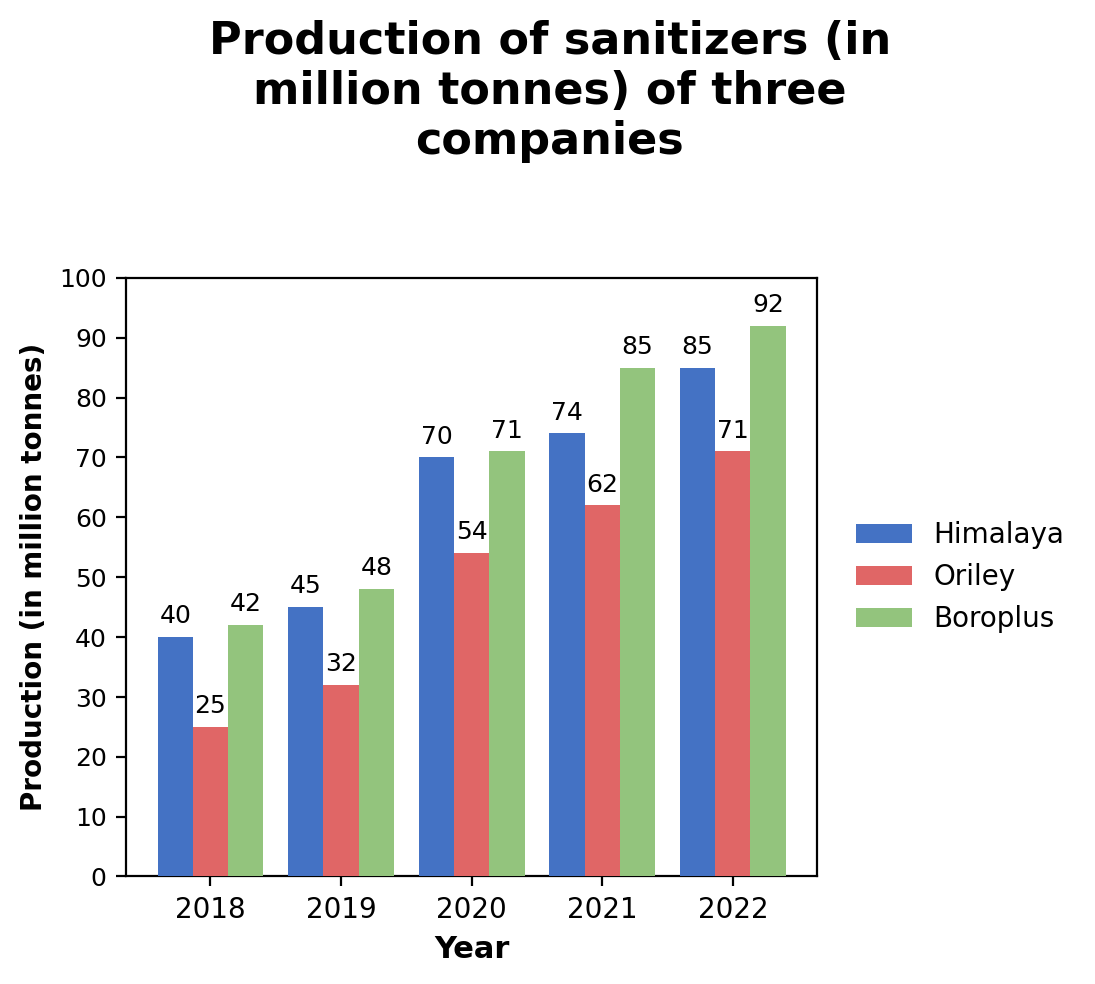
What is the percentage of increase in the production of sanitizers of company Himalaya from 2018 to 2020?
To find the percentage increase in the production of sanitizers by Himalaya from 2018 to 2020, we use the formula for percentage increase:
\[ \text{Percentage Increase} = \frac{\text{New Value} - \text{Old Value}}{\text{Old Value}} \times 100 \]
\[ \text{Percentage Increase} = \frac{30}{40} \times 100 = 75\% \]
Thus, the percentage increase in the production of sanitizers by Himalaya from 2018 to 2020 is 75%.
Correct Option: D) 75%
The question asks about the primary function or reason for the presence of alveoli in the lungs. Alveoli are tiny air sacs that are crucial for gas exchange in the respiratory system. Understanding their structure and role will help identify the correct answer.
D) To increase the surface area — The human lungs contain approximately 300 to 500 million alveoli. If spread out, the total surface area of these alveoli would be about 50 to 100 square meters, roughly the size of a tennis court. This vast surface area is essential for efficient and rapid gas exchange, allowing the body to take in enough oxygen and release sufficient carbon dioxide to meet metabolic demands.
Which of the following letter-number clusters will replace the question mark (?) in the given series to make it logically complete?
V37E, P27H, J19L,?
The problem presents a series of letter-number clusters. To find the missing cluster, we need to identify the pattern in the letters and the numbers separately.
The first letters are V, P, J. Let's find their positions in the English alphabet:
Now, let's find the difference between consecutive letters:
The pattern for the first letter is a subtraction of 6 from its alphabetical position. So, the next first letter will be the letter at position \(10 - 6 = 4\). The 4th letter in the alphabet is D.
The numbers are 37, 27, 19. Let's find the difference between consecutive numbers:
The pattern for the numbers is a subtraction of decreasing even numbers (10, 8). So, the next number will be \(19 - 6 = 13\). The next number is 13.
The second letters are E, H, L. Let's find their positions in the English alphabet:
Now, let's find the difference between consecutive letters:
The pattern for the second letter is an addition of increasing consecutive numbers (3, 4). So, the next second letter will be the letter at position \(12 + 5 = 17\). The 17th letter in the alphabet is Q.
Based on the patterns, the next cluster in the series is D13Q.
C) D13Q is the correct option as it follows all the identified patterns for the first letter, the number, and the second letter.
Study the given line graph and answer the following question.
The given line graph depicts the number of girls in four classes (I, II, III and IV).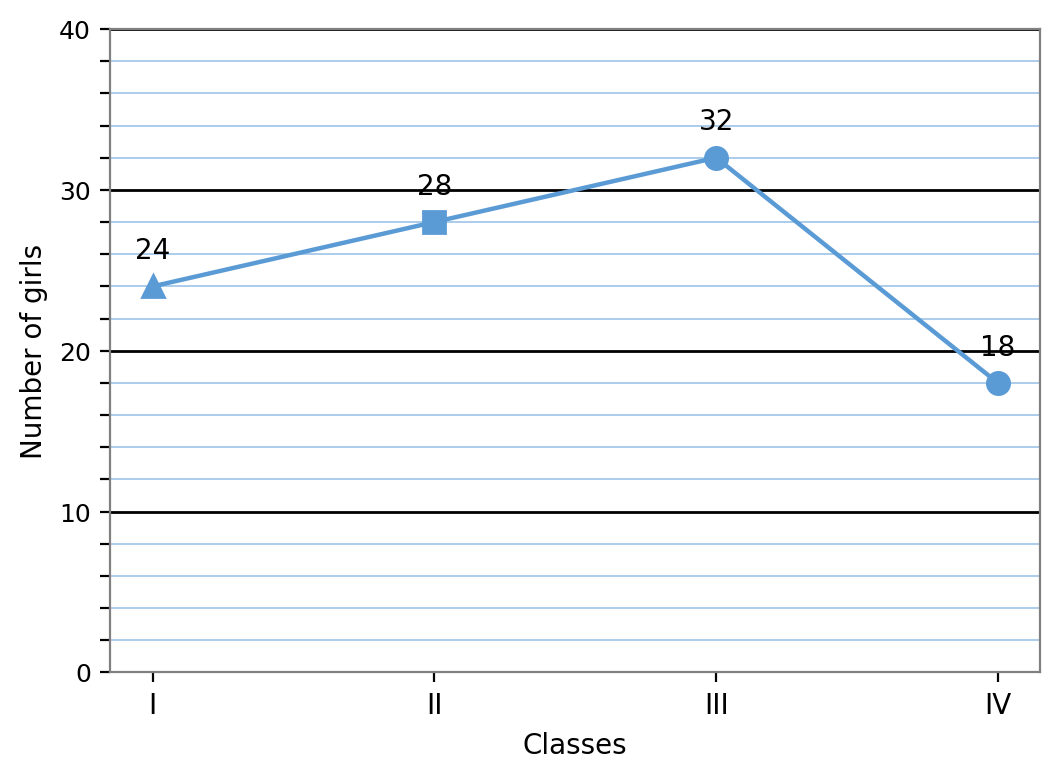
If the total number of boys in classes I, II and IV is 27 more than the total number of girls in the same classes, what is the total number of boys in classes I, II and IV?
To find the total number of boys in classes I, II, and IV, we need to use the information provided in the line graph regarding the number of girls in these classes and the additional information that the number of boys is 27 more than the number of girls.
\[ \text{Total number of girls} = 24 + 28 + 18 = 70 \]
\[ \text{Total number of boys} = 70 + 27 = 97 \]
Correct Option: D) 97