
If p + q + r = 13 and pq + qr + rp = 30, then the value of p³ + q³ + r³ − 3pqr is:
The problem asks for the value of \(p^3 + q^3 + r^3 - 3pqr\) given the sum \(p+q+r\) and the sum of products of two variables \(pq+qr+rp\). We can use the algebraic identity for the sum of cubes to solve this problem.
Recall the algebraic identity for \(p^3 + q^3 + r^3 - 3pqr\):
\[ p^3 + q^3 + r^3 - 3pqr = (p+q+r)(p^2+q^2+r^2 - pq - qr - rp) \]We are given the values:
To use the identity, we need to find the value of \(p^2+q^2+r^2\).
We know another identity relating these terms:
\[ (p+q+r)^2 = p^2+q^2+r^2 + 2(pq+qr+rp) \]Substitute the given values into this identity to find \(p^2+q^2+r^2\):
\[ (13)^2 = p^2+q^2+r^2 + 2(30) \]\[ 169 = p^2+q^2+r^2 + 60 \]\[ p^2+q^2+r^2 = 169 - 60 \]\[ p^2+q^2+r^2 = 109 \]Now substitute the values of \(p+q+r\), \(p^2+q^2+r^2\), and \(pq+qr+rp\) into the main identity from Step 1:
\[ p^3 + q^3 + r^3 - 3pqr = (p+q+r)(p^2+q^2+r^2 - (pq+qr+rp)) \]\[ p^3 + q^3 + r^3 - 3pqr = (13)(109 - 30) \]\[ p^3 + q^3 + r^3 - 3pqr = (13)(79) \]Calculate the final product:
\[ 13 \times 79 = 1027 \]B) The value of \(p^3 + q^3 + r^3 - 3pqr\) is 1027.
________ is spoken by around 2.5 million people, mainly on the central west coast of India, and it is the official language of Goa.
The question asks to identify the language based on its approximate number of speakers, geographical location (central west coast of India), and its status as the official language of Goa. We need to evaluate each option against these criteria.
Correct Option: D) Konkani — Konkani is spoken by approximately 2.5 million people, primarily along the Konkan coast, which is the central west coast of India. It is also the official language of the state of Goa.
The sign convention for focal length of mirrors is determined by the direction of light rays and the location of the focal point relative to the mirror's pole. For a convex mirror, the focal point is always behind the mirror, which is considered the positive direction according to the Cartesian sign convention.
Correct Option: D) positive
The following pie-chart shows the distribution of students of graduate levels in seven different colleges.
Distribution of students at graduate levels in seven different colleges: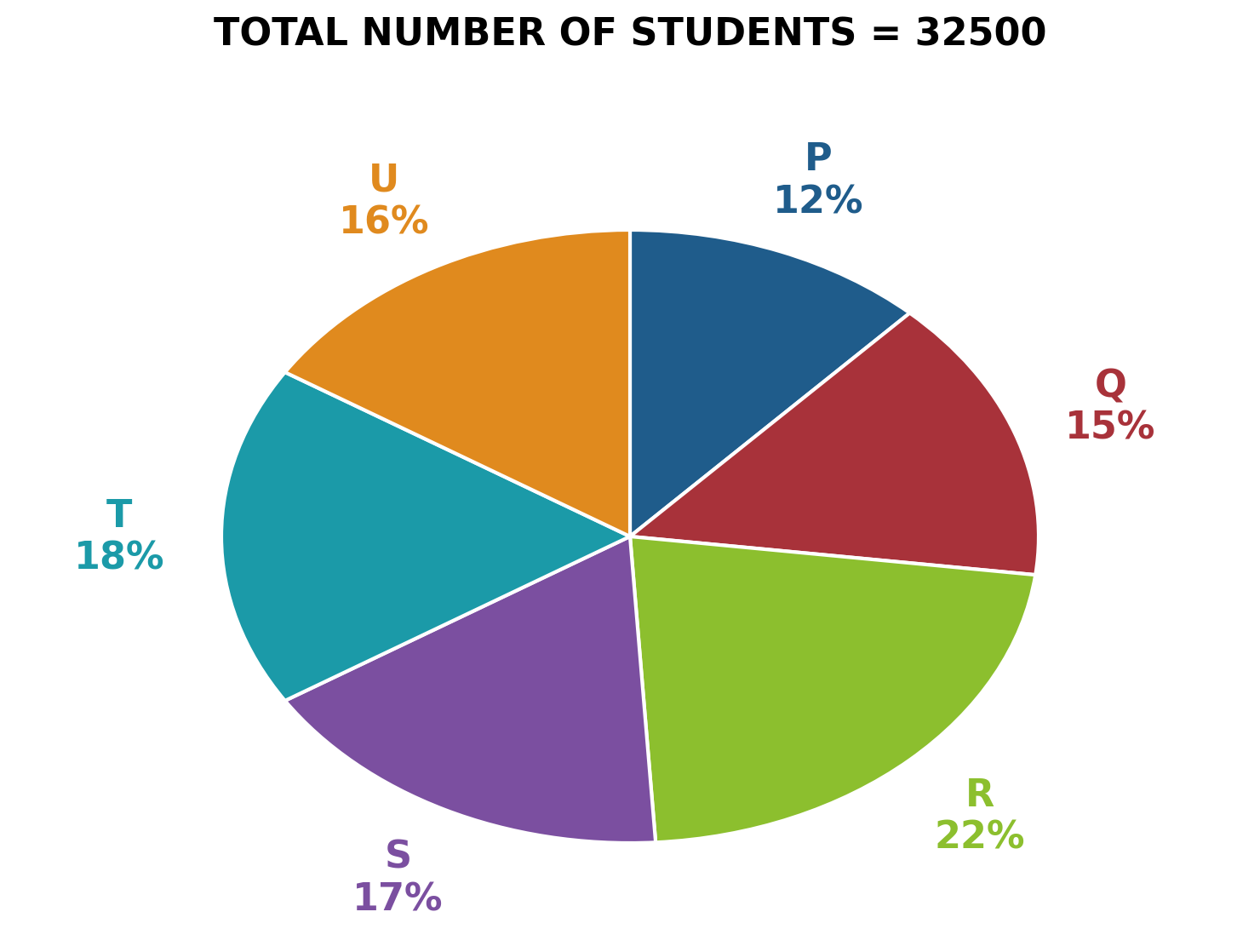
What is the sum of students in College of P and I studying at graduate level?
To find the sum of students in Colleges P and I, we need to calculate the number of students in each college using the percentage values given in the pie chart.
\[ \text{Students in P} = \frac{12}{100} \times 32500 = 3900 \]
\[ \text{Students in R} = \frac{22}{100} \times 32500 = 7150 \]
\[ \text{Total Students in P and R} = 3900 + 7150 = 11050 \]
B) 9750 — This option is incorrect based on the assumption error regarding College I.
The question asks to identify the IIT where the AquaMAP Centre for Water Management and Policy was inaugurated in March 2022. This requires knowledge of recent events related to scientific and technological developments in India, specifically concerning IITs and water management initiatives.
Correct Option: A) IIT-Madras
The AquaMAP Centre for Water Management and Policy was inaugurated at IIT-Madras in March 2022. This initiative is focused on solving real-world water problems and developing sustainable water management strategies.
The question asks to identify which sport is NOT included in the Indian government's scheme for cash awards to medal winners and their coaches in international events. This requires knowledge of the specific sports recognized under such government schemes.
B) Cricket is generally not included in the Indian government's scheme of cash awards for medal winners in international sports events. Its governing body, the BCCI, manages its own financial incentives.
The formula for resultant resistance of three resistors connected in parallel combination is:
R = \(\frac{1}{R_1}+\frac{1}{R_2}+\frac{1}{R_3}\)
R = R₁ + R₂ + R₃
\( \frac{1}{R} \) = \(\frac{1}{R_1}+\frac{1}{R_2}+\frac{1}{R_3}\)
\( \frac{1}{R} \) = R₁ + R₂ + R₃
To determine the resultant resistance of resistors connected in parallel, we need to understand the fundamental formula derived from Kirchhoff's laws and Ohm's law. In a parallel combination, the voltage across each resistor is the same, but the current divides. The total current is the sum of the currents through individual resistors.
Understanding Parallel Combination: When resistors are connected in parallel, the potential difference (voltage) across each resistor is the same. The total current flowing into the combination splits among the resistors and then recombines.
Applying Ohm's Law: According to Ohm's Law, \(V = IR\), where \(V\) is voltage, \(I\) is current, and \(R\) is resistance. This can be rearranged to \(I = \frac{V}{R}\).
Total Current: For three resistors \(R_1\), \(R_2\), and \(R_3\) connected in parallel, the total current \(I\) is the sum of the currents through each resistor:
\[ I = I_1 + I_2 + I_3 \]Substituting Ohm's Law: Let \(V\) be the total voltage across the parallel combination, and \(R_{eq}\) be the equivalent (resultant) resistance. Then, \(I = \frac{V}{R_{eq}}\). Similarly, for individual resistors, \(I_1 = \frac{V}{R_1}\), \(I_2 = \frac{V}{R_2}\), and \(I_3 = \frac{V}{R_3}\).
Deriving the Formula: Substituting these into the total current equation:
\[ \frac{V}{R_{eq}} = \frac{V}{R_1} + \frac{V}{R_2} + \frac{V}{R_3} \]Simplifying: Since \(V\) is common on both sides, we can cancel it out (assuming \(V \neq 0\)):
\[ \frac{1}{R_{eq}} = \frac{1}{R_1} + \frac{1}{R_2} + \frac{1}{R_3} \]Replacing \(R_{eq}\) with \(R\) as given in the options for resultant resistance, the formula becomes:
\[ \frac{1}{R} = \frac{1}{R_1} + \frac{1}{R_2} + \frac{1}{R_3} \]Correct Option: C) \( \frac{1}{R} \) = \[\frac{1}{R_1}+\frac{1}{R_2}+\frac{1}{R_3}\] is the correct formula for the resultant resistance of three resistors connected in parallel.
The question asks about the approximate time when atmospheric ozone levels began to decline significantly. This is a historical fact related to environmental science and the discovery of the ozone hole.
Correct Option: C) 1980. Significant reductions in atmospheric ozone levels, leading to the discovery of the ozone hole, began to be observed and documented around the early 1980s. This period marks the onset of the noticeable decline.
To find the area of a triangle, we use the standard formula which relates the base and the height of the triangle. The formula for the area of a triangle is half the product of its base and height.
The area of a triangle (\(A\)) is given by the formula:
\[ A = \frac{1}{2} \times \text{base} \times \text{height} \]Substitute the given base and height into the area formula:
\[ A = \frac{1}{2} \times 9 \text{ cm} \times 16 \text{ cm} \]Perform the multiplication:
\[ A = \frac{1}{2} \times (9 \times 16) \text{ cm}^2 \]\[ A = \frac{1}{2} \times 144 \text{ cm}^2 \]\[ A = 72 \text{ cm}^2 \]B) The calculated area is 72 cm², which matches option B.
This problem involves setting up and solving a system of linear equations based on the given age conditions. We will define variables for the present ages of the man and his grandson and then translate the two given statements into mathematical equations. Finally, we will solve these equations to find the present age of the grandson.
Define variables:
Let the present age of the man be \(M\) years.
Let the present age of the grandson be \(G\) years.
Formulate the first equation (three years ago):
Three years ago, the man's age was \(M-3\).
Three years ago, the grandson's age was \(G-3\).
According to the problem, three years ago, the man was six times as old as his grandson:
\[ M-3 = 6(G-3) \ M-3 = 6G - 18 \ M = 6G - 15 \quad \text{(Equation 1)} \]
Formulate the second equation (three years later):
Three years later, the man's age will be \(M+3\).
Three years later, the grandson's age will be \(G+3\).
According to the problem, three years later, his age will be 6 more than four times the age of the grandson:
\[ M+3 = 4(G+3) + 6 \ M+3 = 4G + 12 + 6 \ M+3 = 4G + 18 \ M = 4G + 15 \quad \text{(Equation 2)} \]
Solve the system of equations:
Now we have two equations for \(M\):
From Equation 1: \(M = 6G - 15\)
From Equation 2: \(M = 4G + 15\)
Set the expressions for \(M\) equal to each other:
\[ 6G - 15 = 4G + 15 \]
Subtract \(4G\) from both sides:
\[ 2G - 15 = 15 \]
Add 15 to both sides:
\[ 2G = 30 \]
Divide by 2:
\[ G = 15 \]
Find the present age of the man (optional, for verification):
Substitute \(G=15\) into Equation 2 (or Equation 1):
\[ M = 4(15) + 15 \ M = 60 + 15 \ M = 75 \]
Verify the conditions:
Present ages: Man = 75, Grandson = 15.
Three years ago: Man = 72, Grandson = 12. Is \(72 = 6 \times 12\)? Yes, \(72 = 72\).
Three years later: Man = 78, Grandson = 18. Is \(78 = 4 \times 18 + 6\)? Yes, \(78 = 72 + 6\), which is \(78 = 78\).
The conditions are satisfied.
The present age of the grandson is 15 years.
Correct Option: B) 15 years