
Which letter represents the region Bowman’s capsule in the diagram below?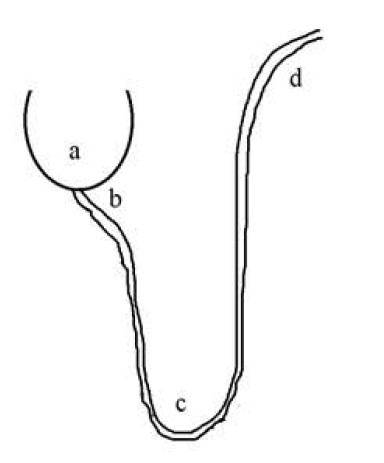
The diagram represents a part of the nephron, which is the functional unit of the kidney. The key components of the nephron include the Bowman's capsule, proximal convoluted tubule, loop of Henle, and distal convoluted tubule. Identifying these components is crucial to answering the question.
Correct Option: A) Region a
The question asks to identify metals that can be extracted from their oxides by reduction using carbon. This method is generally effective for metals that are less reactive than carbon. The reactivity series of metals helps determine which metals can be reduced by carbon.
Therefore, the group containing only metals reducible by carbon is Zn, Fe, Cu.
Correct Option: B) Zn, Fe, Cu
The problem presents a series of terms, each consisting of two letters and a number. To find the next term, we need to identify the pattern in the letters and the numbers separately.
R (18) \(\rightarrow\) W (23) \(\rightarrow\) B (2) \(\rightarrow\) G (7)
The pattern in alphabetical positions is:
The pattern is consistently adding 5 to the alphabetical position. So, the next first letter will be G + 5 = 7 + 5 = 12, which is L.
M (13) \(\rightarrow\) R (18) \(\rightarrow\) W (23) \(\rightarrow\) B (2)
The pattern in alphabetical positions is:
The pattern is consistently adding 5 to the alphabetical position. So, the next second letter will be B + 5 = 2 + 5 = 7, which is G.
13 \(\rightarrow\) 17 \(\rightarrow\) 21 \(\rightarrow\) 25
The pattern is:
The pattern is consistently adding 4. So, the next number will be \(25 + 4 = \textbf{29}\).
C (3) \(\rightarrow\) H (8) \(\rightarrow\) M (13) \(\rightarrow\) R (18)
The pattern in alphabetical positions is:
The pattern is consistently adding 5 to the alphabetical position. So, the next third letter will be R + 5 = 18 + 5 = 23, which is W.
The first letter is L, the second letter is G, the number is 29, and the third letter is W. Combining these gives LG29W.
B) LG29W is the correct term that logically completes the series.
The question asks to identify the holy person credited with giving Jainism its present form. This requires knowledge of the founders and key figures in the development of Jainism.
Correct Option: A) Mahavira is considered the holy person who gave Jainism its present form. While Rishabhanatha was the first Tirthankara and founder, Mahavira is credited with systematizing its philosophy and making it a popular movement, thus giving it its current shape.
The problem asks us to modify a given set of three-letter words by changing each letter to the next letter in the English alphabetical series. Then, we need to count how many of these newly formed words contain at least one vowel. The vowels are A, E, I, O, U.
Let's apply these steps:
The words that have at least one vowel after the transformation are DBU, PXO, BOE, and TBE. There are 4 such words.
B) Four — As determined in the step-by-step analysis, four of the transformed words (DBU, PXO, BOE, TBE) contain at least one vowel.
The question asks for the specific biological process responsible for the long-distance transport of food and other substances in plants through sieve tubes, aided by companion cells, in both upward and downward directions. We need to identify the term that accurately describes this active, bidirectional transport.
Correct Option: A) Translocation is the process by which food (sugars, amino acids, etc.) and other substances are transported through the phloem (specifically sieve tubes, with the help of companion cells) from source to sink in both upward and downward directions within a plant. This is an active process driven by pressure flow.
The problem provides two inequality statements and asks to identify the conclusion that is NOT true among the given options. We need to combine the given statements and then evaluate each conclusion against the combined statement.
A) Y < N
From the combined statement \(X > Y > P > M > N = O\), we can clearly see that \(Y > P\) and \(P > M\) and \(M > N\). Therefore, \(Y > N\). The conclusion \(Y < N\) is the opposite of what is derived from the statements. Hence, this conclusion is NOT true.
To find the least 3-digit number completely divisible by 8 and 12, we need to find the Least Common Multiple (LCM) of 8 and 12. Once we have the LCM, we will find the smallest multiple of this LCM that is a 3-digit number.
First, we find the prime factorization of each number:
To find the LCM, we take the highest power of all prime factors present in either number:
\[ \text{LCM}(8, 12) = 2^3 \times 3^1 = 8 \times 3 = 24 \]We are looking for the smallest multiple of 24 that is a 3-digit number. The smallest 3-digit number is 100.
We can divide 100 by 24 to see how many times 24 fits into 100:
\[ \frac{100}{24} = 4 \text{ with a remainder of } 4 \]\[ 100 = 24 \times 4 + 4 \]Since \(24 \times 4 = 96\) (which is a 2-digit number), the next multiple of 24 will be the least 3-digit number divisible by 24.
\[ 24 \times 5 = 120 \]A) 120 is the least 3-digit number that is completely divisible by both 8 and 12, as it is the smallest multiple of their LCM (24) that is greater than or equal to 100.
The value of (2²⁵ ÷ 2¹⁵) × 2⁴ is:
To solve this problem, we need to apply the laws of exponents. Specifically, we will use the rules for division and multiplication of powers with the same base:
First, evaluate the division part of the expression: \((2^{25} \div 2^{15})\).
Using the division rule \(a^m \div a^n = a^{m-n}\), where \(a=2\), \(m=25\), and \(n=15\):
\[ 2^{25} \div 2^{15} = 2^{25-15} = 2^{10} \]Next, substitute this result back into the original expression:
\[ 2^{10} \times 2^4 \]Now, evaluate the multiplication part using the multiplication rule \(a^m \times a^n = a^{m+n}\), where \(a=2\), \(m=10\), and \(n=4\):
\[ 2^{10} \times 2^4 = 2^{10+4} = 2^{14} \]Thus, the value of the expression \((2^{25} \div 2^{15}) \times 2^4\) is \(2^{14}\).
A) \(2^{14}\) is the correct answer, as derived from applying the laws of exponents.
This question tests the understanding of Ohm's Law and the concept of electrical resistivity. We need to determine which material, among tungsten, manganin, and hard rubber, will allow the maximum current to flow when subjected to the same potential difference and having the same physical dimensions (length and thickness).
C) Maximum current will pass through tungsten. Tungsten is a metal with low resistivity, making it a good conductor. Given the same potential difference, length, and cross-sectional area, the material with the lowest resistivity will conduct the most current.