The problem requires us to find the mode using the empirical relationship between mean, median, and mode, given the values of the median and mean. The empirical formula states that for a moderately skewed distribution, the relationship between these three measures of central tendency is approximately:
\[ \text{Mode} \approx 3 \times \text{Median} - 2 \times \text{Mean} \]We will substitute the given values into this formula to find the mode.
Thus, the value of the mode is 40.
Correct Option: D) 40
To find the average score of the whole class, we need to calculate the total score of all students and then divide it by the total number of students. We can find the total score by summing the total scores of the two groups of students.
The total score for a group is the average score multiplied by the number of students in that group.
\[ \text{Total score of first group} = \text{Number of students} \times \text{Average score} \] \[ = 8 \times 60 = 480 \]Sum the total scores of both groups.
\[ \text{Total score of whole class} = 480 + 480 = 960 \]The average score of the whole class is the total score of the whole class divided by the total number of students.
\[ \text{Average score of whole class} = \frac{\text{Total score of whole class}}{\text{Total number of students}} \] \[ = \frac{960}{20} = 48 \]Correct Option: B) 48
The question asks for the target year by which the National Air Sports Policy 2022 aims to make India one of the top air sports nations. This requires knowledge of the specific goals outlined in the policy document.
Correct Option: B) The National Air Sports Policy 2022, launched by the Ministry of Civil Aviation, has a clear vision to position India among the top air sports nations by the year 2030. This target year is a fundamental aspect of the policy's long-term strategy and planning.
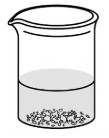
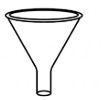
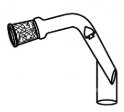
Which of the following is a china dish?
To identify the china dish among the given options, we need to recognize the typical shape and use of a china dish in laboratory settings.
Correct Option: A) The image shows a typical china dish, used for evaporating solutions.
To solve this problem, we need to follow two main steps:
Original Numbers:
Numbers after reversing their digits:
Arranging Original Numbers in Descending Order:
Comparing 7846, 6354, 8745, 4653:
Arranging Reversed Numbers in Descending Order:
Comparing 6487, 4536, 5478, 3564:
Comparing Positions:
Now, let's see which original numbers correspond to the reversed numbers at the same position:
Two numbers (6354 and 4653) retained their positions.
Correct Option: B) Two
This is a syllogism problem. We need to analyze the given statements and determine which of the conclusions logically follow. We can use Venn diagrams or logical deductions to solve this.
D) Only conclusion III follows.
The value of {14 + (2\( \frac{1}{2} \) + \( \frac{4}{5} \) + 1)} × \( \frac{1}{100} \) is:
To solve this problem, we need to follow the order of operations (BODMAS/PEMDAS). First, simplify the expression inside the parentheses, converting mixed fractions to improper fractions and finding a common denominator for addition. Then, perform the addition and finally multiply the result by \( \frac{1}{100} \).
First, let's simplify the expression inside the parentheses: \[2\frac{1}{2} + \frac{4}{5} + 1\].
Convert the mixed fraction to an improper fraction:
\[ 2\frac{1}{2} = \frac{(2 \times 2) + 1}{2} = \frac{4 + 1}{2} = \frac{5}{2} \]Now, the expression inside the parentheses becomes:
\[ \frac{5}{2} + \frac{4}{5} + 1 \]To add these fractions, find a common denominator, which is 10. Convert each term to have a denominator of 10:
\[ \frac{5}{2} = \frac{5 \times 5}{2 \times 5} = \frac{25}{10} \]\[ \frac{4}{5} = \frac{4 \times 2}{5 \times 2} = \frac{8}{10} \]\[ 1 = \frac{10}{10} \]Add the fractions:
\[ \frac{25}{10} + \frac{8}{10} + \frac{10}{10} = \frac{25 + 8 + 10}{10} = \frac{43}{10} \]Substitute this back into the original expression:
\[ \left(14 + \frac{43}{10}\right) \times \frac{1}{100} \]Add 14 and \( \frac{43}{10} \). Convert 14 to a fraction with denominator 10:
\[ 14 = \frac{140}{10} \]Perform the addition:
\[ \frac{140}{10} + \frac{43}{10} = \frac{140 + 43}{10} = \frac{183}{10} \]Finally, multiply by \( \frac{1}{100} \):
\[ \frac{183}{10} \times \frac{1}{100} = \frac{183}{1000} \]Convert the fraction to a decimal:
\[ \frac{183}{1000} = 0.183 \]Correct Option: B) 0.183
The problem asks us to identify a triad of letter pairs that follows the same pattern as two given triads. We need to analyze the positional difference between the letters within each pair and between consecutive pairs in the given triads.
C) DI - HM - LQ
All conditions are met for option C.
This problem involves tracking a person's movement in different directions and calculating the final displacement from the starting point. We can solve this by breaking down the journey into horizontal (East-West) and vertical (North-South) components.
D) 5 km towards the east. As calculated, Point M is 5 km to the west of Point Y. Therefore, to reach Point Y from Point M, Sarvan must drive 5 km towards the east.
The problem asks us to find the principal amount (sum lent) given the simple interest rate, the daily interest earned, and the duration in days. We will first calculate the total interest earned for the year and then use the simple interest formula to find the principal.
The sum lent (principal) is Rs. 2,920.
Correct Option: B) 2,920