
If the cost price of an article is Rs 3,200 and its selling price is Rs 4,700, then the profit percentage is:
46 \( \frac{7}{8} \) %
46 \( \frac{8}{9} \) %
56 \( \frac{7}{8} \) %
56 \( \frac{8}{9} \) %
To find the profit percentage, we first need to calculate the profit by subtracting the cost price from the selling price. Then, we divide the profit by the cost price and multiply by 100 to express it as a percentage. Finally, we convert the decimal or fractional percentage into a mixed fraction if required by the options.
Profit is the difference between the Selling Price and the Cost Price.
\[ \text{Profit} = \text{SP} - \text{CP} \] \[ \text{Profit} = 4700 - 3200 = 1500 \]So, the profit is Rs 1,500.
The profit percentage is calculated with respect to the Cost Price.
\[ \text{Profit Percentage} = \left( \frac{\text{Profit}}{\text{CP}} \right) \times 100 \] \[ \text{Profit Percentage} = \left( \frac{1500}{3200} \right) \times 100 \] \[ \text{Profit Percentage} = \left( \frac{15}{32} \right) \times 100 \] \[ \text{Profit Percentage} = \frac{1500}{32} \]Now, simplify the fraction:
\[ \text{Profit Percentage} = \frac{750}{16} = \frac{375}{8} \]Divide 375 by 8:
\[ 375 \div 8 \]\(375 = 8 \times 46 + 7\)
So, the mixed fraction is \(46 \frac{7}{8}\).
\[ \text{Profit Percentage} = 46 \frac{7}{8} \% \]Correct Option: A) 46 \( \frac{7}{8} \) %
To understand why organic carbon compounds have lower melting points than ionic compounds, we need to compare the nature of bonding and intermolecular/inter-ionic forces in both types of substances. Melting point is directly related to the energy required to overcome these forces.
Correct Option: B) Weak force of attraction between molecules
Organic carbon compounds typically consist of discrete molecules held together by relatively weak intermolecular forces (such as Van der Waals forces or hydrogen bonds). To melt these compounds, only these weak intermolecular forces need to be overcome, which requires less energy and thus results in lower melting points.
The question asks to identify an electrical device that operates based on Joule's Law of Heating. This law describes the heat produced when an electric current flows through a conductor.
A) Immersion rod
An immersion rod contains a heating element, which is a high-resistance wire. When electric current passes through this wire, a significant amount of heat is generated due to its resistance, as per Joule's Law. This heat is then transferred to the water, warming it up. Therefore, an immersion rod directly works on the principle of Joule's Law of Heating.
The question asks to identify the organelle known as the 'suicide bags' of a cell. This term refers to an organelle's ability to break down cellular components, including the cell itself, under certain conditions.
Correct Option: D) Lysosomes
Lysosomes are membrane-bound organelles found in eukaryotic cells. They contain powerful digestive enzymes (hydrolytic enzymes) that can break down waste materials, cellular debris, foreign invaders like bacteria and viruses, and even worn-out organelles. When a cell is damaged or old, lysosomes can release these enzymes to digest the entire cell, leading to its death. This process is known as autolysis, which is why lysosomes are often referred to as the 'suicide bags' of the cell.
Given below are two letter-cluster pairs in which the second letter-cluster is related to the first letter-cluster following a certain logic. Select the letter-cluster pair from among the options that follows the same logic.
QTS : WZY
MPG : SVM
The problem presents two letter-cluster pairs and asks to find an option that follows the same logical relationship. We need to identify the pattern in the given pairs by analyzing the positional values of the letters in the English alphabet.
Correct Option: B) HKW : NQC
The question asks for the ordinal position of Neeraj Chopra among Indian athletes to win a medal at the World Athletics Championships in July 2022. To answer this, we need to recall the history of Indian medalists at this specific event.
Correct Option: D) Neeraj Chopra became the second Indian to win a medal at the World Athletics Championships in July 2022. The first was Anju Bobby George in 2003.
The question asks to identify the quadrilateral whose diagonals do NOT intersect at 90 degrees. We need to recall the properties of diagonals for each given quadrilateral type.
Based on these properties, the parallelogram is the only quadrilateral among the options whose diagonals do not always intersect at 90 degrees.
B) Parallelogram — In a parallelogram, the diagonals bisect each other, but they are generally not perpendicular. They are perpendicular only if the parallelogram is a rhombus (which includes a square).
The problem is a coding-decoding question. We need to identify the pattern or rule used to convert the given words into numerical codes. Once the rule is established, we apply it to the word 'EVENT' to find its code.
This confirms that the coding is consistent for common letters. Each letter is assigned a unique digit.
Upon closer inspection, it seems the coding is not based on alphabetical position or a simple arithmetic operation. It's a direct substitution code where each letter is assigned a specific digit, and some digits might be reused for different letters (e.g., 'V' and 'D' in 'AVOID' both map to 5, and 'M' in 'MULTI' also maps to 5. Similarly, 'L' and 'U' map to 6). This implies that the code for 'E' must be derived from the options or by looking for other patterns.
Let's re-evaluate the given mapping carefully. It's possible that the question implies a direct mapping where each letter has a unique code, and the repetition of digits is coincidental or indicates a different type of pattern.
Let's assume a direct letter-to-digit mapping where each occurrence of a letter gets the same digit. We have:
Now, let's look at the word 'EVENT'. We need codes for E, V, N, T.
So, 'EVENT' will be _ 5 _ 7 _.
Let's check the options:
Only option C and D have '5' as the second digit and '7' as the fourth digit. Let's re-examine the possibility of a mistake in my interpretation or the question itself. The problem is a standard coding-decoding type where letters are assigned digits.
Let's list the unique letter-digit pairs we have:
Notice that 'V', 'D', and 'M' all map to '5'. Also, 'U' and 'L' map to '6'. This is unusual for a simple substitution code unless the digits are derived from some property of the letters.
Let's consider the possibility that the digits are assigned based on the position of the letter in the word, or some other complex rule. However, the consistency of 'I' being '9' in both words suggests a direct letter-to-digit mapping.
Let's assume the question implies a unique digit for each letter, and the given examples are just providing those mappings. If a letter appears multiple times with the same digit, that's its code.
From the given codes:
For 'EVENT':
So, the code for 'EVENT' must be of the form _ 5 _ _ 7.
Let's check the options again with this pattern:
Now we are left with options A and C. Both have '4' for 'E' and '4' for 'N'. This implies E = 4 and N = 4.
Let's verify if this is consistent. If E = 4 and N = 4, then the code for 'EVENT' would be 45447.
This type of coding is often called a 'direct letter coding' where each letter is assigned a specific digit, and sometimes the same digit can be assigned to different letters, or a new letter's code must be inferred from the options or by finding a pattern in the existing codes.
Given the options, if E = 4 and N = 4, then the code for EVENT is 45447.
Combining these, we get 45447.
C) 45447 is the correct code for 'EVENT' based on the derived letter-to-digit mapping.
Both the diagrams A and B given below are of Sclerenchyma tissue in plants, yet they look different. Why?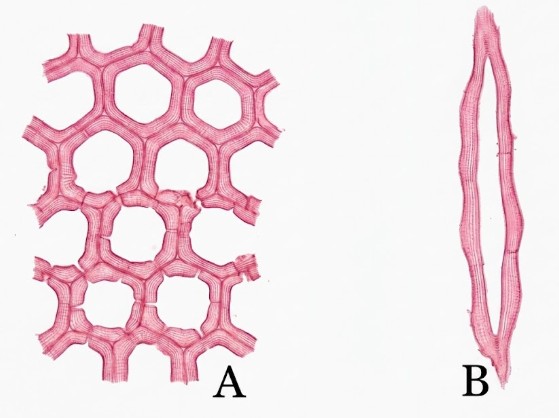
A – Longitudinal section; B – Oblique section
A – Radial section; B – Transverse section
A – Longitudinal section; B – Transverse section
A – Transverse section; B – Longitudinal section
To understand why the diagrams of sclerenchyma tissue look different, we need to identify the type of section each diagram represents. Sclerenchyma tissues can be visualized differently depending on whether they are cut transversely or longitudinally.
Correct Option: D) A – Transverse section; B – Longitudinal section
The question asks about the number of scientists who received the Shanti Swarup Bhatnagar Award in 2021. This is a factual question requiring knowledge of current affairs and specific award announcements.
Correct Option: A) 11 scientists received the Shanti Swarup Bhatnagar Award 2021 for Science & Technology.