
What is the rank of India in the Human Development Index, 2020, prepared by the United Nations Development Programme (UNDP) as per the report released in 2021?
The question asks for India's rank in the Human Development Index (HDI) 2020, as reported by the UNDP in 2021. This requires recalling specific factual information about international reports and rankings.
Correct Option: A) 131 st
The problem asks us to find a set of three numbers that follow the same relationship as the given sets: (12, 15, 18) and (45, 35, 25). We need to identify the pattern or rule that connects the numbers within these sets.
Observe the differences between consecutive numbers:
This set shows a common difference of 3, meaning the numbers are in an arithmetic progression.
Observe the differences between consecutive numbers:
This set shows a common difference of -10, meaning the numbers are also in an arithmetic progression.
From these two examples, the common pattern is that the numbers in each set form an arithmetic progression. That is, the difference between the first and second number is the same as the difference between the second and third number. Let the set be \((a, b, c)\). Then the rule is \(b - a = c - b\).
D) (15, 20, 25)
Since both differences are 5, this set follows the arithmetic progression pattern with a common difference of 5. Therefore, this is the correct option.
The differences are not equal (\(-3 \neq 7\)). So, this set does not follow the pattern.
The differences are not equal (\(-1 \neq -17\)). So, this set does not follow the pattern.
The differences are not equal (\(14 \neq -14\)). So, this set does not follow the pattern.
The question asks to identify the Indian state where the Sangai deer, an endemic species, is found. This requires knowledge of the geographical distribution of specific endangered or endemic species in India.
Correct Option: C) Manipur is the only state where the Sangai deer, also known as the brow-antlered deer, is found. It is endemic to the Keibul Lamjao National Park, which is the world's only floating national park, located in Manipur.
Express 0.\(\overline{42}\) as a fraction in the form of \( \frac{p}{q} \), where p and q are integers and q ≠ 0.
\(\frac{21}{50}\)
\(\frac{14}{33}\)
\(\frac{13}{33}\)
\(\frac{41}{99}\)
To express a repeating decimal (non-terminating but recurring) as a fraction, we can use an algebraic method. We assign the repeating decimal to a variable, multiply it by a power of 10 to shift the repeating part to the left of the decimal, and then subtract the original equation to eliminate the repeating part.
Let the given repeating decimal be equal to \(x\):
\[ x = 0.\overline{42} \]This means the digits '42' repeat infinitely:
\[ x = 0.424242... \quad \text{(Equation 1)} \]Since two digits are repeating, we multiply both sides of Equation 1 by \(10^2 = 100\):
\[ 100x = 42.424242... \quad \text{(Equation 2)} \]Now, subtract Equation 1 from Equation 2:
\[ 100x - x = 42.424242... - 0.424242... \]Simplify both sides of the equation:
\[ 99x = 42 \]Solve for \(x\) by dividing both sides by 99:
\[ x = \frac{42}{99} \]Simplify the fraction by dividing the numerator and the denominator by their greatest common divisor, which is 3:
\[ x = \frac{42 \div 3}{99 \div 3} \]\[ x = \frac{14}{33} \]B) The fraction \(\frac{14}{33}\) is obtained by converting the repeating decimal \(0.\overline{42}\) using the algebraic method. Both 14 and 33 are integers, and 33 \(\neq\) 0.
Study the given diagram carefully. Which option correctly explains the reason for the appearance of the blue-black color?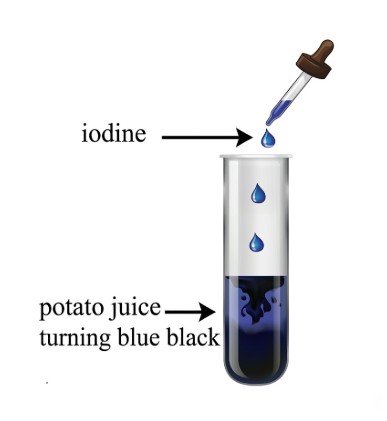
Potato juice contains proteins, which turn blue-black with iodine.
Potato juice contains starch, which turns blue-black with iodine.
Potato juice contains glucose, which turns blue-black with iodine.
Potato juice contains fats, which turn blue-black with iodine.
The question involves understanding a chemical reaction between iodine and a component in potato juice. The diagram shows iodine being added to potato juice, resulting in a blue-black color.
Correct Option: B) Potato juice contains starch, which turns blue-black with iodine.
The problem asks us to find the next number in a given series: 124, 129, 136, 145, 156, ?. We need to identify the pattern or rule governing the sequence of numbers.
B) 169 is the correct answer because it follows the established pattern where the difference between consecutive terms increases by 2 each time (5, 7, 9, 11, 13).
This problem can be solved by setting up a system of two linear equations based on the given information. We are given the total number of pages and the relationship between the number of pages in the two parts of the book. We can then solve for the number of pages in the second part.
Let \(P_1\) be the number of pages in the first part of the book.
Let \(P_2\) be the number of pages in the second part of the book.
From the problem statement, the total number of pages is 892. So, we can write the first equation:
\[ P_1 + P_2 = 892 \quad \text{(Equation 1)} \]The second part of the book has 52 pages less than the first part. So, we can write the second equation:
\[ P_2 = P_1 - 52 \quad \text{(Equation 2)} \]We need to find \(P_2\). We can substitute Equation 2 into Equation 1 to eliminate \(P_1\). First, express \(P_1\) in terms of \(P_2\) from Equation 2:
\[ P_1 = P_2 + 52 \]Now substitute this expression for \(P_1\) into Equation 1:
\[ (P_2 + 52) + P_2 = 892 \]Combine the \(P_2\) terms:
\[ 2P_2 + 52 = 892 \]Subtract 52 from both sides of the equation:
\[ 2P_2 = 892 - 52 \]\[ 2P_2 = 840 \]Divide by 2 to find \(P_2\):
\[ P_2 = \frac{840}{2} \]\[ P_2 = 420 \]Thus, there are 420 pages in the second part of the book.
Correct Option: D) 420
The question asks to identify a bacterium that serves as an indicator of water pollution. This requires knowledge of common bacterial indicators used in water quality testing and their significance.
Correct Option: C) E. coli (Coliform)
The question asks to identify the plant part responsible for gas exchange. We need to recall the basic structures of a plant leaf and their functions related to photosynthesis and respiration.
C) Stomata — Stomata are small pores, primarily found on the epidermis of leaves, that regulate the exchange of gases (carbon dioxide, oxygen, and water vapor) between the plant and the atmosphere. This makes them the primary structures for gas exchange.
The question asks to identify the element that has the maximum number of atoms in its molecular form. This requires knowledge of the typical molecular structures of the given elements under standard conditions.
Correct Option: B) Sulfur (S) exists as an octa-atomic molecule, \(S_8\), which means it has 8 atoms in its molecular form, the highest among the given choices.