
The question asks to identify the religious community with which the Navroz festival is associated. This requires knowledge of major festivals and their respective religious affiliations in India and globally.
C) Parsi — Navroz is the Parsi New Year, celebrated by the Parsi community in India and by Zoroastrians worldwide. It marks the spring equinox and is a significant cultural and religious festival for them.
The question asks for the city where the famous Haji Ali Dargah is located. This is a general knowledge question related to prominent landmarks in India. To answer correctly, one needs to identify the correct geographical location of this historical and religious site.
Correct Option: C) Mumbai is the correct answer. The Haji Ali Dargah is a prominent landmark situated on an islet off the coast of Worli in Mumbai, Maharashtra.
The question asks us to evaluate two statements regarding sodium carbonate and its uses/properties. We need to determine the truthfulness of each statement independently and then choose the option that correctly reflects their status.
D) Statement II is true, and Statement I is false.
To solve this problem, we need to first apply the given rules to each digit of the number 34135278. Then, we identify the new digits at the specified positions (third from the left and third from the right) and calculate their sum.
Let's process each digit:
The new number formed after applying the rules is 53357197.
In the new number 53357197, the digits are:
So, the digit third from the left is 3.
In the new number 53357197, the digits are:
So, the digit third from the right is 1.
Sum \( = \text{Digit third from left} + \text{Digit third from right} \)
Sum \( = 3 + 1 = 4 \)
D) 4 is the correct answer because the sum of the digit third from the left (3) and the digit third from the right (1) in the modified number is \(3 + 1 = 4\).
The question asks to identify the part of the Indian Constitution that contains Article 51A, which deals with Fundamental Duties. This requires knowledge of the structure and articles of the Indian Constitution.
Correct Option: A) Part IV-A is the correct answer. This Part was added to the Constitution by the 42nd Amendment Act, 1976, and it contains only one Article, Article 51A, which enumerates the Fundamental Duties of citizens.
The problem presents a series of terms, each consisting of three letters and a number. To find the missing term, we need to identify the pattern in the letters and the numbers separately.
U, W, Y, A, ?
Let's convert these letters to their alphabetical positions:
The pattern is an increment of 2. \(21 + 2 = 23\), \(23 + 2 = 25\), \(25 + 2 = 27\) (which is A). So, the next letter should be \(1 + 2 = 3\), which is C.
C, F, I, L, ?
Let's convert these letters to their alphabetical positions:
The pattern is an increment of 3. \(3 + 3 = 6\), \(6 + 3 = 9\), \(9 + 3 = 12\). So, the next letter should be \(12 + 3 = 15\), which is O.
K, O, S, W, ?
Let's convert these letters to their alphabetical positions:
The pattern is an increment of 4. \(11 + 4 = 15\), \(15 + 4 = 19\), \(19 + 4 = 23\). So, the next letter should be \(23 + 4 = 27\) (which is A).
4, 9, 19, 39, ?
Let's find the difference between consecutive numbers:
The differences are 5, 10, 20. This is a geometric progression where each term is multiplied by 2. So the next difference should be \(20 \times 2 = 40\).
Therefore, the next number in the series will be \(39 + 40 = 79\).
The next term will have the first letter C, the second letter O, the third letter A, and the number 79. So the complete term is COA-79.
A) COA-79 is the correct option as it follows all the identified patterns for the letters and the number.
The problem asks us to identify numbers in a given arrangement that are immediately preceded by a symbol and immediately followed by a symbol. We need to scan the arrangement and count such instances.
D) There are 3 such numbers (3, 4, and 6) in the arrangement that are immediately preceded by a symbol and immediately followed by a symbol.
To find the correct mean, we first need to calculate the incorrect sum of the numbers using the given incorrect mean. Then, we adjust this sum by subtracting the misread value and adding the correct value. Finally, we divide the corrected sum by the total number of items to get the correct mean.
Calculate the incorrect sum: Given that the mean of 36 numbers was 42, the sum of these numbers can be calculated as:
\[ \text{Incorrect Sum} = \text{Number of items} \times \text{Incorrect Mean} \] \[ \text{Incorrect Sum} = 36 \times 42 = 1512 \]Adjust the sum for the error: The problem states that a number 47 was misread as 41. To correct the sum, we need to subtract the misread value (41) and add the correct value (47).
\[ \text{Correct Sum} = \text{Incorrect Sum} - \text{Misread Value} + \text{Correct Value} \] \[ \text{Correct Sum} = 1512 - 41 + 47 \] \[ \text{Correct Sum} = 1471 + 47 = 1518 \]Calculate the correct mean: Now, divide the correct sum by the total number of items (which remains 36) to find the correct mean.
\[ \text{Correct Mean} = \frac{\text{Correct Sum}}{\text{Number of items}} \] \[ \text{Correct Mean} = \frac{1518}{36} \] \[ \text{Correct Mean} = 42.1666... \]Round off to two decimal places: Rounding 42.1666... to two decimal places gives 42.17.
B) 42.17 is the correct mean after adjusting for the misread number.
The rectangle represents students, the circle represents girls, the oval represents arts stream, and the triangle represents sports. The numbers in different sections indicate the number of persons. How many girl students have taken arts stream and do NOT play sports, and what is the total number of students who play sports but are NOT girls and have taken arts stream?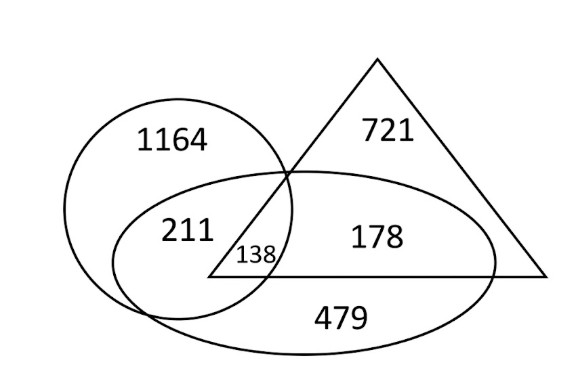
479 and 211, respectively
211 and 178, respectively
138 and 178, respectively
138 and 479, respectively
To solve this problem, we need to analyze the Venn diagram provided to determine the number of girl students who have taken the arts stream and do not play sports, as well as the number of students who play sports but are not girls and have taken the arts stream.
Correct Option: B) 211 and 178, respectively
A is twice as old as B. B is \( \frac{1}{3} \) as old as C. The sum of ages of A, B, and C is 42 years. Find the sum of the ages of A and B.
The problem involves finding the ages of three individuals (A, B, C) based on given relationships between their ages and their total age. We will set up equations based on the given information and solve for the individual ages, then calculate the sum of ages of A and B.
Let the current ages of A, B, and C be \(A\), \(B\), and \(C\) years, respectively.
From Equation 2, we can express \(C\) in terms of \(B\):
\[ C = 3B \]Now substitute \(A = 2B\) and \(C = 3B\) into Equation 3:
\[ (2B) + B + (3B) = 42 \]Combine the terms:
\[ 6B = 42 \]Divide by 6:
\[ B = \frac{42}{6} \]\[ B = 7 \text{ years} \]Check if \(A + B + C = 42\):
\[ 14 + 7 + 21 = 42 \]\[ 42 = 42 \]The ages are correct.
Sum \(A + B\):
\[ A + B = 14 + 7 \]\[ A + B = 21 \text{ years} \]Correct Option: A) 21 years