
The question asks to identify the Article of the Indian Constitution that mandates the separation of the judiciary from the executive. This is a direct question related to the Directive Principles of State Policy (DPSP) in the Indian Constitution.
A) 50 — Article 50 of the Indian Constitution is a Directive Principle of State Policy that specifically directs the State to take steps to separate the judiciary from the executive in the public services of the State. This is crucial for ensuring the independence and impartiality of the judicial system.
The question asks to identify the incorrect statement among the given options regarding common acids and their effects. We need to evaluate each statement for its scientific accuracy.
Correct Option: C) The statement "Bacteria present in the mouth produces base by degradation of the remaining food particles present in the mouth" is incorrect. Mouth bacteria produce acids, not bases, from food particles, which leads to a decrease in pH and causes tooth decay.
The question asks for the primary reason why humans should reduce their dependence on petroleum products. We need to evaluate each option based on its fundamental impact and long-term implications.
C) Amount of petroleum is finite — Petroleum is a non-renewable resource, meaning its reserves are limited and cannot be replenished on a human timescale. Continued high consumption will lead to its eventual depletion, making it imperative to reduce dependence and transition to sustainable alternatives.
The question asks about the historic contribution of Amrita Devi Bishnoi and her community in Rajasthan during the 1700s. This refers to a well-known environmental movement in Indian history.
C) They laid down their lives to stop the cutting down of trees growing in their region. This accurately describes the Khejarli massacre where Amrita Devi Bishnoi and 362 other Bishnois sacrificed their lives to protect Khejri trees.
A needle is placed at a distance of 2.5f from the pole of a convex mirror of focal length f. The linear magnification is:
\(\frac{4}{7}\)
\(\frac{3}{7}\)
\(\frac{2}{7}\)
\(\frac{1}{7}\)
To find the linear magnification for a convex mirror, we need to use the mirror formula and the magnification formula. We are given the object distance and the focal length. Since it's a convex mirror, the focal length is positive, and the object distance (by convention) is negative.
The mirror formula is:
\[ \frac{1}{f} = \frac{1}{v} + \frac{1}{u} \]The linear magnification formula is:
\[ m = -\frac{v}{u} \]C) The linear magnification is \(\frac{2}{7}\). This matches our calculated value.
The problem presents a proportion in the format \(a : b :: c : d\), which means \(a/b = c/d\). We need to find the value of 'y' given the proportion \(16 : y :: y : 25\). This is a case of continued proportion where the middle terms are equal, also known as finding the mean proportional.
Understand the proportion: The given expression \(16 : y :: y : 25\) can be written as a ratio:
\[ \frac{16}{y} = \frac{y}{25} \]Cross-multiplication: To solve for \(y\), cross-multiply the terms:
\[ 16 \times 25 = y \times y \]\[ 400 = y^2 \]Solve for \(y\): Take the square root of both sides to find the value of \(y\):
\[ y = \sqrt{400} \]Determine the positive value: The square root of 400 can be \(+20\) or \(-20\). The question specifically asks for the positive value of \(y\).
\[ y = 20 \]Correct Option: D) 20
If 5x+y = 125 and 5x−y = 3125, then the value of y is:
We are given two exponential equations involving variables \(x\) and \(y\). The goal is to find the value of \(y\). We will convert the given equations into linear equations by expressing the right-hand side numbers as powers of the same base (5). Then, we will solve the resulting system of linear equations.
Convert the first equation:
Given: \(5^{x+y} = 125\)
We know that \(125 = 5^3\). So, we can write the equation as:
\[ 5^{x+y} = 5^3 \]Since the bases are the same, the exponents must be equal:
\[ x+y = 3 \quad \text{(Equation 1)} \]Convert the second equation:
Given: \(5^{x-y} = 3125\)
We know that \(3125 = 5^5\). So, we can write the equation as:
\[ 5^{x-y} = 5^5 \]Since the bases are the same, the exponents must be equal:
\[ x-y = 5 \quad \text{(Equation 2)} \]Solve the system of linear equations:
We now have a system of two linear equations:
Equation 1: \(x+y = 3\)
Equation 2: \(x-y = 5\)
To find the value of \(y\), we can subtract Equation 2 from Equation 1:
\[ (x+y) - (x-y) = 3 - 5 \]\[ x+y-x+y = -2 \]\[ 2y = -2 \]\[ y = \frac{-2}{2} \]\[ y = -1 \]Correct Option: C) -1
Where can we find waste products in a plant cell shown in the following figure?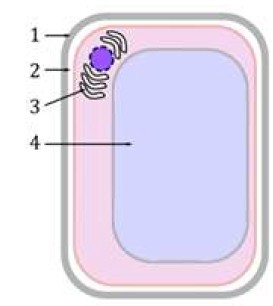
Region shown by arrow 2
Region shown by arrow 4
Region shown by arrow 1
Region shown by arrow 3
In plant cells, waste products are typically stored in the vacuole. The diagram shows different regions of a plant cell, and we need to identify the vacuole among these regions.
Correct Option: B) Region shown by arrow 4
The problem involves inequalities. We need to combine the given statements to establish relationships between the variables and then check which of the given conclusions logically follows from these combined relationships.
The given statements are:
From Statement 1, we know that \(A > C\) and \(C = B\). This implies \(A > B\).
From Statement 2, we know that \(M > N > O > Q\) and \(Q = A\). This implies \(M > N > O > A\).
Now, we can combine these relationships. Since \(M > N > O > A\) and \(A > C = B\), we can write the complete chain of inequalities as:
\[ M > N > O > A > C = B \]A) B < M
From the combined inequality \(M > N > O > A > C = B\), we have \(N > O > A > C\). This means \(N > C\). Therefore, \(N < C\) is false.
From the combined inequality \(M > N > O > A > C = B\), we have \(N > O > A > C\). This means \(N > C\). Therefore, \(C > N\) is false.
From the combined inequality \(M > N > O > A > C = B\), we have \(O > A > C = B\). This means \(O > B\). Therefore, \(O < B\) is false.
If each of the letters in the word MIRACLE is arranged in alphabetical order, then how many letters are there in the English alphabetical series between the letter which is third from the left and the one which is third from the right in the new arrangement?
To solve this problem, we first need to arrange the letters of the given word "MIRACLE" in alphabetical order. Then, we identify the letter that is third from the left and the letter that is third from the right in this new arrangement. Finally, we count the number of letters in the English alphabetical series between these two identified letters.
Wait, let's re-check the counting. The question asks for the number of letters *between* them. If we have E and I, the letters are F, G, H. This is 3 letters. Let's re-read the question carefully. "how many letters are there in the English alphabetical series between the letter which is third from the left and the one which is third from the right in the new arrangement?"
Let's re-evaluate step 5. The letters are E and I. The letters strictly between E and I are F, G, H. There are 3 letters.
Let's re-check the options and the provided correct answer. The provided correct answer is C) Six. This suggests my interpretation of "third from the right" or "between" might be off, or there's a misunderstanding of the question or options.
Let's re-verify the alphabetical order and positions:
Original word: MIRACLE
Letters: A, C, E, I, L, M, R
Arranged alphabetically: A C E I L M R
Third from the left: E (1st=A, 2nd=C, 3rd=E)
Third from the right: L (7th=R, 6th=M, 5th=L)
Ah, I made a mistake in identifying the third letter from the right in my initial thought process. Let's correct that.
New arrangement: A C E I L M R
Now, we need to count the number of letters in the English alphabetical series between E and L.
English alphabet: A B C D E F G H I J K L M N O P Q R S T U V W X Y Z
Letters between E and L are: F, G, H, I, J, K.
Counting these letters: There are 6 letters.
C) Six
The letters in the word MIRACLE, when arranged alphabetically, are A, C, E, I, L, M, R. The letter third from the left is E. The letter third from the right is L. The letters between E and L in the English alphabet are F, G, H, I, J, K. There are 6 such letters.