
The question asks about the location of India's first Graphene Innovation Centre. This is a factual question related to current affairs and technological developments in India. Recalling the specific state where this significant innovation centre was established is key to answering correctly.
Correct Option: D) Kerala
India's first Graphene Innovation Centre, also known as the India Innovation Centre for Graphene (IICG), was announced to be established in Kerala. This project is a collaboration between the Digital University Kerala, Centre for Materials for Electronics Technology (C-MET), Thrissur, and Tata Steel Limited, with support from the Ministry of Electronics and Information Technology (MeitY) and the Kerala government. Its aim is to promote research, development, and commercialization of graphene and 2D materials.
To determine the correct congruence between the two triangles, we need to find all angles in both triangles and then compare corresponding angles and sides. We will use the Angle Sum Property of a triangle and the Angle-Side-Angle (ASA) or Angle-Angle-Side (AAS) congruence criteria.
The sum of angles in a triangle is 180°.
\[ \angle A + \angle B + \angle C = 180^\circ \]Given \(\angle A = 40^\circ\) and \(\angle B = 55^\circ\).
\[ 40^\circ + 55^\circ + \angle C = 180^\circ \]\[ 95^\circ + \angle C = 180^\circ \]
\[ \angle C = 180^\circ - 95^\circ \]
\[ \angle C = 85^\circ \]
The sum of angles in a triangle is 180°.
\[ \angle D + \angle E + \angle F = 180^\circ \]Given \(\angle D = 55^\circ\) and \(\angle E = 85^\circ\).
\[ 55^\circ + 85^\circ + \angle F = 180^\circ \]\[ 140^\circ + \angle F = 180^\circ \]
\[ \angle F = 180^\circ - 140^\circ \]
\[ \angle F = 40^\circ \]
We are given that \(AB = FD\).
Let's check the angles opposite to these sides:
Since \(\angle C = \angle E = 85^\circ\) and \(AB = FD\), this suggests a correspondence where C corresponds to E, and the side AB corresponds to FD.
Now let's match the other angles:
So, the correspondence is A ↔ F, B ↔ D, C ↔ E.
Therefore, ΔABC is congruent to ΔFDE.
This congruence is based on the AAS (Angle-Angle-Side) criterion: \(\angle A = \angle F\), \(\angle C = \angle E\), and the non-included side \(AB = FD\).
D) ΔABC ≅ ΔFDE
This option correctly matches the corresponding vertices based on the angles and the given side: A (40°) corresponds to F (40°), B (55°) corresponds to D (55°), and C (85°) corresponds to E (85°). The given side AB corresponds to FD, which is consistent with the angle correspondence.
Study the following diagram carefully, and answer the question based on it. The numbers given in different parts represent the number of people who like different dry fruits in breakfast.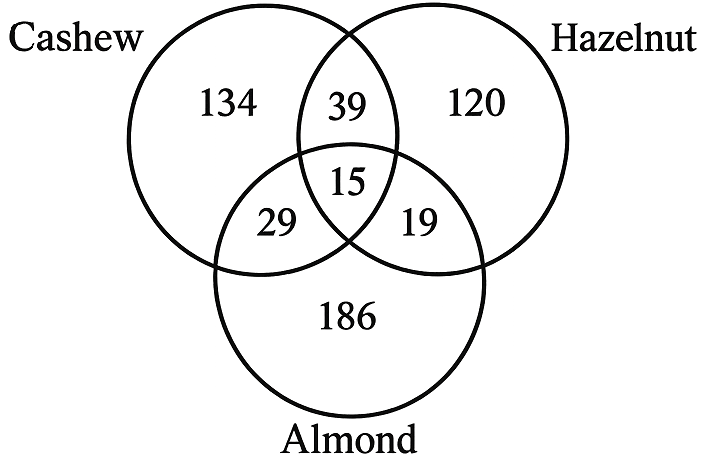
How many people like Hazelnut but do not like Cashew?
The question requires us to determine how many people like Hazelnut but do not like Cashew. We will use the Venn diagram provided to identify the relevant section.
Correct Option: C) 139
The problem asks us to identify the relationship between the numbers in the given sets and then find an option that follows the same relationship. We are given two example sets: (24, 12, 72) and (15, 16, 60). We need to find a pattern involving multiplication, division, addition, or subtraction between the first two numbers to get the third, or a combination of these operations.
A) (20, 24, 120)
Here, \(A = 20\), \(B = 24\).
Using the pattern \(C = (A \times B) / 4\):
\[ C = (20 \times 24) / 4 \]\[ C = 480 / 4 \]\[ C = 120 \]This matches the third number in the set. Therefore, option A follows the same relationship.
When two trains move in opposite directions, their relative speed is the sum of their individual speeds. The total distance covered to cross each other is the sum of their lengths. We can use the formula: \(\text{Distance} = \text{Speed} \times \text{Time}\) to find the speed of each train.
Identify the given information:
Calculate the total distance covered:
When two trains cross each other, the total distance covered is the sum of their lengths.
Calculate the relative speed:
Since the trains are moving in opposite directions, their relative speed is the sum of their individual speeds.
Apply the distance, speed, time formula:
\[ D = S_{\text{rel}} \times T \]Substitute the values:
\[ 260 = 2S \times 10 \]Solve for \(S\):
\[ 260 = 20S \] \[ S = \frac{260}{20} \] \[ S = 13 \text{ m/s} \]Thus, the speed of each train is 13 m/s.
Correct Option: B) 13 m/s
When the ratio of two numbers and their HCF (Highest Common Factor) are given, the numbers can be found by multiplying each part of the ratio by the HCF. This is because the HCF is the largest number that divides both numbers, and the ratio represents the numbers after they have been divided by their HCF.
D) 85, 119 — As calculated, the numbers are 85 and 119.
Find the value of \(\left(a+\frac{1}{b}\right)^{r}\left(a-\frac{1}{b}\right)^{s}\div\left(b+\frac{1}{a}\right)^{r}\left(b-\frac{1}{a}\right)^{s}\).
arbs
\( \left(\frac{a}{b}\right)^{r+s} \)
\( \left(\frac{b}{a}\right)^{r+s} \)
(ab)r+s
The problem asks us to simplify a given algebraic expression involving powers. We will simplify each term in the numerator and denominator by combining fractions, then use the properties of exponents to simplify the entire expression.
Let the given expression be \(E\). The expression is:
\[ E = \left(a+\frac{1}{b}\right)^{r}\left(a-\frac{1}{b}\right)^{s}\div\left(b+\frac{1}{a}\right)^{r}\left(b-\frac{1}{a}\right)^{s} \]Simplify the terms in the numerator:
So the numerator becomes:
\[ \text{Numerator} = \left(\frac{ab+1}{b}\right)^{r}\left(\frac{ab-1}{b}\right)^{s} \]Simplify the terms in the denominator:
So the denominator becomes:
\[ \text{Denominator} = \left(\frac{ab+1}{a}\right)^{r}\left(\frac{ab-1}{a}\right)^{s} \]Now, substitute these simplified forms back into the original expression:
\[ E = \frac{\left(\frac{ab+1}{b}\right)^{r}\left(\frac{ab-1}{b}\right)^{s}}{\left(\frac{ab+1}{a}\right)^{r}\left(\frac{ab-1}{a}\right)^{s}} \]Rearrange the terms using the property \( (X/Y)^n = X^n / Y^n \):
\[ E = \frac{\frac{(ab+1)^r}{b^r} \cdot \frac{(ab-1)^s}{b^s}}{\frac{(ab+1)^r}{a^r} \cdot \frac{(ab-1)^s}{a^s}} \]Combine the terms with the same base in the numerator and denominator:
\[ E = \frac{(ab+1)^r (ab-1)^s / (b^r b^s)}{(ab+1)^r (ab-1)^s / (a^r a^s)} \]\[ E = \frac{(ab+1)^r (ab-1)^s / b^{r+s}}{(ab+1)^r (ab-1)^s / a^{r+s}} \]Cancel out the common terms \( (ab+1)^r (ab-1)^s \) from the numerator and denominator:
\[ E = \frac{1 / b^{r+s}}{1 / a^{r+s}} \]Simplify the complex fraction:
\[ E = \frac{1}{b^{r+s}} \times \frac{a^{r+s}}{1} \]\[ E = \frac{a^{r+s}}{b^{r+s}} \]Finally, use the property \( X^n / Y^n = (X/Y)^n \):
\[ E = \left(\frac{a}{b}\right)^{r+s} \]Correct Option: B) \( \left(\frac{a}{b}\right)^{r+s} \)
The problem asks for the equivalent resistance between two diametrically opposite points of a circular wire. The total resistance of the wire is given, and it is bent into a circle. We need to determine how the resistance is distributed along the circle and then apply the rules for parallel resistors.
Understand the setup: A metallic wire of total resistance \(R_{\text{total}} = 100 \, \Omega\) is bent into a circle. The circumference of the circle is equal to the length of the wire.
Identify the points of interest: We need to find the equivalent resistance between two diametrically opposite points on the circle. Let's call these points A and B.
Determine the resistance distribution: When the wire is bent into a circle, and we consider two diametrically opposite points, the circle is effectively divided into two semicircles. Each semicircle forms a path between the two diametrically opposite points.
Calculate the resistance of each path: Since the points are diametrically opposite, each semicircle has a length equal to half the total length of the wire. Therefore, the resistance of each semicircle will be half of the total resistance of the wire.
\[ R_{\text{semicircle}} = \frac{R_{\text{total}}}{2} \]\[ R_{\text{semicircle}} = \frac{100 \, \Omega}{2} = 50 \, \Omega \]Identify the circuit configuration: The two semicircles form two parallel paths between the diametrically opposite points A and B. Each path has a resistance of \(50 \, \Omega\).
Calculate the equivalent resistance: For two resistors in parallel, the equivalent resistance \(R_{\text{eq}}\) is given by the formula:
\[ \frac{1}{R_{\text{eq}}} = \frac{1}{R_1} + \frac{1}{R_2} \]In this case, \(R_1 = R_{\text{semicircle}} = 50 \, \Omega\) and \(R_2 = R_{\text{semicircle}} = 50 \, \Omega\).
\[ \frac{1}{R_{\text{eq}}} = \frac{1}{50 \, \Omega} + \frac{1}{50 \, \Omega} \]\[ \frac{1}{R_{\text{eq}}} = \frac{2}{50 \, \Omega} \]\[ R_{\text{eq}} = \frac{50 \, \Omega}{2} \]\[ R_{\text{eq}} = 25 \, \Omega \]The equivalent resistance between two diametrically opposite points is \(25 \, \Omega\).
D) 25 Ω
The acidity or basicity of an oxide depends on the electronegativity of the element forming the oxide. Generally, non-metals form acidic oxides, while metals form basic oxides. Elements with higher electronegativity tend to form acidic oxides. We need to identify the group that primarily consists of non-metals or elements with high electronegativity.
B) Group 16 — This group contains non-metals like sulfur and selenium, which have high electronegativity and readily form acidic oxides (e.g., \(\text{SO}_2\), \(\text{SO}_3\)).
The problem asks us to modify given letter clusters by changing each letter to the next letter in the English alphabetical order. Then, we need to count how many of the newly formed clusters will contain no vowels. The vowels in the English alphabet are A, E, I, O, U.
After transforming all clusters, we find that MBZN and KPFL are the two clusters that contain no vowels.
A) Two. As determined in the step-by-step analysis, two clusters (MBZN and KPFL) have no vowels after the transformation.