
The problem requires us to determine which conclusion logically follows from the given statement. We need to combine the inequalities and equalities to establish relationships between the variables and then check each option.
A) E < A
[(1690 − 934) × \( \frac{5}{6} \) + 815] ÷ 17 equals:
To solve this problem, we need to follow the order of operations (BODMAS/PEMDAS): Brackets first, then Orders (powers/roots), Division/Multiplication (from left to right), and finally Addition/Subtraction (from left to right).
Let's perform the calculations:
Thus, the final result is \(85\).
A) 85 is the correct answer, as derived from following the order of operations.
The question asks about the product formed when calcium carbonate is heated. This involves understanding the thermal decomposition reaction of calcium carbonate.
C) Quick lime — When calcium carbonate (\(\text{CaCO}_3\)) is heated, it undergoes thermal decomposition to form calcium oxide (\(\text{CaO}\)) and carbon dioxide (\(\text{CO}_2\)). Calcium oxide is commonly known as quicklime.
The question asks to identify the causative agent of AIDS. This requires knowledge of common infectious diseases and their microbial origins.
Correct Option: C) AIDS (Acquired Immunodeficiency Syndrome) is caused by the Human Immunodeficiency Virus (HIV). Viruses are microscopic infectious agents that replicate inside the living cells of an organism. HIV specifically targets and destroys CD4+ T cells, which are crucial components of the human immune system, leading to immunodeficiency.
The question asks which aqueous solution, upon electrolysis, produces sodium hydroxide (NaOH). This involves understanding the principles of electrolysis, specifically what happens at the anode and cathode when different aqueous solutions are electrolyzed. We need to identify a solution where \(\text{Na}^+\) ions remain in the solution and \(\text{OH}^-\) ions are formed, typically by the reduction of water, while other species are oxidized or reduced at the electrodes.
When an aqueous solution of NaCl is electrolyzed (brine electrolysis), the following reactions occur:
As \(\text{OH}^-\) ions are produced at the cathode and \(\text{Na}^+\) ions remain in the solution, they combine to form sodium hydroxide (\(\text{NaOH}\)) in the solution. This is the basis of the chlor-alkali process.
The question asks for the theme of International Women's Day 2022 as issued by the United Nations. To answer this, one needs to recall or identify the specific theme for that year.
A) Gender Equality Today for a Sustainable Tomorrow is the correct theme for International Women's Day 2022 as declared by the United Nations.
This is a circular seating arrangement problem. We need to deduce the positions of five people around a circular table based on the given clues and then identify who is sitting third to the right of Riya.
B) Indu is sitting third to the right of Riya.
This problem involves calculating profit sharing in a partnership. The profit share of each partner is proportional to the product of their investment and the time for which the investment was made. Since the investment amounts are equal, the profit share will be directly proportional to the time each person invested in the business.
Determine the investment period for each partner:
Calculate the ratio of their investment periods:
Since the investment amounts are equal, the ratio of their profits will be the ratio of the time their money was invested.
\[ \text{Ratio of Anil's time to Sunil's time} = 9 : 12 \]Simplify the ratio:
Divide both sides by the greatest common divisor, which is 3.
\[ 9 : 12 = 3 : 4 \]Calculate the total parts in the ratio:
\[ \text{Total parts} = 3 + 4 = 7 \]Calculate Sunil's share of the profit:
The total annual profit is Rs 28,000. Sunil's share corresponds to 4 parts out of 7.
\[ \text{Sunil's share} = \frac{4}{7} \times \text{Rs } 28,000 \]\[ \text{Sunil's share} = 4 \times \text{Rs } 4,000 \]\[ \text{Sunil's share} = \text{Rs } 16,000 \]Correct Option: A) Rs 16,000
Two questions based on the transverse section of human heart are given below. Find the option that gives the correct answers to both the questions.
Q. Why does the part labelled ‘A’ have thick walls?
Q. What is the function of the part labelled ‘B’?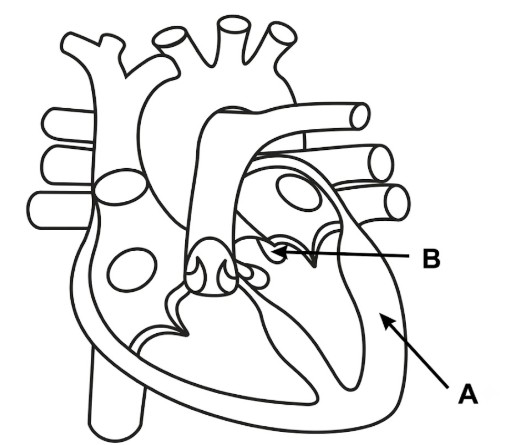
A – Because it pumps blood to the left auricle B – Does not let the blood flow forward
A – Because it pumps blood to the right auricle B – Prevents back flow of blood
A – Because it pumps blood to different parts of the body B – Prevents back flow of blood
A – Because it pumps blood to the pulmonary artery B – Pumps blood to aorta
To answer the questions about the heart, we need to understand the anatomy and function of its parts. The diagram shows a transverse section of the human heart with labels 'A' and 'B'.
Correct Option: C) A – Because it pumps blood to different parts of the body B – Prevents back flow of blood
Select the option that represents the letters that, when placed from left to right in the same sequence in the blanks below, will complete the letter series.
S X _ A B S _ Y B B S X Y _ B S X _ D B
The problem asks us to identify the sequence of letters that completes a given letter series. We need to look for a repeating pattern or a logical progression within the series.
C) YXCY is the correct option because when these letters are placed in the blanks, the series forms a logical pattern of SXYAB, SXYBB, SXYCB, SXYDB, where the first three letters (SXY) and the last letter (B) are constant in each block, and the fourth letter progresses alphabetically (A, B, C, D).