
The question asks for the term that defines the percentage of deposits banks must hold as reserves. This is a fundamental concept in banking and monetary policy, specifically related to how central banks regulate the liquidity and lending capacity of commercial banks.
A) Cash Reserve Ratio (CRR) — The Cash Reserve Ratio (CRR) is the percentage of a bank's total deposits (Net Demand and Time Liabilities - NDTL) that it must keep as cash reserves with the central bank (RBI) at all times. This amount cannot be used for lending or investment purposes. It is a key monetary policy tool used by the RBI to control liquidity in the banking system and influence inflation.
The question asks to identify the element that has the hardest natural allotrope. This requires knowledge of common allotropes of the given elements and their properties, specifically hardness.
D) C — Carbon's allotrope, diamond, is the hardest known natural material. Its exceptional hardness stems from its crystal structure where each carbon atom is covalently bonded to four other carbon atoms in a tetrahedral arrangement, forming a very strong, rigid network.
This problem involves calculating the profit-sharing ratio in a partnership where partners invest different amounts for different durations. The profit-sharing ratio is directly proportional to the product of each partner's investment and the duration of their investment.
A) 2 : 1 — This is the correct ratio derived from the product of investment and time for both partners.
The given series is an alternating series, meaning it consists of two interleaved sub-series. We need to identify the pattern in each sub-series to find the missing term.
D) 38 is the correct answer because it follows the established pattern of subtracting 10 in the first sub-series.
To identify the correct name of a carbon compound with a three-carbon chain and a ketone group, we need to understand the IUPAC nomenclature rules for organic compounds. Specifically, we'll focus on the prefixes for carbon chain length and suffixes for functional groups.
Correct Option: B) Propanone is the correct name for a three-carbon compound with a ketone group. Its chemical formula is \(\text{CH}_3\text{COCH}_3\).
To determine Pintu's final direction from his house, we need to track his movements in the North-South and East-West directions separately. We will calculate the net displacement in each cardinal direction.
Correct Option: C) South-west
Find the value of \(\frac{\tan A}{1-\cot A}+\frac{\cot A}{1-\tan A}\) is
sec A cosec A − 1
cosec A cos A + 1
sec A cosec A + 1
sec A sin A + 1
To simplify the given trigonometric expression, we will convert all terms into sine and cosine functions. Then, we will find a common denominator and combine the fractions. Finally, we will use trigonometric identities to simplify the expression to one of the given options.
The given expression is:
\[ \frac{\tan A}{1-\cot A} + \frac{\cot A}{1-\tan A} \]Convert \(\tan A\) and \(\cot A\) into sine and cosine:
\(\tan A = \frac{\sin A}{\cos A}\)
\(\cot A = \frac{\cos A}{\sin A}\)
Substitute these into the expression:
\[ \frac{\frac{\sin A}{\cos A}}{1-\frac{\cos A}{\sin A}} + \frac{\frac{\cos A}{\sin A}}{1-\frac{\sin A}{\cos A}} \]Simplify the denominators:
\[ \frac{\frac{\sin A}{\cos A}}{\frac{\sin A - \cos A}{\sin A}} + \frac{\frac{\cos A}{\sin A}}{\frac{\cos A - \sin A}{\cos A}} \]Invert and multiply:
\[ \frac{\sin A}{\cos A} \cdot \frac{\sin A}{\sin A - \cos A} + \frac{\cos A}{\sin A} \cdot \frac{\cos A}{\cos A - \sin A} \] \[ = \frac{\sin^2 A}{\cos A (\sin A - \cos A)} + \frac{\cos^2 A}{\sin A (\cos A - \sin A)} \]Notice that \((\cos A - \sin A) = -(\sin A - \cos A)\). Rewrite the second term:
\[ = \frac{\sin^2 A}{\cos A (\sin A - \cos A)} + \frac{\cos^2 A}{-\sin A (\sin A - \cos A)} \] \[ = \frac{\sin^2 A}{\cos A (\sin A - \cos A)} - \frac{\cos^2 A}{\sin A (\sin A - \cos A)} \]Combine the fractions with a common denominator \(\sin A \cos A (\sin A - \cos A)\):
\[ = \frac{\sin^2 A \cdot \sin A - \cos^2 A \cdot \cos A}{\sin A \cos A (\sin A - \cos A)} \] \[ = \frac{\sin^3 A - \cos^3 A}{\sin A \cos A (\sin A - \cos A)} \]Use the algebraic identity \(a^3 - b^3 = (a-b)(a^2+ab+b^2)\), where \(a = \sin A\) and \(b = \cos A\):
\[ = \frac{(\sin A - \cos A)(\sin^2 A + \sin A \cos A + \cos^2 A)}{\sin A \cos A (\sin A - \cos A)} \]Cancel out the common term \((\sin A - \cos A)\) (assuming \(\sin A \neq \cos A\)):
\[ = \frac{\sin^2 A + \cos^2 A + \sin A \cos A}{\sin A \cos A} \]Use the identity \(\sin^2 A + \cos^2 A = 1\):
\[ = \frac{1 + \sin A \cos A}{\sin A \cos A} \]Separate the terms:
\[ = \frac{1}{\sin A \cos A} + \frac{\sin A \cos A}{\sin A \cos A} \] \[ = \frac{1}{\sin A \cos A} + 1 \]Recall that \(\frac{1}{\sin A} = \csc A\) and \(\frac{1}{\cos A} = \sec A\):
\[ = \sec A \csc A + 1 \]C) sec A cosec A + 1 is the correct answer, which matches our simplified expression.
Simplify:
(731)2−(269)2=?
The problem asks us to simplify the expression \((731)^2 - (269)^2\). This expression is in the form of \(a^2 - b^2\), which is a common algebraic identity. We can use the difference of squares formula, \(a^2 - b^2 = (a - b)(a + b)\), to simplify the calculation.
Thus, the simplified value of \((731)^2 - (269)^2\) is \(462000\).
C) 462000 is the correct answer, as derived from the step-by-step calculation using the difference of squares formula.
The problem presents a number series, and we need to find the pattern to determine the missing number. We will analyze the relationship between consecutive terms to identify the underlying rule.
The operations are alternating between addition and multiplication, and the number involved in the operation is increasing by 1 each time.
Following this pattern, the next operation should be multiplication by 5.
A) 350 is the correct answer because it follows the established pattern of alternating multiplication and addition with sequentially increasing numbers.
Study the given diagram carefully and answer the questions. The numbers in different sections indicate the number of employees.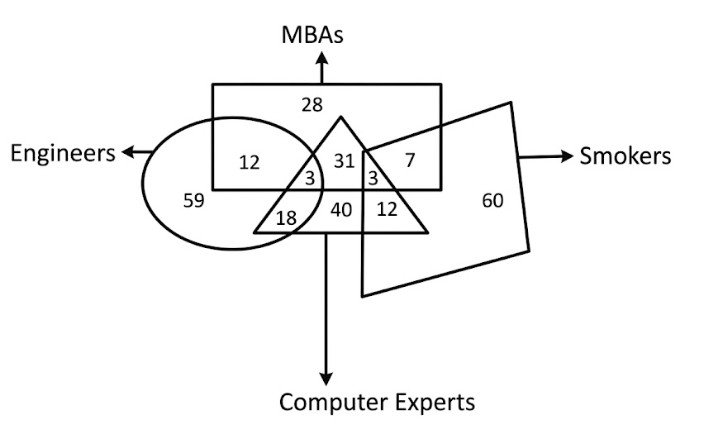
How many employees with MBA degrees are computer experts but are NOT engineers and also don’t smoke?
To solve this problem, we need to identify the section of the diagram that represents employees who have MBA degrees, are computer experts, but are neither engineers nor smokers.
Correct Option: A) 11