
This problem involves the concept of work and time, specifically related to pipes filling a tank. We need to determine the individual rates of the pipes based on their relative speeds and then use their combined rate to find the time taken by pipe A alone.
Define the rates of the pipes: Let the rate at which pipe A fills the tank be \(x\) units/hour. This means pipe A can fill \(1/x\) of the tank in one hour.
Relate the rates of pipes B and C to A: We are given that pipe B is twice as fast as pipe A. So, the rate of pipe B is \(2x\) units/hour.
We are given that pipe C is twice as fast as pipe B. So, the rate of pipe C is \(2 \times (\text{rate of B}) = 2 \times (2x) = 4x\) units/hour.
Calculate the combined rate of pipes A, B, and C: When all three pipes work together, their combined rate is the sum of their individual rates:
\[ \text{Combined rate} = \text{Rate of A} + \text{Rate of B} + \text{Rate of C} \] \[ \text{Combined rate} = x + 2x + 4x = 7x \text{ units/hour} \]Use the given information about the combined filling time: The tank is filled in 4 hours by all three pipes working together. This means that in 1 hour, they fill \(1/4\) of the tank. So, their combined rate is \(1/4\) of the tank per hour.
Equate the combined rate expressions: We have two expressions for the combined rate:
\[ 7x = \frac{1}{4} \]Solve for \(x\): \[ x = \frac{1}{4 \times 7} = \frac{1}{28} \] This means pipe A fills \(1/28\) of the tank in one hour.
Calculate the time taken by pipe A alone: If pipe A fills \(1/28\) of the tank in one hour, then to fill the entire tank (1 unit of work), it will take the reciprocal of its rate:
\[ \text{Time taken by A} = \frac{1}{\text{Rate of A}} = \frac{1}{x} = \frac{1}{1/28} = 28 \text{ hours} \]Correct Option: B) 28 hours
The question asks to identify the dignitary who launched the "Dare2eraD TB" initiative by the Department of Biotechnology, Ministry of Science & Technology, on World TB Day. This requires knowledge of recent government initiatives and the officials involved.
C) Dr. Jitendra Singh — He was the Union Minister of State (Independent Charge) for Science & Technology when the "Dare2eraD TB" initiative was launched on World TB Day 2022.
To find the least number that must be added to 2488 so that it is completely divisible by 3, 4, 5, and 6, we first need to find the Least Common Multiple (LCM) of these divisors. Then, we will divide 2488 by the LCM and find the remainder. The difference between the LCM and the remainder will be the number to be added.
First, we list the prime factors of each number:
To find the LCM, we take the highest power of each prime factor present:
\[ \text{LCM}(3, 4, 5, 6) = 2^2 \times 3^1 \times 5^1 = 4 \times 3 \times 5 = 60 \]We perform the division:
\[ 2488 \div 60 \]\[ 2488 = 60 \times Q + R \]\[ 2488 = 60 \times 41 + 28 \]Here, \(Q = 41\) (quotient) and \(R = 28\) (remainder).For 2488 to be completely divisible by 60, the remainder should be 0. Since the remainder is 28, we need to add a number to 2488 such that the sum is the next multiple of 60. The next multiple of 60 after \(60 \times 41\) is \(60 \times 42\).
The number to be added is the difference between the LCM and the remainder:
\[ \text{Number to be added} = \text{LCM} - \text{Remainder} \]\[ \text{Number to be added} = 60 - 28 = 32 \]If we add 32 to 2488, we get:
\[ 2488 + 32 = 2520 \]Now, we check if 2520 is divisible by 60:\[ 2520 \div 60 = 42 \]Since 2520 is perfectly divisible by 60, and 60 is the LCM of 3, 4, 5, and 6, 2520 is also perfectly divisible by 3, 4, 5, and 6. The least number added is 32.A) 32 — As calculated, adding 32 to 2488 makes it 2520, which is perfectly divisible by 60 (the LCM of 3, 4, 5, and 6).
The question asks to identify the correct statements about the Law of Demand in economics. We need to evaluate each statement individually based on established economic principles.
C) Both a and b are correct statements. Statement (a) accurately defines the Law of Demand, and statement (b) correctly identifies the Law of Diminishing Marginal Utility as a foundation for the Law of Demand.
The figure below shows refraction of a ray of light AB through a triangular glass prism. Here, ∠ EOD represents: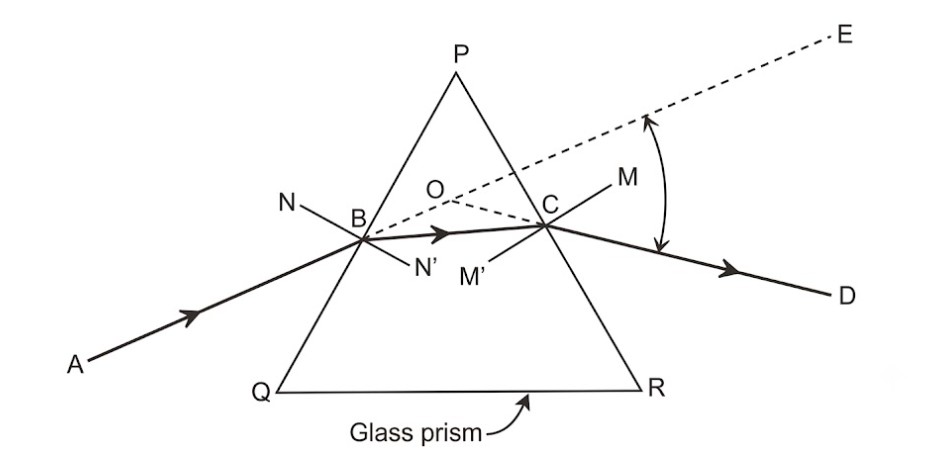
angle of incidence
angle of emergence
angle of refraction
angle of deviation
In the refraction of light through a prism, the angle of deviation is an important concept. It is the angle between the incident ray and the emergent ray.
Correct Option: D) angle of deviation
The problem requires us to modify a given set of 3-digit numbers according to a specific rule and then count how many of these modified numbers satisfy a divisibility condition. We need to add 2 to the hundreds digit of each number, and then check if the new hundreds digit is exactly divisible by the tens digit of the original number.
D) 3
Which of the following is an example of a thermal decomposition reaction?
2H₂O → 2H₂ + O₂
2NaCl (molten) → 2Na + Cl₂
ZnCO₃ → ZnO + CO₂
2AgCl → 2Ag + Cl₂
To identify a thermal decomposition reaction, we need to look for a reaction where a single compound breaks down into two or more simpler substances upon heating. The key characteristic is the input of heat energy to cause the decomposition.
Correct Option: C) \(\text{ZnCO}_3 \to \text{ZnO} + \text{CO}_2\) is an example of a thermal decomposition reaction because zinc carbonate breaks down into zinc oxide and carbon dioxide upon heating.
When a number divides several other numbers leaving the same remainder, the difference between any two of these numbers must be perfectly divisible by that number. Therefore, to find the greatest such number, we need to find the HCF (Highest Common Factor) of the differences between the given numbers.
Let the given numbers be \(a = 8954\), \(b = 9806\), and \(c = 11297\).
Let the greatest number be \(x\) and the common remainder be \(r\). According to the problem statement:
\[ 8954 = q_1 x + r \]\[ 9806 = q_2 x + r \]\[ 11297 = q_3 x + r \]Subtract the numbers from each other to eliminate the remainder \(r\):
Difference between the second and first number:
\[ b - a = 9806 - 8954 = 852 \]Difference between the third and second number:
\[ c - b = 11297 - 9806 = 1491 \]Difference between the third and first number:
\[ c - a = 11297 - 8954 = 2343 \]The greatest number \(x\) must be a common factor of these differences: \(852\), \(1491\), and \(2343\). To find the greatest such number, we need to calculate the HCF of these differences.
Find the HCF of \(852\), \(1491\), and \(2343\).
First, find the HCF of \(852\) and \(1491\) using the Euclidean algorithm:
\[ 1491 = 1 \times 852 + 639 \]\[ 852 = 1 \times 639 + 213 \]\[ 639 = 3 \times 213 + 0 \]The HCF of \(852\) and \(1491\) is \(213\).
Now, find the HCF of \(213\) and the third difference, \(2343\):
\[ 2343 = 11 \times 213 + 0 \]The HCF of \(213\) and \(2343\) is \(213\).
Therefore, the HCF of \(852\), \(1491\), and \(2343\) is \(213\).
Let's verify this. If we divide the numbers by \(213\):
In each case, the remainder is \(8\).
B) 213 is the greatest number by which when 8954, 9806 and 11297 are divided, the remainder in each case is the same.
Six persons, L, M, N, O, P and Q, have cooking classes in different months of the same year, viz. February, March, June, August, September and December. P has the class immediately before Q. Only M has the class before O. L has the class immediately after N and before Q. Which of the following is correct?
Q has the class in February.
M has the class in March.
P has the class in September
L has the class in June.
The problem involves arranging six persons (L, M, N, O, P, Q) in six different months (February, March, June, August, September, December) based on given conditions. We will use a step-by-step deduction process to determine the correct order of classes and then identify the correct statement among the options.
C) P has the class in September.
From our final arrangement, P has the class in September. This statement is correct.
This is a seating arrangement problem. We need to deduce the positions of W, X, Y, and Z around a square table based on the given clues and then identify who is sitting opposite to X.
Visualize the setup: Four friends are sitting at the corners of a square table, facing the center. This means there are four positions, and each person has one person opposite them and two people adjacent to them (one to the immediate right, one to the immediate left).
Use the clue: "W is to the immediate right of Y."
Let's place Y first. If Y is at one corner, then W must be at the corner immediately to Y's right. For example:
  [ ]
 Y  W
  [ ]
(Assuming we are looking from above, and 'right' is clockwise).
Use the clue: "W and Z are not at the opposite corners."
Since W is already placed, we know where Z cannot be. The person opposite W is not Z. In a square, if W is at one corner, the person opposite W is the corner diagonally across from it. The remaining two corners are adjacent to W.
Deduce Z's position:
We have four positions. Let's label them 1, 2, 3, 4 clockwise.
  1   2
  4   3
If Y is at position 4, then W is at position 3 (immediate right of Y).
  1   2
 Y(4) W(3)
The person opposite W (position 3) is position 1. Since W and Z are not opposite, Z cannot be at position 1. The only remaining position for Z is position 2.
  Z(2)
 Y(4) W(3)
Place X:
Now, all positions except one are filled. The remaining person is X, and the remaining position is 1.
  X(1) Z(2)
 Y(4) W(3)
Identify who is opposite X:
In our arrangement, X is at position 1. The person opposite position 1 is position 3. The person at position 3 is W.
A) W is sitting opposite to X. Based on our step-by-step deduction, X is at position 1 and W is at position 3, making them opposite each other.