
Select the option that represents the letters that, when placed from left to right in the same sequence in the blanks below, will complete the letter series.
G _ Q _ A _ T _ N _ G T Q N _ G _ Q N D
T N G Q B C T
T A G N B C T
T G G Q B C Q
T N G Q B Q C
The problem asks us to complete a letter series by identifying the repeating pattern. We need to fill in the blanks with letters from the given options to form a logical sequence.
Correct Option: A) T N G Q B C T
When these letters are placed in the blanks, the series becomes: G T Q N A G T Q N B G T Q N C G T Q N D. This reveals a clear pattern of "GTQN" followed by a sequential letter (A, B, C, D).
Which group of the modern periodic table is NOT mentioned in Mendeleev’s periodic table?
Chalcogen group
Noble gas group
Halogen group
Pnictogen group
The question asks to identify which group of elements, present in the modern periodic table, was not included in Mendeleev's original periodic table. This requires knowledge of the historical development of the periodic table, specifically the elements known and classified during Mendeleev's time.
Correct Option: B) Noble gas group. The noble gases were unknown at the time Mendeleev constructed his periodic table and were discovered much later, leading to their addition as a separate group (Group 0 or 18) in later versions of the periodic table.
The problem presents a series of number pairs and asks us to find the missing number in the last pair based on the relationship observed in the previous pairs. We need to identify the pattern that connects the first number to the second number in each given pair.
Analyze the first pair: 8 : 67
Let the first number be \(N_1 = 8\) and the second number be \(N_2 = 67\).
We can try to find a relationship involving squaring the first number and adding/subtracting a small value.
If we square \(N_1\): \(8^2 = 64\).
To get \(67\) from \(64\), we add \(3\): \(64 + 3 = 67\).
So, the pattern for the first pair seems to be \(N_1^2 + 3 = N_2\).
Analyze the second pair: 10 : 103
Let the first number be \(N_3 = 10\) and the second number be \(N_4 = 103\).
Let's check if the same pattern \(N^2 + 3\) holds true.
Square \(N_3\): \(10^2 = 100\).
Add \(3\): \(100 + 3 = 103\).
This matches \(N_4\). So, the pattern \(N^2 + 3\) is consistent.
Apply the pattern to the third pair: 17 : ?
Let the first number be \(N_5 = 17\). We need to find \(N_6\).
Using the established pattern \(N^2 + 3\):
\[ N_6 = N_5^2 + 3 \] \[ N_6 = 17^2 + 3 \]Calculate \(17^2\):
\[ 17 \times 17 = 289 \]Now, add \(3\):
\[ N_6 = 289 + 3 \] \[ N_6 = 292 \]Correct Option: B) 292
The question asks for the specific year when the Municipal Corporation in Calcutta (now Kolkata) was established by a royal charter. This is a factual question related to the history of urban local self-government in India during the British colonial period.
B) 1726 is the correct year when the Municipal Corporation in Calcutta was set up by a royal charter. This charter also established similar corporations in Madras and Bombay.
The question asks for the theme of World Wetland Day 2022. To answer this, one needs to recall the specific theme designated for that year's celebration.
Correct Option: D) Wetlands’ action for people and nature
In the following diagram, R = Students, P = Boys, W = Girls, and Z = Psychology. The numbers in different sections indicate the number of persons. How many girls are psychology students?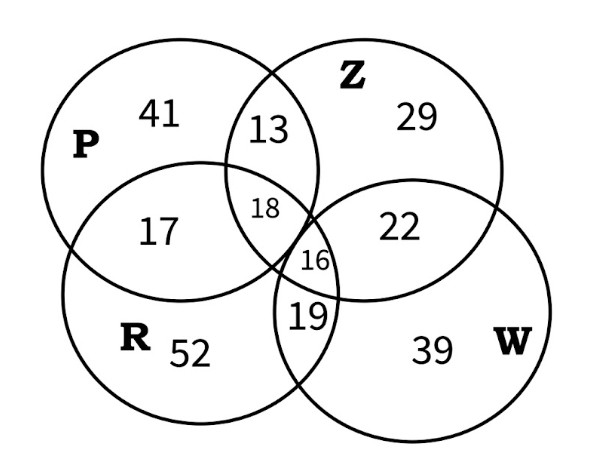
To find the number of girls who are psychology students, we need to identify the intersection between the sets labeled "W" (Girls) and "Z" (Psychology) in the Venn diagram.
Correct Option: C) 16
The question asks for the most suitable material for electrical transmission lines. The ideal material for transmission lines should possess high electrical conductivity, reasonable mechanical strength, and be economically viable. We will evaluate the given options based on these criteria.
D) Copper is widely used for electrical transmission lines and wiring due to its excellent electrical conductivity, good mechanical strength, ductility, and reasonable cost.
The problem asks us to evaluate two arguments in relation to a given statement. The statement claims that private schools increased fees due to rising costs. We need to determine if each argument weakens or strengthens this claim.
A) Both arguments I and II weaken the statement. As analyzed, both a reduction in taxes and a cut in salaries would lead to lower costs for schools, thereby undermining their claim of rising costs as a reason for increasing fees.
The question asks about the presence of aerenchyma cells in different plants. Aerenchyma is a specialized tissue found in plants that live in aquatic or waterlogged environments. Its primary function is to facilitate gas exchange and provide buoyancy.
A) Common water hyacinth — As an aquatic plant, the common water hyacinth requires aerenchyma for buoyancy and efficient gas exchange to its submerged parts, which often experience oxygen deficiency.
To find the time taken for the faster train to cross the slower train when both are moving in the same direction, we need to calculate their relative speed and the total distance they need to cover to cross each other. The total distance will be the sum of their lengths.
When one train crosses another, the total distance covered is the sum of their lengths.
\[ \text{Total Distance} (D) = L_1 + L_2 = 320 \text{ m} + 380 \text{ m} = 700 \text{ m} \]Since both trains are moving in the same direction, their relative speed is the difference between their individual speeds.
\[ \text{Relative Speed} (S_{\text{rel}}) = S_1 - S_2 = 84 \text{ km/h} - 42 \text{ km/h} = 42 \text{ km/h} \]To convert km/h to m/s, multiply by \(\frac{5}{18}\).
\[ S_{\text{rel}} = 42 \times \frac{5}{18} \text{ m/s} = \frac{7 \times 5}{3} \text{ m/s} = \frac{35}{3} \text{ m/s} \]Time is calculated by dividing the total distance by the relative speed.
\[ \text{Time} (T) = \frac{\text{Total Distance}}{\text{Relative Speed}} = \frac{700 \text{ m}}{\frac{35}{3} \text{ m/s}} \]\[ T = 700 \times \frac{3}{35} \text{ s} = (20 \times 3) \text{ s} = 60 \text{ s} \]The faster train will cross the slower train in 60 seconds.
Correct Option: C) 60 sec