
{[(54.36×0.4)+0.256]÷\(\sqrt{121}\)} equals:
To solve this problem, we need to follow the order of operations (BODMAS/PEMDAS): Brackets/Parentheses, Orders (powers and square roots), Division and Multiplication (from left to right), Addition and Subtraction (from left to right). We will simplify the expression step-by-step.
Thus, the value of the given expression is 2.
Correct Option: B) 2
The given table shows the number of people of various age groups visiting a park in a locality. Find the modal age (in years) of visitors (rounded off to one decimal place).
| Age (years) | Number of persons |
| 0 - 10 | 4 |
| 10 - 20 | 14 |
| 20 - 30 | 18 |
| 30 - 40 | 23 |
| 40 - 50 | 27 |
| 50 - 60 | 16 |
| 60 - 70 | 8 |
To find the modal age for grouped data, we first identify the modal class, which is the class interval with the highest frequency. Then, we use the formula for the mode of grouped data to calculate the exact modal value.
| Age (years) | Number of persons (Frequency, \(f\)) |
|---|---|
| 0 - 10 | 4 |
| 10 - 20 | 14 |
| 20 - 30 | 18 |
| 30 - 40 | 23 |
| 40 - 50 | 27 |
| 50 - 60 | 16 |
| 60 - 70 | 8 |
Correct Option: B) 42.7
The question asks to identify the recipient of the CSIR Young Scientist Award in 2021. This requires knowledge of specific awards and their recipients, which is a factual recall question often found in current affairs or general knowledge sections of competitive exams.
A) Dr. K Giribabu received the CSIR Young Scientist Award in 2021 for his significant contributions in the field of Chemical Sciences. He was recognized for his work at the CSIR-Indian Institute of Chemical Technology (IICT), Hyderabad.
Which Act provided constitutional status to the Panchayati Raj institutions?
73rd Constitutional Amendment Act 1990
73rd Constitutional Amendment Act 1992
73rd Constitutional Amendment Act 1991
73rd Constitutional Amendment Act 1993
The question asks to identify the specific Constitutional Amendment Act that granted constitutional status to Panchayati Raj institutions. This requires knowledge of Indian constitutional history, particularly the amendments related to local self-governance.
Correct Option: B) 73 rd Constitutional Amendment Act 1992
The question asks to identify the class of carbon compounds that contain a carbon-carbon double bond. This requires knowledge of basic organic chemistry nomenclature and classification of hydrocarbons based on their bonding.
B) Unsaturated compounds. Compounds containing carbon-carbon double bonds (or triple bonds) are classified as unsaturated because they do not contain the maximum possible number of hydrogen atoms and can undergo addition reactions.
To find the mode of a dataset, we need to identify the value that appears most frequently. We will list the given data points and count the occurrences of each unique value.
C) 3 — The value 3 appears 3 times in the given dataset, which is the highest frequency among all the numbers. Therefore, 3 is the mode.
The question asks to identify the wrestler who won her maiden Commonwealth Games gold medal in the 62 kg category at the Commonwealth Games 2022. This requires knowledge of the results and specific achievements of Indian wrestlers at that event.
Correct Option: A) Sakshi Malik
The question asks to identify the instrument used to measure heartbeats. We need to evaluate each given option to determine its function and select the one that corresponds to measuring heartbeats.
B) Stethoscope — A stethoscope is used by medical professionals to auscultate (listen to) the internal sounds of the body, including heart sounds, which allows them to count heartbeats and assess their rhythm and quality.
In the given figure, l1 is parallel to l2 and p is their transversal with angle 4 = 5x + 35 and angle 7 = 45°. Find the value of x.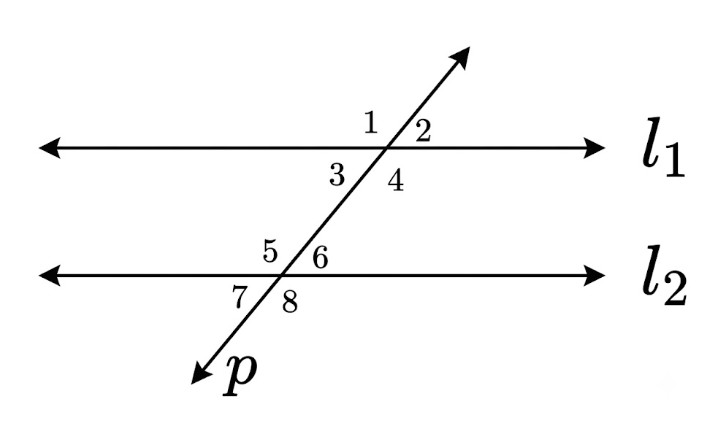
To find the value of \(x\), we use the properties of parallel lines and a transversal. Specifically, we use the fact that alternate interior angles are equal when two lines are parallel.
Thus, the value of \(x\) is \(2^\circ\).
Correct Option: C) 20°
This is a logical deduction problem based on seating arrangement (or in this case, floor arrangement). We need to use the given clues to determine the exact floor on which each person lives and then identify who lives on floor number 5.
Identify the floors: There are 6 floors, numbered 1 to 6.
Clue 1: I does not live on an odd-numbered floor.
This means I lives on an even-numbered floor: 2, 4, or 6.
Clue 2: J lives immediately above K and immediately below H.
This implies a block arrangement: H - J - K. These three people must occupy three consecutive floors.
Combine Clue 1 and Clue 2:
Since H, J, K must be on consecutive floors, and I cannot be on an odd floor, let's consider the possible positions for the H-J-K block:
Clue 3: I lives between G and K.
This means the arrangement is G - I - K or K - I - G. Since we already know J lives immediately above K, the sequence H - J - K is established. If I is between G and K, and J is immediately above K, then K cannot be immediately below I. Therefore, the arrangement must be G - I - K, and J must be above K. This means the overall sequence is G - I - K - J - H (or H - J - K - I - G). However, the clue states J is immediately above K, and I is between G and K. This implies K is below J. So, the sequence is H - J - K. Now, I is between G and K. This means G - I - K. Combining these, we get G - I - K - J - H is not possible as J is above K. The only way for I to be between G and K, and J to be immediately above K, is if K is the lowest of the H-J-K block and I is below K, which contradicts J being immediately above K. Let's re-evaluate. If I is between G and K, it means G, I, K are on consecutive floors, or at least in that order. If J is immediately above K, then K is below J. So, the sequence H-J-K is fixed. If I is between G and K, and K is part of H-J-K, then I must be below K. So, G-I-K is the order. This means G-I-K-J-H is the overall order from lowest to highest, or highest to lowest. But J is immediately above K, so K is below J. This means the arrangement is H-J-K. If I is between G and K, then K must be above I. So, G-I-K. This implies the order is G-I-K and then J is above K, and H is above J. This is contradictory. Let's re-read carefully: "I lives between G and K." and "J lives immediately above K and immediately below H."
From "J lives immediately above K and immediately below H", we have the block:
H
J
K
From "I lives between G and K", we have two possibilities for the order of G, I, K:
1. G
I
K
OR
2. K
I
G
Now let's combine these. Since J is immediately above K, K cannot be immediately above I if I is between G and K. This means the order G-I-K must be from top to bottom, or bottom to top, but K must be below J. So, we have H-J-K. If I is between G and K, and K is below J, then I must be below K. So the sequence is G-I-K. This means G, I, K are in that order. So, G-I-K and H-J-K. This implies the order from top to bottom is H, J, K, I, G. Let's verify. J is above K. H is above J. I is between G and K. This arrangement fits: H, J, K, I, G. So the order from top to bottom is H, J, K, I, G.
Now we have the sequence of people from top to bottom: H, J, K, I, G. These are 5 people. There is one more person, L.
Apply Clue 1 again: I does not live on an odd-numbered floor.
I must live on an even floor: 2, 4, or 6.
Apply Clue 4: Neither J nor H live on the lowest floor (floor 1).
This is consistent with the H-J-K-I-G sequence, as G would be on floor 1.
Let's try placing the H, J, K, I, G sequence on the floors.
The sequence H, J, K, I, G occupies 5 consecutive floors. The remaining person L will occupy the 6th floor.
Possible placements for H, J, K, I, G (from top to bottom):
Let's confirm all conditions with Case 2:
All conditions are met with this arrangement.
Identify who lives on floor number 5.
Based on the confirmed arrangement, H lives on floor number 5.
C) H