
The question asks about the relationship between the heat generated due to Joule's heating effect and the current flowing through a conductor. This can be determined by recalling Joule's Law of Heating.
Correct Option: A) square of the current
The heat generated \(H\) due to Joule's heating effect is directly proportional to the square of the current (\(I^2\)), as given by the formula \(H = I^2 R t\).
The value of \(\frac{(0.42)^{2}+36(0.05)^{2}}{9(0.21)^{2}+(0.45)^{2}}\) is
\( \frac{2}{9} \)
\( \frac{5}{18} \)
\( \frac{2}{3} \)
\( \frac{4}{9} \)
The problem asks us to evaluate a given expression involving squares of decimal numbers. The key to solving this efficiently is to recognize common factors or relationships between the numbers in the numerator and the denominator, which can simplify the expression significantly. We will look for ways to factor out common terms or express numbers as multiples of others to cancel terms.
Let the given expression be \(E\):
\[ E = \frac{(0.42)^{2}+36(0.05)^{2}}{9(0.21)^{2}+(0.45)^{2}} \]Observe the numbers in the numerator: \(0.42\) and \(0.05\). Also, \(36\) is \(6^2\).
Observe the numbers in the denominator: \(0.21\) and \(0.45\). Also, \(9\) is \(3^2\).
Let's try to find relationships between the numbers. Notice that \(0.42 = 2 \times 0.21\).
Also, \(0.45 = 9 \times 0.05\).
Substitute these relationships into the expression:
Numerator:
\[ (0.42)^2 + 36(0.05)^2 = (2 \times 0.21)^2 + 6^2 \times (0.05)^2 \]\[ = 2^2 \times (0.21)^2 + (6 \times 0.05)^2 \]\[ = 4 \times (0.21)^2 + (0.30)^2 \]Denominator:
\[ 9(0.21)^2 + (0.45)^2 = 3^2 \times (0.21)^2 + (9 \times 0.05)^2 \]\[ = 9 \times (0.21)^2 + 9^2 \times (0.05)^2 \]\[ = 9 \times (0.21)^2 + 81 \times (0.05)^2 \]Now, let's substitute the simplified numerator and denominator back into the expression for \(E\):
\[ E = \frac{4 \times (0.21)^2 + (0.30)^2}{9 \times (0.21)^2 + 81 \times (0.05)^2} \]Let's re-examine the numerator: \(4 \times (0.21)^2 + (0.30)^2\). We know \(0.30 = 6 \times 0.05\). So, \((0.30)^2 = (6 \times 0.05)^2 = 36 \times (0.05)^2\).
So, the numerator is \(4 \times (0.21)^2 + 36 \times (0.05)^2\).
Now, let's look at the denominator: \(9 \times (0.21)^2 + 81 \times (0.05)^2\).
We can factor out \(9\) from the denominator:
\[ 9 \times (0.21)^2 + 81 \times (0.05)^2 = 9 \left( (0.21)^2 + 9 \times (0.05)^2 \right) \]Let's try to express the terms in the numerator and denominator using a common base. Let \(a = 0.21\) and \(b = 0.05\).
Numerator: \((0.42)^2 + 36(0.05)^2 = (2a)^2 + 36b^2 = 4a^2 + 36b^2\)
Denominator: \(9(0.21)^2 + (0.45)^2 = 9a^2 + (9b)^2 = 9a^2 + 81b^2\)
Substitute these back into the expression:
\[ E = \frac{4a^2 + 36b^2}{9a^2 + 81b^2} \]Factor out common terms from the numerator and denominator:
Numerator: \(4a^2 + 36b^2 = 4(a^2 + 9b^2)\)
Denominator: \(9a^2 + 81b^2 = 9(a^2 + 9b^2)\)
Now, substitute these factored forms back into the expression for \(E\):
\[ E = \frac{4(a^2 + 9b^2)}{9(a^2 + 9b^2)} \]Since \(a^2 + 9b^2\) is a common factor in both the numerator and the denominator, and it's not zero (as \(a=0.21\) and \(b=0.05\)), we can cancel it out:
\[ E = \frac{4}{9} \]D) \( \frac{4}{9} \) is the correct answer, as derived by simplifying the expression through factoring common terms.
Aditya can complete a piece of work alone in 8 days and Bhagawan can complete the same piece of work alone in 12 days. They started the work together, but Aditya had to leave 3 days before the completion of the work. In how many days will the work be complete?
6 \( \frac{3}{5} \) days
6 \( \frac{4}{5} \) days
6 \( \frac{1}{5} \) days
6 \( \frac{2}{5} \) days
This problem involves work and time. We need to calculate the individual work rates, then consider the combined work rate, and finally account for one person leaving before completion. A common approach is to find the total work as the LCM of individual days, then calculate daily work units.
A) \(6 \frac{3}{5}\) days is the total time taken to complete the work, as calculated by summing the time they worked together and the time Bhagawan worked alone.
The correct increasing order of metallic character is:
Ge < Ga < Sc < Ca
Ge < As < Ga < Ca
Ge < Zn < Cu < As
Ca < Ga < Ge < As
To determine the correct increasing order of metallic character, we need to recall the periodic trends for metallic character. Metallic character generally decreases across a period from left to right and increases down a group. We will locate each element in the periodic table and compare their positions.
All the elements listed (Ge, Ga, Sc, Ca, As, Zn, Cu) are in Period 4. According to the trend, metallic character decreases from left to right across a period.
Their order in Period 4 from left to right is: Ca (Group 2) < Sc (Group 3) < ... < Cu (Group 11) < Zn (Group 12) < Ga (Group 13) < Ge (Group 14) < As (Group 15).
Therefore, the order of decreasing metallic character is: Ca > Sc > Cu > Zn > Ga > Ge > As.
The order of increasing metallic character is: As < Ge < Ga < Zn < Cu < Sc < Ca.
Correct Option: A) Ge < Ga < Sc < Ca
Study the given diagram carefully and answer the question. The numbers in different sections indicate the number of persons.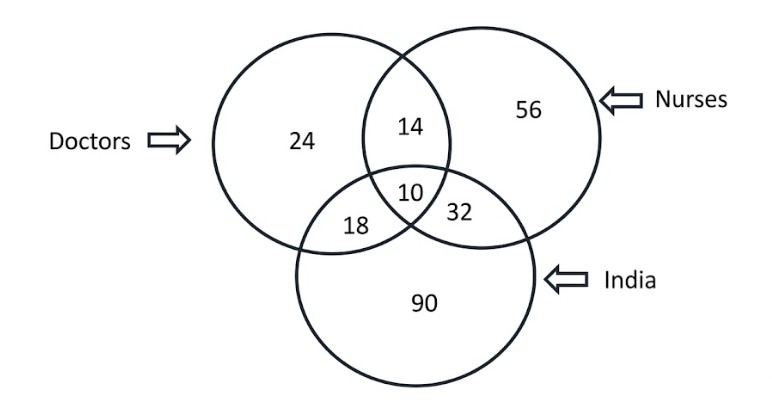
How many such nurses are there who are from India but are NOT doctors?
To solve this problem, we need to identify the number of nurses who are from India but are not doctors using the Venn diagram provided.
Correct Option: A) 32
If x = (\(\sqrt{2352}\) ÷ \(\sqrt{1200}\)) ÷ \(\sqrt{0.04}\), then the value of \( \frac{x+1}{x-1} \) is:
\( \frac{3}{2} \)
\( \frac{4}{3} \)
\( \frac{2}{3} \)
\( \frac{3}{4} \)
The problem requires us to first simplify the expression for \(x\) and then substitute its value into the expression \( \frac{x+1}{x-1} \). The simplification of \(x\) involves operations with square roots and decimals.
Given: \( x = (\sqrt{2352} \div \sqrt{1200}) \div \sqrt{0.04} \)
First, simplify the division within the parenthesis:
\[ \frac{\sqrt{2352}}{\sqrt{1200}} = \sqrt{\frac{2352}{1200}} \]\[ \frac{2352}{1200} = \frac{1176}{600} = \frac{588}{300} = \frac{294}{150} = \frac{147}{75} \]\[ \sqrt{\frac{147}{75}} = \sqrt{\frac{49 \times 3}{25 \times 3}} = \sqrt{\frac{49}{25}} = \frac{\sqrt{49}}{\sqrt{25}} = \frac{7}{5} \]Now substitute \( x=7 \) into the expression \( \frac{x+1}{x-1} \):
\[ \frac{x+1}{x-1} = \frac{7+1}{7-1} \]\[ \frac{7+1}{7-1} = \frac{8}{6} \]\[ \frac{8}{6} = \frac{4}{3} \]B) The value of \( \frac{x+1}{x-1} \) is \( \frac{4}{3} \).
The question asks to identify the Light Combat Aircraft (LCA) designed and manufactured in India from the given options. This requires knowledge of prominent Indian aerospace projects and their names.
The Light Combat Aircraft (LCA) project was initiated to develop a multirole light fighter aircraft for the Indian Air Force and Indian Navy. This indigenous project resulted in the aircraft named Tejas.
Correct Option: D) Tejas is the name of the Light Combat Aircraft (LCA) designed and manufactured in India. It is a single-engine, delta wing, multirole light fighter developed by the Aeronautical Development Agency (ADA) in collaboration with Hindustan Aeronautics Limited (HAL) for the Indian Air Force and Indian Navy.
The question asks about the primary biological function of the sticky gum substance produced by some plants. This requires understanding plant metabolism and the classification of plant products.
Correct Option: D) It is a waste product of metabolism.
The question asks to identify the Indian state for which Brahma Kamal is the state flower. This requires knowledge of the state symbols of various Indian states.
Correct Option: D) Uttarakhand is the correct answer. Brahma Kamal (Saussurea obvallata) is indeed the state flower of Uttarakhand. It is a sacred flower in Hindu mythology and is found at high altitudes in the Himalayan region.
The problem requires us to transform each letter in the word 'CLIPBOARD' based on specific rules: vowels are changed to the next letter in the alphabet, and consonants are changed to the previous letter. After this transformation, we need to count the number of vowels in the newly formed group of letters.
D) Two. After applying the given rules, the new group of letters formed is B K J O A P B Q C. In this group, the vowels are 'O' and 'A'. Therefore, there are two vowels.