
To solve this problem, we first need to determine the initial number of boys and girls in the school using the given total number of students and their ratio. Then, we will add the specified number of new girls to the count of girls and calculate the new ratio of boys to girls.
Calculate the initial number of boys and girls:
The total number of students in the school is 480.
The ratio of boys to girls is \(7 : 9\).
The sum of the ratio parts is \(7 + 9 = 16\).
Number of boys \(= \frac{7}{16} \times 480\)
\[ \text{Number of boys} = \frac{7}{16} \times 480 = 7 \times 30 = 210 \]
Number of girls \(= \frac{9}{16} \times 480\)
\[ \text{Number of girls} = \frac{9}{16} \times 480 = 9 \times 30 = 270 \]
So, initially there are 210 boys and 270 girls.
Add the new girls:
3 more girls are admitted to the school.
New number of girls \(= 270 + 3 = 273\).
The number of boys remains the same, which is 210.
Calculate the new ratio:
The new ratio of boys to girls is \(210 : 273\).
To simplify this ratio, we need to find the greatest common divisor (GCD) of 210 and 273.
Let's divide both numbers by common factors:
\[ \frac{210}{3} = 70 \]
\[ \frac{273}{3} = 91 \]
So the ratio becomes \(70 : 91\).
\[ \frac{70}{7} = 10 \]
\[ \frac{91}{7} = 13 \]
The simplified new ratio of boys to girls is \(10 : 13\).
Correct Option: C) 10 : 13
In the given figure, l ∥ m and p ∥ q. The value of x is: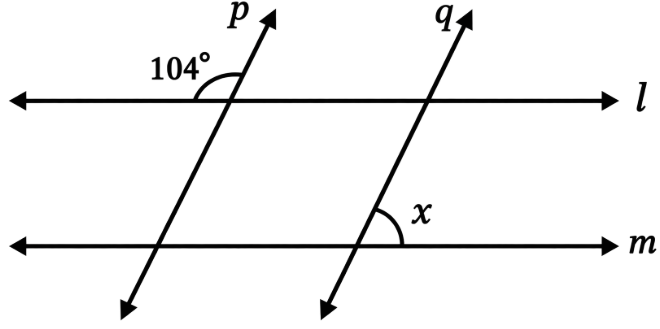
In the given diagram, lines \(l\) and \(m\) are parallel, as are lines \(p\) and \(q\). We need to find the value of angle \(x\) using the properties of parallel lines and transversals.
Correct Option: C) 76°
This question is about a chemical reaction, specifically a displacement reaction, between iron and copper sulphate solution. We need to identify the colour change that occurs when iron reacts with copper sulphate.
A) brown. The iron nail gets coated with reddish-brown copper metal, which is displaced from the copper sulphate solution by the more reactive iron.
The problem asks us to identify the number of consonants in a given letter series that are immediately preceded by a vowel and immediately followed by a vowel. We need to go through the series letter by letter, identify vowels and consonants, and then check for the specified pattern (Vowel - Consonant - Vowel).
A) 2 is the correct answer because we found two consonants (P and Q) that satisfy the given condition of being immediately preceded by a vowel and immediately followed by a vowel.
The question asks about the location of the first step of cellular respiration, specifically the breakdown of glucose into pyruvate. This process is known as glycolysis, and its cellular location is a fundamental concept in biology.
C) Cytoplasm is the site where glycolysis, the initial breakdown of glucose into pyruvate, occurs. This process does not require oxygen and is common to both aerobic and anaerobic respiration.
The question asks about the fate of various flower parts (stamens, style, stigma, petal, and sepal) after fertilization. Fertilization marks the beginning of fruit and seed development, leading to changes in the floral structures.
C) They shed off except sepal which may be persistent in some plants. This option accurately describes that most floral parts (stigma, style, stamens, petals) shed off after fertilization, while sepals, though generally shed, can be persistent in certain plant species.
The given series consists of numbers that appear to be perfect squares. We need to identify the pattern of these squares to find the missing number.
Correct Option: B) 169
The problem presents a series of number pairs where the second number is related to the first number by a specific mathematical operation. We need to identify this relationship and apply it to the last given number to find the missing value.
Correct Option: D) 90
We are given the list price of a tie and its final selling price after two successive discounts. We know the percentage of the second discount and need to find the first discount percentage. We will work backward from the final selling price, applying the second discount to find the price after the first discount, and then calculate the first discount percentage.
Let the price after the first discount be \( P_1 \). If the first discount is \( D_1\% \), then
\[ P_1 = \text{List Price} \times \left(1 - \frac{D_1}{100}\right) \]\[ P_1 = 120 \times \left(1 - \frac{D_1}{100}\right) \]The second discount of \( 9\% \) is applied to \( P_1 \). So, the Final Selling Price is:
\[ \text{Final Selling Price} = P_1 \times \left(1 - \frac{9}{100}\right) \]\[ 90 = P_1 \times \left(1 - 0.09\right) \]\[ 90 = P_1 \times 0.91 \]A) 17.58% is the calculated first discount percentage when rounded to two decimal places.
The problem presents a proportion in the format \(A : B :: C : D\). This notation means that the ratio of A to B is equal to the ratio of C to D. We need to find the value of X by setting up an equation based on this proportionality and solving for X.
Thus, the value of \(X\) is 625.
Correct Option: D) 625