
The average propensity to consume (APC) is a fundamental concept in macroeconomics that measures the proportion of total income that is consumed. It is calculated by dividing total consumption (C) by total disposable income (Y).
The formula for the average propensity to consume (APC) is:
\[ \text{APC} = \frac{\text{Consumption (C)}}{\text{Income (Y)}} \]Given values are:
Substitute these values into the formula:
\[ \text{APC} = \frac{400}{1000} \]Perform the division:
\[ \text{APC} = 0.4 \]C) 0.4 is the correct answer. The average propensity to consume is calculated as Consumption divided by Income, which is \(400 / 1000 = 0.4\).
To find the critical angle for a glass-air interface, we use the formula for total internal reflection. The critical angle (\(i_c\)) is related to the refractive indices of the two media by Snell's Law. When light travels from a denser medium (glass) to a rarer medium (air), total internal reflection occurs if the angle of incidence exceeds the critical angle. At the critical angle, the angle of refraction is 90 degrees.
The critical angle (\(i_c\)) for light going from a medium with refractive index \(n_1\) to a medium with refractive index \(n_2\) (where \(n_1 > n_2\)) is given by:
\[ \sin i_c = \frac{n_2}{n_1} \]Here, \(n_1 = 1.56\) (glass) and \(n_2 = 1\) (air).
\[ \sin i_c = \frac{1}{1.56} \]Rounding to two decimal places, we get:
\[ \sin i_c \approx 0.64 \]The question asks to identify which feature of the Indian government is a direct result of its federal structure. We need to understand the core characteristics of a federal system and then evaluate each option against this understanding.
Correct Option: B) Two-tier government – Union and State
The existence of two distinct levels of government, the Union (Central) and the States, each with its own powers and responsibilities as defined by the Constitution, is the most direct and fundamental manifestation of India's federal structure. Federalism inherently implies a division of governmental power across multiple levels.
This question tests knowledge of the general formulas for different classes of hydrocarbons. Each class (alkanes, alkenes, alkynes) has a specific general formula relating the number of carbon atoms (\(n\)) to the number of hydrogen atoms.
Correct Option: D) Alkyne — The general formula \(C_n H_{2n-2}\) represents alkynes, which are hydrocarbons containing at least one carbon-carbon triple bond.
Study the given Venn diagram carefully and answer the question that follows.
The numbers in different sections indicate the number of gardeners assigned to the following tasks:
A = Watering the plants; B = Growing the plants; C = Beautification of park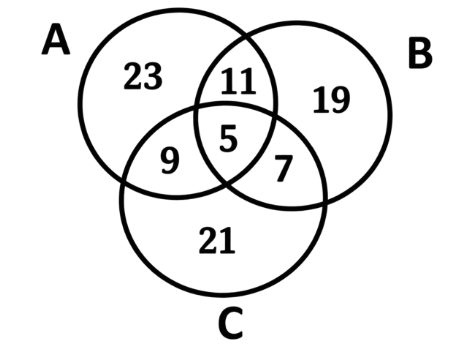
How many such gardeners are there who are assigned the task of only growing new plants?
The question requires identifying the number of gardeners assigned exclusively to the task of growing new plants, represented by circle B in the Venn diagram.
Correct Option: C) 19
The question asks to identify the medical procedure that involves removing nitrogenous waste from the body using an artificial kidney. We need to evaluate each option to determine which one correctly describes this process.
B) Haemodialysis is the process of removing nitrogenous waste from the body using an artificial kidney (dialyzer). It is a life-sustaining treatment for people with kidney failure.
Simplify: \(\frac{(5p-q)^{3}-(3p-2q)^{3}-(q+2p)^{3}}{13pq-15p^{2}-2q^{2}}\)
The problem requires simplifying a complex algebraic expression involving cubes. We can use the algebraic identity \(a^3 + b^3 + c^3 - 3abc = (a+b+c)(a^2+b^2+c^2-ab-bc-ca)\). A special case of this identity is when \(a+b+c=0\), which implies \(a^3+b^3+c^3 = 3abc\). We will try to transform the given numerator into this form.
Let \(a = 5p-q\)
Let \(b = -(3p-2q) = 2q-3p\)
Let \(c = -(q+2p) = -q-2p\)
The numerator can be written as \(a^3 + b^3 + c^3\).
Add the terms \(a\), \(b\), and \(c\):
\[ a+b+c = (5p-q) + (2q-3p) + (-q-2p) \]\[ a+b+c = 5p - 3p - 2p - q + 2q - q \]\[ a+b+c = (5p - 5p) + (-2q + 2q) \]\[ a+b+c = 0 + 0 = 0 \]Since \(a+b+c=0\), we know that \(a^3+b^3+c^3 = 3abc\).
Substitute the values of \(a\), \(b\), and \(c\):
\[ a^3+b^3+c^3 = 3(5p-q)(2q-3p)(-q-2p) \]\[ a^3+b^3+c^3 = 3(5p-q)(2q-3p)(-1)(q+2p) \]\[ a^3+b^3+c^3 = -3(5p-q)(2q-3p)(q+2p) \]First, multiply \((2q-3p)(q+2p)\):
\[ (2q-3p)(q+2p) = 2q(q+2p) - 3p(q+2p) \]\[ = 2q^2 + 4pq - 3pq - 6p^2 \]\[ = 2q^2 + pq - 6p^2 \]Now, multiply this result by \((5p-q)\):\[ (5p-q)(2q^2 + pq - 6p^2) \]\[ = 5p(2q^2 + pq - 6p^2) - q(2q^2 + pq - 6p^2) \]\[ = 10pq^2 + 5p^2q - 30p^3 - 2q^3 - pq^2 + 6p^2q \]\[ = -30p^3 - 2q^3 + 10pq^2 - pq^2 + 5p^2q + 6p^2q \]\[ = -30p^3 - 2q^3 + 9pq^2 + 11p^2q \]So, the numerator is \( -3 \times (-30p^3 - 2q^3 + 9pq^2 + 11p^2q) \). This expansion is getting complex and might not directly simplify with the denominator. Let's re-examine the denominator and look for common factors.The denominator is \(13pq-15p^{2}-2q^{2}\).
Let's try to factor the denominator. It looks like a quadratic expression in terms of \(p\) and \(q\).
Consider the product of \((5p-q)\) and \((2p+q)\) and \((3p-2q)\).
Let's rewrite the original numerator as \((5p-q)^3 + (2q-3p)^3 + (-q-2p)^3\).
Since \(a+b+c=0\), the numerator is \(3abc = 3(5p-q)(2q-3p)(-q-2p)\).
\[ \text{Numerator} = -3(5p-q)(2q-3p)(q+2p) \]Let's expand the product \((2q-3p)(q+2p)\):
\[ (2q-3p)(q+2p) = 2q^2 + 4pq - 3pq - 6p^2 = 2q^2 + pq - 6p^2 \]So, the numerator becomes:\[ -3(5p-q)(2q^2 + pq - 6p^2) \]Now, let's compare the term \((2q^2 + pq - 6p^2)\) with the denominator \((13pq-15p^{2}-2q^{2})\).Notice that \((2q^2 + pq - 6p^2)\) is similar to the denominator, but with different signs and coefficients. Let's try to factor the denominator:
\[ 13pq-15p^{2}-2q^{2} = -(2q^2 - 13pq + 15p^2) \]We need to find two numbers that multiply to \(2 \times 15 = 30\) and add to \(-13\). These numbers are \(-3\) and \(-10\).\[ 2q^2 - 13pq + 15p^2 = 2q^2 - 3pq - 10pq + 15p^2 \]\[ = q(2q - 3p) - 5p(2q - 3p) \]\[ = (q - 5p)(2q - 3p) \]So, the denominator is \( -(q-5p)(2q-3p) = (5p-q)(2q-3p) \).Substitute the factored forms back into the original expression:
\[ \frac{-3(5p-q)(2q-3p)(q+2p)}{(5p-q)(2q-3p)} \]Cancel out the common terms \((5p-q)\) and \((2q-3p)\) from the numerator and denominator:\[ = -3(q+2p) \]\[ = -3q - 6p \]\[ = -6p - 3q \]C) \(-6p - 3q\)
The given reaction is an example of a ______.
Zn(s) + CuSO4(aq) → ZnSO4(aq) + Cu(s)
Double displacement reaction
Displacement reaction
Decomposition reaction
Combination reaction
The question asks to identify the type of chemical reaction represented by the given equation: \( \text{Zn (s) + CuSO}_4 \text{(aq)} \rightarrow \text{ZnSO}_4 \text{(aq) + Cu (s)} \). We need to analyze the reactants and products to determine how the atoms or ions have rearranged.
Correct Option: B) Displacement reaction. In this reaction, a more reactive metal (Zinc) displaces a less reactive metal (Copper) from its salt solution. The Zinc atom replaces the Copper ion in Copper(II) Sulfate, forming Zinc Sulfate and elemental Copper.
The question asks to identify the co-founder of the Home Rule League in Madras, alongside Bal Gangadhar Tilak, with the objective of achieving self-government in India. This requires knowledge of key figures and events in the Indian independence movement, specifically the Home Rule League movement.
Correct Option: B) Annie Besant — Annie Besant, an Irish nationalist and a prominent figure in the Theosophical Society, established the Home Rule League in Madras in September 1916. Her league worked towards the same goal of self-government as Tilak's league, and they often coordinated their efforts.
Simplify the given expression: \( \frac{5}{2} \)x² + 4x + \( \frac{3}{2} \) + \( \frac{x^2}{2} \) − 6x + \( \frac{5}{2} \)
To simplify the given algebraic expression, we need to combine like terms. Like terms are terms that have the same variables raised to the same powers. In this expression, we have terms with \(x^2\), terms with \(x\), and constant terms. We will group these terms together and then perform the addition or subtraction.
Write down the given expression:
\[ \frac{5}{2}x^2 + 4x + \frac{3}{2} + \frac{x^2}{2} - 6x + \frac{5}{2} \]Group the like terms together. We will group terms containing \(x^2\), terms containing \(x\), and constant terms:
\[ \left( \frac{5}{2}x^2 + \frac{x^2}{2} \right) + (4x - 6x) + \left( \frac{3}{2} + \frac{5}{2} \right) \]Combine the \(x^2\) terms:
\[ \frac{5}{2}x^2 + \frac{1}{2}x^2 = \left( \frac{5+1}{2} \right)x^2 = \frac{6}{2}x^2 = 3x^2 \]Combine the \(x\) terms:
\[ 4x - 6x = (4-6)x = -2x \]Combine the constant terms:
\[ \frac{3}{2} + \frac{5}{2} = \frac{3+5}{2} = \frac{8}{2} = 4 \]Now, combine the simplified terms to get the final simplified expression:
\[ 3x^2 - 2x + 4 \]B) \(3x^2 - 2x + 4\). This matches our simplified expression.