
This question is based on divisibility rules. We need to identify which of the given numbers are exactly divisible by 44. Since 44 = 4 × 11, a number must be divisible by both 4 and 11 to be exactly divisible by 44.
A number is exactly divisible by 44 when it satisfies both of the following conditions:
We must apply both rules to each given number.
Divisibility by 4:
The last two digits are 32.
32 ÷ 4 = 8
Therefore, 155232 is divisible by 4.
Divisibility by 11:
Sum of alternating digits = 1 + 5 + 3 = 9
Sum of remaining digits = 5 + 2 + 2 = 9
Difference = 9 - 9 = 0
Therefore, 155232 is divisible by 11.
Verification:
155232 ÷ 44 = 3528
Hence, (a) is exactly divisible by 44.
Divisibility by 4:
The last two digits are 48.
48 ÷ 4 = 12
Therefore, 155248 is divisible by 4.
Divisibility by 11:
Sum of alternating digits = 1 + 5 + 4 = 10
Sum of remaining digits = 5 + 2 + 8 = 15
Difference = 15 - 10 = 5
Since 5 is not divisible by 11, the number is not divisible by 11.
Hence, (b) is not exactly divisible by 44.
Divisibility by 4:
The last two digits are 44.
44 ÷ 4 = 11
Therefore, 156944 is divisible by 4.
Divisibility by 11:
Sum of alternating digits = 1 + 6 + 4 = 11
Sum of remaining digits = 5 + 9 + 4 = 18
Difference = 18 - 11 = 7
Since 7 is not divisible by 11, the number is not divisible by 11.
Hence, (c) is not exactly divisible by 44.
Divisibility by 4:
The last two digits are 92.
92 ÷ 4 = 23
Therefore, 156992 is divisible by 4.
Divisibility by 11:
Sum of alternating digits = 1 + 6 + 9 = 16
Sum of remaining digits = 5 + 9 + 2 = 16
Difference = 16 - 16 = 0
Therefore, 156992 is divisible by 11.
Verification:
156992 ÷ 44 = 3568
Hence, (d) is exactly divisible by 44.
Therefore, only (a) and (d) satisfy the divisibility rule.
Correct Option: B) Only (a) and (d)
Both 155232 and 156992 are divisible by 4 and 11, so they are exactly divisible by 44. The other two numbers fail the divisibility test for 11. Therefore, the correct option is B) Only (a) and (d).
On 1 March 2022, the National Commission for Protection of Child Rights (NCPCR) marked its ________ Foundation Day.
The question asks for the specific foundation day marked by the National Commission for Protection of Child Rights (NCPCR) on 1 March 2022. To answer this, we need to know the establishment year of the NCPCR and then calculate the number of years passed until 2022.
D) The National Commission for Protection of Child Rights (NCPCR) was constituted in March 2007. On 1 March 2022, it marked its 17th Foundation Day. This is based on official announcements and historical records of the organization's anniversaries.
Select the option that is related to the fifth term in the same way as the fourth term is related to the third term and the second term is related to the first term.
DOLPHIN : ALIMEFK :: GROUP : DOLRM :: SHARK :?
The problem presents a series of word analogies. We need to identify the pattern or rule that transforms the first word into the second word in each pair and apply that same rule to the third pair to find the missing term.
D) PEXOH is the correct answer, as derived from applying the -3 alphabetical position shift to each letter of SHARK.
The question asks for the color of ferrous sulfate (\(\text{FeSO}_4\)) before it undergoes thermal decomposition. This is a common observation in chemistry experiments involving iron compounds.
Therefore, the color of ferrous sulfate in its common form, as used in such reactions, is green.
D) Green is the correct answer. Ferrous sulfate, especially its hydrated form (\(\text{FeSO}_4 \cdot 7\text{H}_2\text{O}\)), is typically green.
Amongst six friends A, B, C, D, E and F, each has a different height. Only two people are taller than A. F is not the tallest. E is shorter than B but taller than D. Only one person is shorter than E. B is not taller than F. Who is the second tallest among all the friends?
We need to determine the second tallest person among six friends (A, B, C, D, E, F) based on a series of height comparison statements. We will use a systematic approach to deduce the relative heights of all individuals.
"Only two people are taller than A."
This means A is the third tallest person. If we arrange them from tallest to shortest, A's position is 3rd.
_ _ A _ _ _
"Only one person is shorter than E."
This means E is the second shortest person. If we arrange them from tallest to shortest, E's position is 5th.
_ _ A _ E _
"E is shorter than B but taller than D."
From this, we know B > E > D. Since E is 5th, D must be 6th (the shortest). B must be taller than E, so B can be 1st, 2nd, or 4th.
_ _ A _ E D
"B is not taller than F."
This means F is taller than or equal to B (\(F \ge B\)). Since all heights are different, F must be strictly taller than B (\(F > B\)).
Combining information:
We have the partial order: \(F > B > E > D\).
We know A is 3rd, E is 5th, and D is 6th.
Let's place them in the 6 positions:
1st 2nd 3rd 4th 5th 6th
_ _ A _ E D
Since \(F > B > E\), and E is 5th, B must be 4th or higher. F must be 3rd or higher.
If B is 4th, then F must be 1st or 2nd. This fits with A being 3rd.
So, the arrangement becomes:
1st 2nd 3rd 4th 5th 6th
_ _ A B E D
Now, we have F and C left. F must be taller than B. So F can be 1st or 2nd.
"F is not the tallest."
This means F cannot be 1st. Therefore, F must be 2nd.
This implies the 1st position is taken by C.
So the complete order from tallest to shortest is:
C F A B E D
Identify the second tallest:
Based on the final arrangement, F is the second tallest.
The question asks for the specific name of the cell established by the Government of India in 2016 to promote Korean investment. This requires knowledge of specific government initiatives related to foreign direct investment (FDI) and bilateral economic relations.
Correct Option: A) Korea Plus
Study the given bar graph and answer the following question.
The given bar graph depicts the number of animals in four national parks.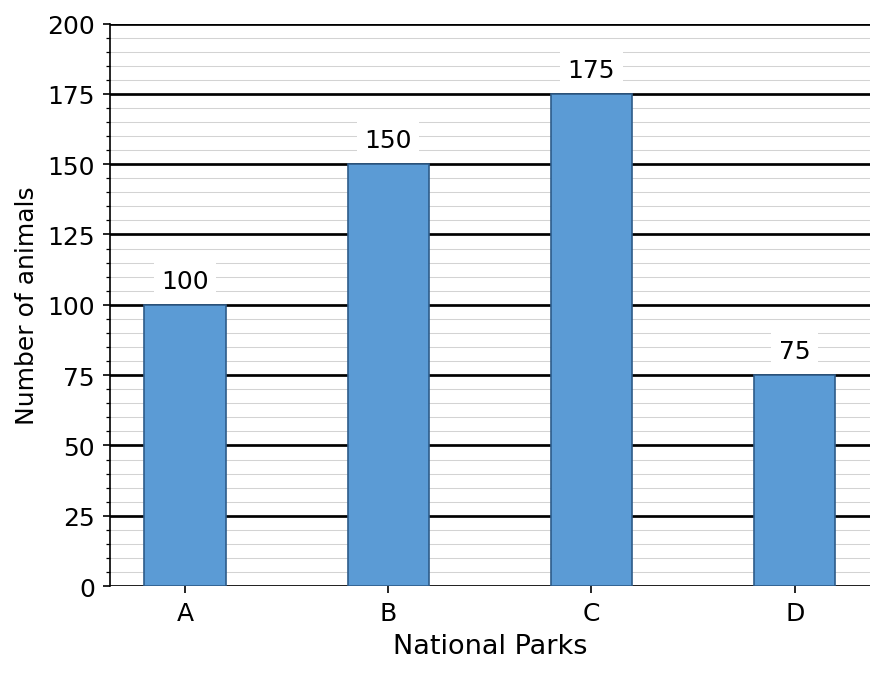
Out of the total number of animals in National Parks A and C together, the respective ratio between the number of herbivores and carnivores was 11 : 14. What was the total number of herbivores in National Parks A and C together?
(All national parks mentioned above contain herbivore and carnivore animals only.)
The problem requires calculating the total number of herbivores in National Parks A and C, given the ratio of herbivores to carnivores.
Thus, the total number of herbivores in National Parks A and C together is 121.
Correct Option: D) 121
Simplify the given expression:
(\(\sqrt{1008}\) ÷ \(\sqrt{448}\)) × \(\sqrt{0.16}\)
To simplify the given expression, we will first simplify each square root term. We will use the property \(\sqrt{a} \div \sqrt{b} = \sqrt{a \div b}\) and \(\sqrt{a \times b} = \sqrt{a} \times \sqrt{b}\). We will also convert the decimal to a fraction inside the square root.
Simplify the first part of the expression: \(\sqrt{1008} \div \sqrt{448}\).
\[ \sqrt{1008} \div \sqrt{448} = \sqrt{\frac{1008}{448}} \]Simplify the fraction inside the square root. We can divide both the numerator and the denominator by common factors. Let's start by dividing by 4:
\[ \frac{1008}{448} = \frac{1008 \div 4}{448 \div 4} = \frac{252}{112} \]Divide by 4 again:
\[ \frac{252}{112} = \frac{252 \div 4}{112 \div 4} = \frac{63}{28} \]Divide by 7:
\[ \frac{63}{28} = \frac{63 \div 7}{28 \div 7} = \frac{9}{4} \]Now, substitute this back into the square root:
\[ \sqrt{\frac{9}{4}} = \frac{\sqrt{9}}{\sqrt{4}} = \frac{3}{2} \]Simplify the second part of the expression: \(\sqrt{0.16}\).
\[ \sqrt{0.16} = \sqrt{\frac{16}{100}} \]Take the square root of the numerator and the denominator:
\[ \sqrt{\frac{16}{100}} = \frac{\sqrt{16}}{\sqrt{100}} = \frac{4}{10} = 0.4 \]Finally, multiply the results from step 5 and step 7:
\[ \frac{3}{2} \times 0.4 \]Convert \(\frac{3}{2}\) to a decimal:
\[ \frac{3}{2} = 1.5 \]Perform the multiplication:
\[ 1.5 \times 0.4 = 0.6 \]D) 0.6 is the correct answer after simplifying the expression.
To find the final direction from the starting point, we need to calculate the net displacement in the North-South direction and the East-West direction. We can assign positive values for North and East movements, and negative values for South and West movements.
Calculate Net Displacement in North-South Direction:
Total North-South displacement:
\[ (-10) + 5 + 3 + 2 = -10 + 10 = 0 \text{ km} \]This means the person is at the same North-South level as the starting point.
Calculate Net Displacement in East-West Direction:
Total East-West displacement:
\[ (-6) + 1 + 2 = -6 + 3 = -3 \text{ km} \]A negative value indicates a displacement towards the West.
Determine Final Position:
Since the net North-South displacement is 0 km and the net East-West displacement is \(-3 \text{ km}\) (3 km West), the person is 3 km to the West of the starting point.
Correct Option: C) West
A dishonest shopkeeper promises to sell his goods at cost price. However, he uses a weight that actually weighs 40% less than what is written on it. Find his profit percentage.
62\( \frac{2}{3} \)%
65\( \frac{2}{3} \)%
66\( \frac{2}{3} \)%
66\( \frac{1}{3} \)%
This problem involves a dishonest shopkeeper who claims to sell goods at cost price but uses a faulty weight. We need to calculate the profit percentage based on the actual weight delivered versus the weight claimed.
Understand the shopkeeper's deception: The shopkeeper promises to sell at cost price, meaning he charges the customer for the weight shown on the scale. However, the actual weight delivered is less.
Assume a convenient value for the marked weight: Let's assume the shopkeeper intends to sell \(1000 \text{ g}\) (or \(1 \text{ kg}\)) of goods. This will be the weight for which the customer pays.
Calculate the actual weight delivered: The weight used actually weighs \(40\%\) less than what is written on it. So, if the shopkeeper shows \(1000 \text{ g}\) on the scale, the actual weight delivered is:
\[ \text{Actual weight} = 1000 \text{ g} - (40\% \text{ of } 1000 \text{ g}) \] \[ \text{Actual weight} = 1000 \text{ g} - \left(\frac{40}{100} \times 1000\right) \text{ g} \] \[ \text{Actual weight} = 1000 \text{ g} - 400 \text{ g} \] \[ \text{Actual weight} = 600 \text{ g} \]So, for every \(1000 \text{ g}\) the customer pays for, they only receive \(600 \text{ g}\).
Determine the cost price (CP) and selling price (SP) in terms of weight:
Let the cost of \(1 \text{ g}\) of goods be \(₹1\). Then:
\[ \text{CP of } 600 \text{ g} = ₹600 \] \[ \text{SP for } 600 \text{ g} (\text{which is charged as } 1000 \text{ g}) = ₹1000 \]Calculate the profit:
\[ \text{Profit} = \text{SP} - \text{CP} \] \[ \text{Profit} = ₹1000 - ₹600 = ₹400 \]Calculate the profit percentage: Profit percentage is always calculated on the cost price.
\[ \text{Profit Percentage} = \left(\frac{\text{Profit}}{\text{CP}}\right) \times 100\% \] \[ \text{Profit Percentage} = \left(\frac{400}{600}\right) \times 100\% \] \[ \text{Profit Percentage} = \left(\frac{2}{3}\right) \times 100\% \] \[ \text{Profit Percentage} = \frac{200}{3}\% \] \[ \text{Profit Percentage} = 66\frac{2}{3}\% \]C) \(66\frac{2}{3}\)\%