
This problem involves calculating the potential difference across a resistor given its resistance and the rate at which heat is produced. We can use Joule's Law of heating, which relates heat produced, current, resistance, and time. Alternatively, we can use the power formula, as heat produced per second is equivalent to power. Once power is known, Ohm's law can be combined with the power formula to find the potential difference.
Heat produced per second is power (\(P\)). So, \(P = 200 \, \text{W}\).
The formula relating power (\(P\)), potential difference (\(V\)), and resistance (\(R\)) is given by:
\[ P = \frac{V^2}{R} \]Multiply both sides by \(R\):
\[ V^2 = P \times R \]Take the square root of both sides:
\[ V = \sqrt{400} \, \text{V} \]\[ V = 20 \, \text{V} \]Correct Option: C) The potential difference across the resistor is 20 volt.
OT 05 is related to SX 07 in a certain way. In the same way, GK 09 is related to KO 11. To which of the following is BG 13 related, following the same logic?
The problem involves identifying a pattern in letter-number codes. We need to analyze the relationship between the letters and numbers in the given pairs and apply the same logic to the third pair.
The established pattern is: each letter advances by 4 positions in the alphabet, and the number increases by 2.
Correct Option: C) FK 15
This is a circular arrangement puzzle. We need to deduce the seating positions of six people (A, B, C, D, E, F) around a circular table based on the given clues. We will start with a definite position and build the arrangement step-by-step.
... E D ...E D, if D is at position 1, B is at position 3 (1st right is empty, 2nd right is B).... E D _ B ...E D _ B, E has D on its immediate right. For A to be an immediate neighbour of E, A must be to the immediate left of E. This also means F must be the other neighbour of A.F A E D _ BF A E D _ B. The only person left is C, and the only spot left is between D and B. So, C must be between D and B.F A E D C B (in a circular order, clockwise).F A E D C B. Starting from A, moving right: 1st right is E, 2nd right is D, 3rd right is C. This matches the clue.F A E D C B, moving counter-clockwise from B, the person immediately to its left is C.C) C is sitting to the immediate left of B, as determined from the step-by-step arrangement.
The question asks for the year in which Article 21-A, concerning the Fundamental Right to compulsory education for children aged six to fourteen years, was inserted into the Constitution of India. This requires knowledge of constitutional amendments related to education.
D) 2002 — The 86th Constitutional Amendment Act, 2002, inserted Article 21-A into the Constitution of India. This article declares that the State shall provide free and compulsory education to all children of the age of six to fourteen years in such manner as the State may, by law, determine.
M, N, O, P, Q and R live on six different floors of the same building. The lowermost floor in the building is numbered 1, the floor above it is numbered 2, and so on till the topmost floor is numbered 6.
Q lives on an odd-numbered floor but not on the lowermost floor. Only one person lives between Q and N. R lives immediately above Q. Only two people live between O and Q. If P lives immediately above R, where does M live?
This is a logical reasoning problem involving arrangement. We need to deduce the floor on which each person lives based on the given clues. We will systematically place each person on a floor, eliminating possibilities as we go, until the arrangement is complete.
Identify the floors: There are 6 floors, numbered 1 to 6.
Clue 1: Q lives on an odd-numbered floor but not on the lowermost floor.
The odd-numbered floors are 1, 3, 5. Since Q does not live on floor 1, Q can live on floor 3 or floor 5.
Clue 2: R lives immediately above Q.
If Q lives on floor 3, R lives on floor 4.
If Q lives on floor 5, R lives on floor 6.
Clue 3: Only one person lives between Q and N.
If Q is on floor 3, N can be on floor 1 or floor 5.
If Q is on floor 5, N can be on floor 3.
Clue 4: Only two people live between O and Q.
If Q is on floor 3, O can be on floor 6 (since R is on 4, and one person is between Q and N, O must be 3+2+1 = 6). Or O can be on floor 1 (3-2-1 = 0, not possible, so O must be above Q).
If Q is on floor 5, O can be on floor 2 (5-2-1 = 2).
Clue 5: P lives immediately above R.
Let's combine the clues and try to form a consistent arrangement.
Case 1: Assume Q lives on floor 3.
Let's check if this arrangement is consistent with all clues:
This arrangement is consistent.
Case 2: Assume Q lives on floor 5.
Therefore, Case 1 is the only valid arrangement.
The final arrangement is:
Answer the question: M lives on the 2nd floor.
D) 2nd floor — As per our step-by-step deduction, M lives on the 2nd floor.
The twinkling of stars is a common atmospheric phenomenon. To understand it, we need to consider how light from distant stars interacts with Earth's atmosphere before reaching our eyes. The key concept here is the change in the optical properties of the atmosphere.
Correct Option: D) atmospheric refraction of starlight
The twinkling of stars is primarily caused by the continuous and random changes in the refractive index of Earth's atmosphere. As starlight passes through these turbulent layers, it undergoes multiple refractions, causing its apparent position and brightness to fluctuate rapidly, which we observe as twinkling.
Select the correct group of statements that support the criteria of being a classical language in India according to the Government of India.
The language in its property should have:
A) High antiquity of its early texts/recorded history over a period of 1500–2000 years.
B) A body of ancient literature/texts, which is considered a valuable heritage by generations of speakers.
C) Original literary tradition that is not borrowed from another speech community.
D) Been spoken by at least two million active speakers.
The question asks to identify the correct set of criteria for a language to be designated as a Classical Language in India, according to the Government of India. This requires knowledge of the specific guidelines established for this designation.
Correct Option: A) A, B and C
The Government of India's criteria for declaring a language as 'Classical' include:
To find the value of \(x\), we need to simplify the left side of the given equation by performing the arithmetic operations in the correct order (BODMAS/PEMDAS). Once the left side is simplified, we can isolate \(x\) to find its value and then determine which range it falls into.
The equation is given as:
\[ 0.045 + 0.154 - 0.09 + 1.5 - (0.3 \times 0.8) = x - 0.231 \]\[ 0.3 \times 0.8 = 0.24 \]So, the left side of the equation simplifies to \(1.369\).
To find \(x\), add \(0.231\) to both sides of the equation:
\[ x = 1.369 + 0.231 \]\[ x = 1.600 \]The value of \(x\) is \(1.6\). We need to find which given range contains \(1.6\).
Correct Option: D) 1.5 and 1.8
To determine the time it takes for an investment to double at a simple interest rate, we use the simple interest formula. The investment doubles when the total amount becomes twice the principal. This means the simple interest earned must be equal to the principal amount itself.
Let the principal amount be \(P\). If the investment doubles, the final amount will be \(2P\).
The simple interest (\(SI\)) earned will be the final amount minus the principal amount:
\[ SI = \text{Final Amount} - \text{Principal Amount} = 2P - P = P \]
The formula for simple interest is:
\[ SI = \frac{P \times R \times T}{100} \]
where:
We are given that the simple interest rate (\(R\)) is 4% per annum. We have already established that \(SI = P\).
Substitute these values into the simple interest formula:
\[ P = \frac{P \times 4 \times T}{100} \]
Now, we need to solve for \(T\). We can cancel \(P\) from both sides (assuming \(P \neq 0\)):
\[ 1 = \frac{4 \times T}{100} \]
Multiply both sides by 100:
\[ 100 = 4 \times T \]
Divide by 4 to find \(T\):
\[ T = \frac{100}{4} = 25 \]
So, it will take 25 years for the investment to double.
Correct Option: A) 25
Study the given diagram carefully and answer the question. The numbers in different sections indicate the number of students speaking various languages.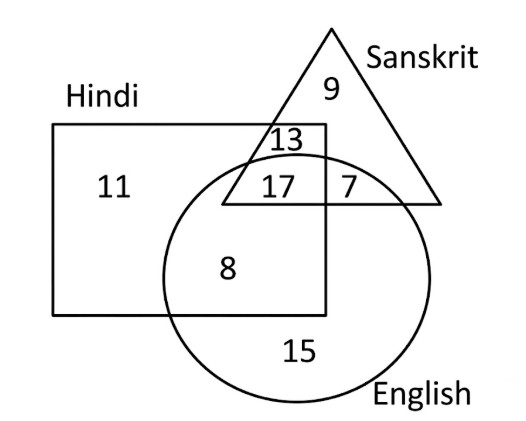
How many students can speak all three languages i.e. Sanskrit, Hindi and English?
The question involves identifying the number of students who can speak all three languages: Sanskrit, Hindi, and English. The diagram provided is a Venn diagram with different sections indicating the number of students speaking various combinations of these languages.
This indicates that 17 students can speak all three languages: Sanskrit, Hindi, and English.
Correct Option: C) 17