
The question describes the order of seven boxes stacked one over the other. We need to place the boxes using the given conditions and then count how many boxes are between T and W.
Identify the given information:
Fix the position of R with respect to Q:
W is immediately above Q.
If R were two places above Q, then T (immediately below R) would be in the place directly above Q, which is W's place. This is not possible.
So, R is two places below Q, and the box between them is unknown.
T is immediately below R.
Place U:
Only one box is kept between R and U.
Two places above R is Q's place, so U must be two places below R, which is directly below T.
Write the arrangement:
From top to bottom: W, Q, (box), R, T, U, with one more box either at the top or at the bottom.
Count the boxes between T and W:
Between W and T are Q, the unknown box and R.
Therefore, 3 boxes are kept between T and W. This does not depend on where the last box is placed.
Correct Option: D) 3 — From top to bottom, the order is W, Q, (box), R, T, U. The boxes between W and T are Q, one unknown box and R, which makes 3. Hence, Option D is the correct answer.
A) 2: This is incorrect because the correct value works out to 3 boxes; this value cannot be obtained mathematically from the given data.
B) 1: This is incorrect because the correct value works out to 3 boxes; this value cannot be obtained mathematically from the given data.
C) 4: This is incorrect because the correct value works out to 3 boxes; this value cannot be obtained mathematically from the given data.
We are given the sum of two natural numbers and their HCF. We need to find the number of possible pairs of these numbers, given an additional condition that one number is greater than the other. We will use the property that if HCF of two numbers is \(h\), then the numbers can be expressed as \(hx\) and \(hy\), where \(x\) and \(y\) are coprime.
Let the two natural numbers be \(x\) and \(y\). We are given:
Since the HCF of \(x\) and \(y\) is 20, we can write \(x = 20a\) and \(y = 20b\), where \(a\) and \(b\) are coprime natural numbers (i.e., \(\text{HCF}(a, b) = 1\)).
Substitute these expressions into the sum equation:
\[ 20a + 20b = 320 \]Divide by 20:
\[ 20(a + b) = 320 \]\[ a + b = \frac{320}{20} \]\[ a + b = 16 \]Now we need to find pairs of natural numbers \((a, b)\) such that their sum is 16 and they are coprime. Also, we are given \(x > y\), which implies \(20a > 20b\), so \(a > b\).
Let's list all pairs \((a, b)\) such that \(a + b = 16\) and \(a > b\):
The valid pairs \((a, b)\) are \((15, 1)\), \((13, 3)\), \((11, 5)\), and \((9, 7)\).
Each of these pairs corresponds to a unique pair of \((x, y)\):
There are 4 such possible pairs of \(x\) and \(y\).
B) 4
The problem requires us to code a given sequence of numbers and symbols based on a provided table and a set of conditions. We need to first find the direct codes for each element from the table and then apply the conditions in the given order to modify the codes if necessary.
D) A T A Y D X — This matches our derived code after applying Condition (iii).
Study the given diagram carefully and answer the question. The numbers in different sections indicate the number of persons living in a village.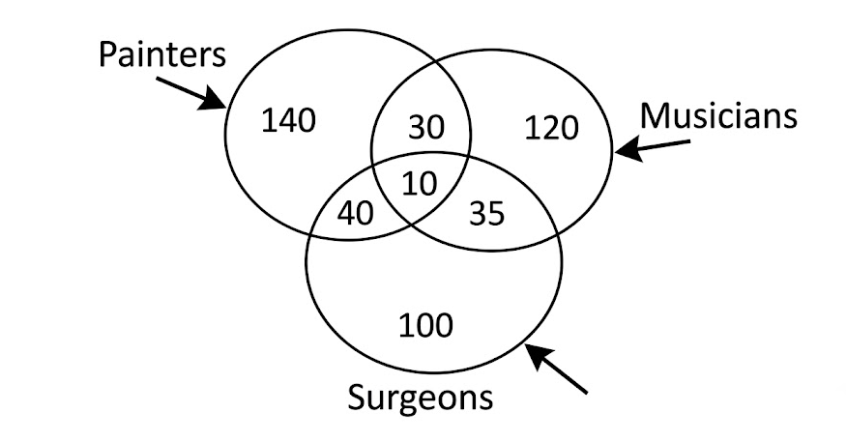
How many surgeons are living in the village?
To find the number of surgeons living in the village, we need to analyze the Venn diagram provided, which shows the distribution of people among different professions: painters, musicians, and surgeons.
Thus, the total number of surgeons in the village is 185.
Correct Option: A) 185
The question gives two letter-cluster pairs, POT : UPQ and EST : UTF, and asks which option follows the same logic. We need to find the rule that changes the first cluster into the second, and then check each option against it.
Identify the given information:
Find the rule using POT : UPQ:
Move each letter of POT one step forward: P→Q, O→P, T→U, giving QPU.
Reverse QPU to get UPQ.
So, the rule is: move each letter one step forward and then reverse the order.
Check the rule with EST : UTF:
E→F, S→T, T→U gives FTU.
Reversing FTU gives UTF. The rule holds.
Apply the rule to each option:
Therefore, only CAT : UBD follows the same logic.
Correct Option: A) CAT : UBD — Each letter of the first cluster moves one step forward and the result is reversed. CAT becomes DBU, which reversed gives UBD. Hence, Option A is the correct answer.
B) TOW : UPU: This is incorrect because applying the rule to TOW gives XPU, not UPU.
C) MEN : NFO: This is incorrect because the letters are moved forward but not reversed; the correct result is OFN.
D) PTU : VUV: This is incorrect because applying the rule to PTU gives VUQ, not VUV.
The problem asks us to modify a given set of 3-letter words by changing each letter to the next letter in the English alphabetical order. Then, we need to count how many of the newly formed words will contain no vowels. The vowels are A, E, I, O, U.
From the analysis, only one word (DSZ) has no vowels.
B) One is the correct answer because only one of the newly formed words (DSZ) contains no vowels.
This question deals with electromagnetic induction, specifically Faraday's Law of Induction and Lenz's Law. Faraday's Law states that the magnitude of the induced electromotive force (EMF) is proportional to the rate of change of magnetic flux. Lenz's Law determines the direction (sign) of the induced EMF, stating that the induced current will flow in a direction that opposes the change in magnetic flux that produced it.
Correct Option: C) The induced potential differences are of the same magnitude(s) and have opposite sign(s) in the above two cases.
The question gives two coding examples: 'ASSURED' is written as 'TTBUEFS' and 'BENEFIT' is written as 'OFCEUJG'. We need to find the rule that changes each word into its code and then apply the same rule to 'CABINET'.
Identify the given information:
Find the pattern using ASSURED:
Split the 7-letter word into three parts: ASS | U | RED.
First part: reverse ASS to SSA, then move each letter one step forward: S→T, S→T, A→B, giving TTB.
Middle letter: U stays as U.
Last part: reverse RED to DER, then move each letter one step forward: D→E, E→F, R→S, giving EFS.
Code: TTB + U + EFS = TTBUEFS.
Check the pattern with BENEFIT:
BEN | E | FIT.
Reverse BEN to NEB, then +1: OFC.
Middle letter E stays as E.
Reverse FIT to TIF, then +1: UJG.
Code: OFC + E + UJG = OFCEUJG. The rule holds.
Apply the rule to CABINET:
CAB | I | NET.
Reverse CAB to BAC, then +1: C, B, D, giving CBD.
Middle letter I stays as I.
Reverse NET to TEN, then +1: U, F, O, giving UFO.
Therefore, CABINET is written as CBDIUFO.
Correct Option: B) CBDIUFO — The first three and last three letters are each reversed and moved one step forward, while the middle letter stays the same. CAB becomes CBD, I stays, and NET becomes UFO. Hence, Option B is the correct answer.
A) DBCIOFU: This is incorrect because it moves the letters forward without reversing the first and last parts.
C) CBDJUFO: This is incorrect because the middle letter I must stay unchanged, not become J.
D) CBDIUFU: This is incorrect because the last part NET must become UFO; this code cannot be obtained from the given rule.
The question asks to identify the digestive enzyme present in saliva. This requires knowledge of the initial stages of digestion and the enzymes involved in breaking down different food components.
Correct Option: A) Amylase is the digestive enzyme present in saliva. It initiates the breakdown of starches into simpler sugars.
The question asks to identify the company booked by the CBI in February 2022 for India's largest bank fraud involving ₹22,842 crore and 28 banks. This is a factual question related to current affairs and major financial frauds in India.
A) ABG Shipyard — In February 2022, the CBI booked ABG Shipyard Ltd. and its directors for allegedly defrauding a consortium of 28 banks of ₹22,842 crore. This was reported as the biggest bank fraud in India's history at that time.