
To balance a chemical equation, we need to ensure that the number of atoms of each element is the same on both the reactant and product sides. We also need to assign appropriate state symbols (g for gas, l for liquid, s for solid, aq for aqueous solution) to each substance involved in the reaction. This specific reaction represents photosynthesis.
\( \text{CO}_2 + \text{H}_2\text{O} \rightarrow \text{C}_6\text{H}_{12}\text{O}_6 + \text{O}_2 + \text{H}_2\text{O} \)
There are 6 carbon atoms on the product side (\(\text{C}_6\text{H}_{12}\text{O}_6\)). So, we need 6 \(\text{CO}_2\) molecules on the reactant side.
\( 6\text{CO}_2 + \text{H}_2\text{O} \rightarrow \text{C}_6\text{H}_{12}\text{O}_6 + \text{O}_2 + \text{H}_2\text{O} \)
There are 12 hydrogen atoms in \(\text{C}_6\text{H}_{12}\text{O}_6\) on the product side. There are also 12 hydrogen atoms in \(6\text{H}_2\text{O}\) on the product side, making a total of 24 hydrogen atoms on the product side. Therefore, we need 24 hydrogen atoms on the reactant side. Since each \(\text{H}_2\text{O}\) molecule has 2 hydrogen atoms, we need \(24/2 = 12\) \(\text{H}_2\text{O}\) molecules on the reactant side.
\( 6\text{CO}_2 + 12\text{H}_2\text{O} \rightarrow \text{C}_6\text{H}_{12}\text{O}_6 + \text{O}_2 + 6\text{H}_2\text{O} \)
Reactant side: \((6 \times 2) \text{ from } \text{CO}_2 + (12 \times 1) \text{ from } \text{H}_2\text{O} = 12 + 12 = 24\) oxygen atoms.
Product side (before balancing \(\text{O}_2\)): \(6 \text{ from } \text{C}_6\text{H}_{12}\text{O}_6 + (6 \times 1) \text{ from } 6\text{H}_2\text{O} = 6 + 6 = 12\) oxygen atoms.
We need \(24 - 12 = 12\) more oxygen atoms on the product side. Since \(\text{O}_2\) has 2 oxygen atoms, we need \(12/2 = 6\) \(\text{O}_2\) molecules.
\( 6\text{CO}_2 + 12\text{H}_2\text{O} \rightarrow \text{C}_6\text{H}_{12}\text{O}_6 + 6\text{O}_2 + 6\text{H}_2\text{O} \)
So the balanced equation with state symbols is:
\( 6\text{CO}_2\text{(g)} + 12\text{H}_2\text{O}\text{(l)} \rightarrow \text{C}_6\text{H}_{12}\text{O}_6\text{(aq)} + 6\text{O}_2\text{(g)} + 6\text{H}_2\text{O}\text{(l)} \)
Correct Option: A) \( 6\text{CO}_2\text{(g)} + 12\text{H}_2\text{O}\text{(l)} \rightarrow \text{C}_6\text{H}_{12}\text{O}_6\text{(aq)} + 6\text{O}_2\text{(g)} + 6\text{H}_2\text{O}\text{(l)} \)
The question asks to identify the Union Minister who, along with Dr. Bharati Pravin Pawar, launched the ICMR/DHR Policy on Biomedical Innovation and Entrepreneurship. This is a factual question related to current affairs and government initiatives in the health sector.
D) Dr. Mansukh Mandaviya — Dr. Mansukh Mandaviya, as the Union Minister for Health and Family Welfare, launched the ICMR/DHR Policy on Biomedical Innovation and Entrepreneurship along with Dr. Bharati Pravin Pawar. This policy aims to foster research and innovation in diagnosis, treatment methods, and vaccines to bring modern health technologies to the people.
The question asks us to identify the true statement(s) regarding the reaction between zinc metal and copper sulphate solution. This involves understanding the reactivity series of metals and the characteristics of a displacement reaction.
D) i — Statement (i) is true because zinc is more reactive than copper and thus displaces copper from copper sulphate solution.
The question asks about the specific incident that led Mahatma Gandhi to call off the Non-Cooperation Movement in February 1922. We need to identify the event that directly caused this decision.
Correct Option: A) The Chauri-Chaura incident directly led to Mahatma Gandhi's decision to end the Non-Cooperation agitation in February 1922 due to his unwavering commitment to non-violence.
The question asks about the function of the long hair-like parts of root epidermal cells. This relates to the primary function of roots in plants, which is water and nutrient absorption from the soil. We need to consider how the structure of these cells aids this function.
Correct Option: A) To enhance the amount of surface area available for absorption
The long, hair-like extensions of root epidermal cells, known as root hairs, are crucial for efficient water and mineral uptake. By greatly increasing the surface area of the root in contact with the soil, they maximize the plant's ability to absorb essential resources from its environment.
The question asks to convert a time given in the 12-hour format (quarter to eight) into the 24-hour format. Understanding the meaning of "quarter to" and the conversion rules between 12-hour and 24-hour formats is key.
B) 19:45 hours is correct because "quarter to eight" means 7:45, and assuming it's in the evening (PM), adding 12 hours to 7 gives 19, making it 19:45 in 24-hour format.
Seven people with the initials of their names G, H, I, J, K, L and M were sipping their tea, sitting around a circular table, facing the centre. They were equidistant from one another. K was sitting to the immediate right of I. Only H was sitting between M and J. L was an immediate neighbour of M. G was sitting third to the right and fourth to the left of J. Who were the immediate neighbours of G?
This is a circular seating arrangement puzzle. We need to deduce the positions of seven people (G, H, I, J, K, L, M) sitting around a circular table, facing the center, based on the given clues. We will place individuals one by one or in blocks based on direct and relative positioning information.
To find the approximate value, we will round off each number to its nearest whole number and then perform the operations in the correct order (division before multiplication).
The equation becomes:
\[ ? = 444 \div 16 \div 37 \times 12 \]First division:
\[ 444 \div 16 \]\[ 444 \div 16 = 27.75 \] (For approximation, we can use \(448 \div 16 = 28\), or simply proceed with \(27.75\))Let's use \(27.75\) for better accuracy, or round \(444/16\) to \(28\). If we use \(28\), then:
\[ 28 \div 37 \] (This will be a small fraction. Let's stick to the original division for now and simplify the expression.)Alternatively, rewrite the divisions as fractions:
\[ ? = \frac{444}{16 \times 37} \times 12 \]Calculate the denominator:
\[ 16 \times 37 = 592 \]\[ ? = \frac{444}{592} \times 12 \]We can simplify the fraction first or multiply directly.
Let's simplify \(\frac{444}{592}\) by dividing both by common factors. Both are divisible by 4:
\[ \frac{444 \div 4}{592 \div 4} = \frac{111}{148} \] (Both are divisible by 37: \(111 = 3 \times 37\), \(148 = 4 \times 37\))\[ \frac{111}{148} = \frac{3}{4} \]A) 9 is the correct approximate value.
Study the given diagram carefully and answer the question. The numbers in different sections indicate the number of persons who like different sports.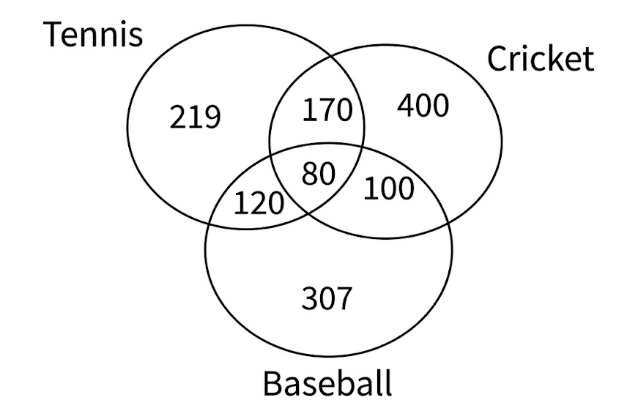
How many people like both cricket and baseball?
To find how many people like both cricket and baseball, we need to identify the section in the Venn diagram that represents the intersection of these two sports.
Correct Option: A) 180
To find the edge of a cube when its volume is given, we need to recall the formula for the volume of a cube. The volume of a cube is calculated by cubing the length of its edge. Therefore, to find the edge, we need to calculate the cube root of the given volume.
The volume \(V\) of a cube with edge length \(a\) is given by:
\[ V = a^3 \]We are given that the volume of the cube is \(729 \text{ cm}^3\). So,
\[ 729 \text{ cm}^3 = a^3 \]To find \(a\), we need to take the cube root of \(729\):
\[ a = \sqrt[3]{729 \text{ cm}^3} \]We need to find a number that, when multiplied by itself three times, equals \(729\). Let's test some integers:
So, the cube root of \(729\) is \(9\).
\[ a = 9 \text{ cm} \]Correct Option: D) 9 cm — The edge of the cube is 9 cm, as \(9^3 = 729\).