
Select the option that is related to the third term in the same way as the second term is related to the first term and the sixth term is related to the fifth term.
7 : 52 :: 11 : ? :: 9 : 84
The problem presents a series of analogies. We need to find the relationship between the numbers in the first pair (7 : 52) and the third pair (9 : 84). Once the pattern is identified, we apply it to the second pair (11 : ?) to find the missing number.
Let the first number be \(N\). We need to find a mathematical operation that transforms 7 into 52.
Let's check if the same pattern holds for the third pair.
Now, we apply the established pattern \(N^2 + 3\) to find the missing number for \(N = 11\).
Therefore, the missing number is 124.
Correct Option: B) 124
Select the set in which the numbers are related in the same way as are the numbers of the given sets.
(NOTE: Operations should be performed on the whole numbers, without breaking down the numbers into their constituent digits. E.g. 13 – Operations on 13 such as adding/subtracting/multiplying etc. to 13 can be performed. Breaking down 13 into 1 and 3 and then performing mathematical operations on 1 and 3 is not allowed.)
(1, 3, 4);
(8, 24, 18)
The question asks for the date on which the second 'Muslim Women Rights Day' was observed in India to commemorate the enactment of the law against Triple Talaq. This requires knowledge of the specific date associated with this observance.
A) 1 August 2021 is the correct date for the second 'Muslim Women Rights Day', as it marks two years since the Triple Talaq law came into effect.
The question asks for the enactment year of the Delhi Land Reforms Act. This requires knowledge of specific historical legislation related to land reforms in India, particularly concerning the Delhi region.
D) 1954 — The Delhi Land Reforms Act was indeed enacted in the year 1954. This act was crucial for abolishing the zamindari system and introducing land reforms in the Delhi region, aligning with the broader land reform agenda across independent India.
The question asks to identify the state where Sarhul is the main festival of the tribal population. This requires knowledge of major tribal festivals and their associated regions in India.
D) Jharkhand — Sarhul is indeed one of the most important and popular tribal festivals in Jharkhand. It marks the beginning of the new year and is celebrated to worship the village deity who is considered the protector of the tribes. The festival is associated with the worship of trees and nature, especially the Sal tree, which is considered sacred.
The question asks for the economic term that defines output per unit of variable input. This is a fundamental concept in the theory of production, relating total output to the amount of a specific input used.
Correct Option: C) Average product is defined as the output per unit of variable input. It measures the productivity of each unit of the variable input.
If pipe A can fill a cistern in X hours, pipe B can fill the same cistern in Y hours, and pipe C can empty the full cistern in Z hours, then find the time taken to completely fill the cistern, if pipes A, B and C are opened together.
\(\frac{XYZ}{YZ+XZ-XY}\)
\(\frac{XYZ}{YZ+XZ+XY}\)
\(\frac{XYZ}{YZ-XZ-XY}\)
\(\frac{XYZ}{YZ-XZ+XY}\)
This problem involves calculating the combined work rate of multiple pipes, some filling and some emptying. We will determine the individual filling/emptying rates per hour and then sum them up to find the net rate. The reciprocal of the net rate will give the total time taken to fill the cistern.
Calculate the filling rate of Pipe A:
Pipe A can fill the cistern in \(X\) hours. So, in one hour, Pipe A fills \(\frac{1}{X}\) of the cistern.
Calculate the filling rate of Pipe B:
Pipe B can fill the cistern in \(Y\) hours. So, in one hour, Pipe B fills \(\frac{1}{Y}\) of the cistern.
Calculate the emptying rate of Pipe C:
Pipe C can empty the cistern in \(Z\) hours. So, in one hour, Pipe C empties \(\frac{1}{Z}\) of the cistern. Since it's emptying, its contribution to filling is negative.
Calculate the net filling rate when all three pipes are opened together:
The net amount of cistern filled in one hour will be the sum of the filling rates minus the emptying rate:
\[ \text{Net rate} = \frac{1}{X} + \frac{1}{Y} - \frac{1}{Z} \]To combine these fractions, find a common denominator, which is \(XYZ\):
\[ \text{Net rate} = \frac{YZ}{XYZ} + \frac{XZ}{XYZ} - \frac{XY}{XYZ} \] \[ \text{Net rate} = \frac{YZ + XZ - XY}{XYZ} \]Calculate the total time taken to fill the cistern:
The total time taken to fill the cistern is the reciprocal of the net filling rate:
\[ \text{Time taken} = \frac{1}{\text{Net rate}} = \frac{1}{\frac{YZ + XZ - XY}{XYZ}} \] \[ \text{Time taken} = \frac{XYZ}{YZ + XZ - XY} \]Correct Option: A) The derived formula \(\frac{XYZ}{YZ+XZ-XY}\) matches option A.
Study the given bar-graph and answer the question that follows. The bar-graph depicts the number of tickets booked for Delhi and Mumbai by Airlines P, Q and R.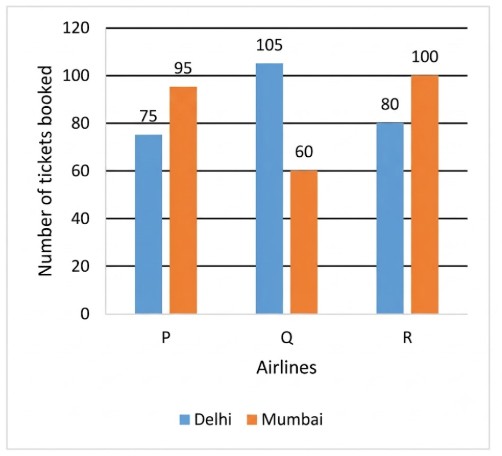
The total number of tickets booked for Mumbai by Airlines Q and R was what per cent more than the number of tickets booked for Delhi by Airline R?
To solve this problem, we need to compare the total number of tickets booked for Mumbai by Airlines Q and R with the number of tickets booked for Delhi by Airline R. The goal is to determine the percentage increase.
\[ \text{Total Mumbai tickets by Q and R} = 60 + 100 = 160 \]
\[ \text{Difference} = 160 - 80 = 80 \]
\[ \text{Percentage Increase} = \left( \frac{\text{Difference}}{\text{Delhi tickets by R}} \right) \times 100 \]
Substitute the values:
\[ \text{Percentage Increase} = \left( \frac{80}{80} \right) \times 100 = 100\% \]
Thus, the total number of tickets booked for Mumbai by Airlines Q and R was 100% more than the number of tickets booked for Delhi by Airline R.
Correct Option: B) 100%
The given statements are followed by three conclusions. Find out which conclusion is true based on the given statements.
Statements: L > M = N ≥ O, P ≥ Q ≤ R = O.
Conclusions:
I. N ≥ O,
II. L > R,
III. M ≥ Q
Only conclusion II is true
Only conclusion III is true
Only conclusion I is true
All conclusions I, II and III are true
This problem involves analyzing inequalities and equalities to determine the truthfulness of given conclusions. We will combine the given statements into a single relational chain and then evaluate each conclusion against this combined chain.
The given statements are:
From the first statement, we have \(L > M\), \(M = N\), and \(N \ge O\). This can be combined as \(L > M = N \ge O\).
From the second statement, we have \(P \ge Q\), \(Q \le R\), and \(R = O\). This can be combined as \(P \ge Q \le R = O\).
Now, we can link these two chains using the common element \(O\). Since \(N \ge O\) and \(R = O\), we can substitute \(O\) with \(R\) in the first chain or \(O\) with \(N\) in the second chain. Let's use \(R = O\).
So, the combined chain becomes:
\[ L > M = N \ge O = R \ge Q \le P \]From the combined statement \(L > M = N \ge O = R \ge Q \le P\), we can directly see that \(N \ge O\). This conclusion is true.
From the combined statement \(L > M = N \ge O = R \ge Q \le P\), we have \(L > M\), \(M = N\), \(N \ge O\), and \(O = R\). Therefore, \(L > M = N \ge O = R\). This implies \(L > R\). This conclusion is true.
From the combined statement \(L > M = N \ge O = R \ge Q \le P\), we have \(M = N\), \(N \ge O\), \(O = R\), and \(R \ge Q\). Therefore, \(M = N \ge O = R \ge Q\). This implies \(M \ge Q\). This conclusion is true.
Since all three conclusions are true, the correct option is D.
D) All conclusions I, II and III are true
The question asks about the chemical behavior of washing soda. To determine this, we need to recall its chemical formula and understand how it behaves when dissolved in water, specifically whether it produces hydrogen ions (\(H^+\)) or hydroxide ions (\(OH^-\)) or neither.
\[ Na_2CO_3(s) \xrightarrow{H_2O} 2Na^+(aq) + CO_3^{2-}(aq) \]
The sodium ions (\(Na^+\)) are spectators as they come from a strong base. However, the carbonate ions (\(CO_3^{2-}\)) are the conjugate base of a weak acid (\(H_2CO_3\)) and will react with water in a process called hydrolysis.\[ CO_3^{2-}(aq) + H_2O(l) ightleftharpoons HCO_3^-(aq) + OH^-(aq) \]
C) It is basic in nature. As explained in the step-by-step analysis, sodium carbonate (washing soda) hydrolyzes in water to produce hydroxide ions, making its aqueous solution basic.