
The problem presents a proportion involving algebraic expressions. The key is to simplify the given ratio and then equate it to the second ratio to solve for the unknown variable \(w\). We will factor out common terms from the expressions to simplify them.
The given proportion is:
\[ x^2y - xy^2 : yz(x - y) :: xa^2 - xb^2 : w \]This can be written as an equality of two ratios:
\[ \frac{x^2y - xy^2}{yz(x - y)} = \frac{xa^2 - xb^2}{w} \]Simplify the left-hand side (LHS) of the equation. Factor out \(xy\) from the numerator:
\[ x^2y - xy^2 = xy(x - y) \]Substitute this back into the LHS:
\[ \frac{xy(x - y)}{yz(x - y)} \]Since it is given that \(x \neq y\), it means \(x - y \neq 0\). Therefore, we can cancel out the \((x - y)\) term from the numerator and the denominator. Also, cancel out \(y\) from the numerator and denominator:
\[ \frac{x \cancel{y} \cancel{(x - y)}}{\cancel{y} z \cancel{(x - y)}} = \frac{x}{z} \]Now, the simplified proportion is:
\[ \frac{x}{z} = \frac{xa^2 - xb^2}{w} \]Simplify the numerator of the right-hand side (RHS) by factoring out \(x\):
\[ xa^2 - xb^2 = x(a^2 - b^2) \]Substitute this back into the RHS:
\[ \frac{x}{z} = \frac{x(a^2 - b^2)}{w} \]Since \(x \neq 0\) (if \(x=0\), the original expression \(x^2y - xy^2\) would be 0, making the ratio undefined or trivial depending on \(y\); assuming \(x \neq 0\) for a meaningful proportion), we can cancel out \(x\) from both sides of the equation:
\[ \frac{\cancel{x}}{z} = \frac{\cancel{x}(a^2 - b^2)}{w} \]This leaves us with:
\[ \frac{1}{z} = \frac{a^2 - b^2}{w} \]To find \(w\), cross-multiply:
\[ w \times 1 = z \times (a^2 - b^2) \]\[ w = z(a^2 - b^2) \]\[ w = za^2 - zb^2 \]A) \(za^2 - zb^2\) is the expression equivalent to \(w\) derived from the simplification of the given proportion.
The question asks for the maximum strength of the Rajya Sabha as of April 2022. This is a factual question related to the Indian parliamentary system. We need to recall the constitutional provisions regarding the composition of the Rajya Sabha.
Correct Option: D) 250 is the maximum strength of the Rajya Sabha as per the Indian Constitution.
As on August 2022, under the Pradhan Mantri Jeevan Jyoti Bima Yojana (PMJJBY), the life cover of Rs. _______ lakhs shall be for the one year period stretching from 1st June to 31st May and will be renewable.
The question asks about the life cover amount provided under the Pradhan Mantri Jeevan Jyoti Bima Yojana (PMJJBY) as of August 2022. This is a factual question related to a government social security scheme, requiring knowledge of its specific provisions.
B) 2 — The Pradhan Mantri Jeevan Jyoti Bima Yojana (PMJJBY) offers a life cover of Rs. 2 lakhs for the one-year period from 1st June to 31st May, which is renewable annually. This amount was consistent as of August 2022.
If the volume of a sphere is 4851 cm³, then find the radius of the sphere. [Use π = \( \frac{22}{7} \)]
To find the radius of the sphere, we will use the formula for the volume of a sphere and substitute the given volume. We will then solve the equation for the radius.
The volume \(V\) of a sphere with radius \(r\) is given by:
\[ V = \frac{4}{3} \pi r^3 \]We are given the volume \(V = 4851 \text{ cm}^3\) and \(\pi = \frac{22}{7}\). Substituting these into the formula:
\[ 4851 = \frac{4}{3} \times \frac{22}{7} \times r^3 \]Multiply both sides by \(\frac{21}{88}\):
\[ r^3 = 4851 \times \frac{21}{88} \]First, simplify the terms. We can divide 4851 by 11:
\[ 4851 \div 11 = 441 \]And \(88 \div 11 = 8\). So the equation becomes:
\[ r^3 = 441 \times \frac{21}{8} \] \[ r^3 = \frac{441 \times 21}{8} \]We know that \(441 = 21^2\). So,
\[ r^3 = \frac{21^2 \times 21}{8} \] \[ r^3 = \frac{21^3}{2^3} \]Take the cube root of both sides:
\[ r = \sqrt[3]{\frac{21^3}{2^3}} \] \[ r = \frac{21}{2} \] \[ r = 10.5 \text{ cm} \]Correct Option: B) 10.5 cm
The question asks to identify which Fundamental Right encompasses the 'Protection of life and personal liberty' according to the Indian Constitution. This requires knowledge of the various Fundamental Rights and their specific articles.
Correct Option: B) Right to Freedom. Article 21, which guarantees the 'Protection of life and personal liberty', is a part of the Right to Freedom, enumerated in Articles 19-22 of the Indian Constitution.
We need to determine the seating arrangement of seven students (A, B, C, D, E, F, G) in a row facing North based on the given clues. We will build the arrangement step-by-step and then identify the student at the fifth position from the left end.
_ _ _ D _ _ _
_ _ _ D _ A _
_ B _ D _ A _
_ B _ D G A _
_ B F D G A _
C B F D G A _
C B F D G A E
The final arrangement from left to right is: C, B, F, D, G, A, E.
The positions are:
Therefore, G stands fifth from the left end of the row.
D) G is the student standing fifth from the left end of the row.
The question asks for the definition of a self-sustaining ecosystem. A self-sustaining ecosystem is one that can maintain its structure and function over time without significant external inputs, primarily by recycling matter and utilizing an external energy source.
A) The organic matter remains almost constant generation over generation. This statement accurately describes a key aspect of a self-sustaining ecosystem. In such an ecosystem, the rate of production of organic matter by producers is balanced by its consumption and decomposition by consumers and decomposers. This continuous cycling ensures that the total amount of organic matter remains relatively stable over time, allowing the ecosystem to persist without external inputs of matter.
How does the following organism (Amoeba) get rid of its nitrogenous wastes?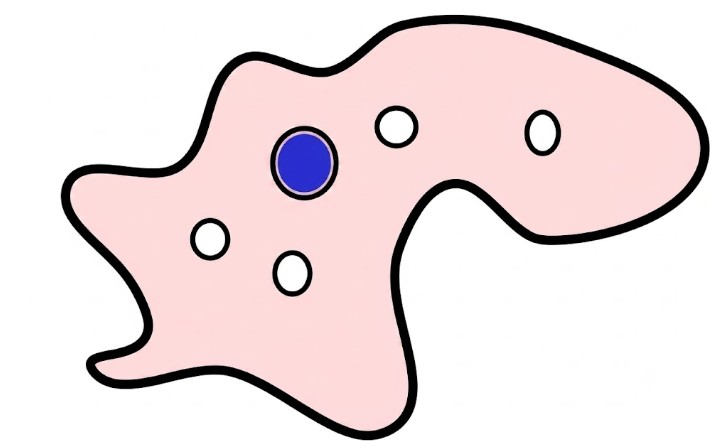
Through excretory vacuoles
By simple diffusion
By secretion
By depositing crystals in vacuoles
Amoeba is a simple, single-celled organism that lacks specialized excretory structures. Understanding how it manages waste is crucial for biology students.
Correct Option: B) By simple diffusion
Which of the following statements is INCORRECT about Mendel's pea plant experiments?
He took a tall plant and a short plant, produced progeny by crossing them and in the resulting F1 progeny, all plants were tall
Mendel used a number of contrasting visible characters of garden peas – round/wrinkled seeds, tall/short plants.
Mendel conducted his experiments on the garden pea (Pisum sativum).
In the second-generation, or F2 generation which are the progeny of the F1 tall plants, all the plants are tall.
The question asks to identify the incorrect statement regarding Mendel's pea plant experiments. We need to recall the fundamental principles of Mendelian genetics, particularly the results of the F1 and F2 generations in monohybrid crosses.
Correct Option: D) In the second-generation, or F2 generation which are the progeny of the F1 tall plants, all the plants are tall. — This statement is incorrect because in the F2 generation, Mendel observed both tall and short plants in a 3:1 ratio, not all tall plants.
To simplify the given algebraic expression, we need to first expand the terms by applying the distributive property, then combine like terms, and finally arrange the terms in descending order of their powers of \(x\).
Apply the distributive property to \(3x(x - 9)\):
\[ 3x(x - 9) = (3x)(x) - (3x)(9) = 3x^2 - 27x \]The original expression is \(3x(x - 9) - 9x^2 + 2x + 24 - x^3\). Substituting the expanded term, we get:
\[ (3x^2 - 27x) - 9x^2 + 2x + 24 - x^3 \]Now, remove the parentheses and group like terms together. It's often helpful to arrange them in descending order of powers of \(x\) from the start.
\[ -x^3 + 3x^2 - 9x^2 - 27x + 2x + 24 \]Putting all the combined terms together in descending order of powers of \(x\):
\[ -x^3 - 6x^2 - 25x + 24 \]The options typically list the constant term first or last. Rearranging to match the format of the given options:
\[ 24 - 25x - 6x^2 - x^3 \]Correct Option: B) \(24 - 25x - 6x^2 - x^3\)