
The problem states that four numbers are in proportion. When four numbers \(a, b, c, d\) are in proportion, it means that the ratio of the first two numbers is equal to the ratio of the last two numbers. This can be written as \(a:b = c:d\) or \[\frac{a}{b} = \frac{c}{d}\]. We will use this property to find the value of the unknown variable \(x\).
Identify the given numbers: The given numbers are 7, 12, 21, and \(x\).
Set up the proportion: Since the numbers are in proportion, we can write the relationship as:
\[ \frac{7}{12} = \frac{21}{x} \]Cross-multiply to solve for \(x\): To solve for \(x\), we cross-multiply the terms in the proportion:
\[ 7 \times x = 12 \times 21 \]Perform the multiplication:
\[ 7x = 252 \]Isolate \(x\): Divide both sides of the equation by 7 to find the value of \(x\):
\[ x = \frac{252}{7} \]Calculate the final value of \(x\):
\[ x = 36 \]A) 36. The step-by-step calculation shows that \(x = 36\) when 7, 12, 21, and \(x\) are in proportion.
This problem involves work and time. We need to calculate the individual work rates of Aditya, Bhaskar, and Chandra. The total payment for the work is distributed based on the amount of work each person does. First, find the work done by Aditya and Bhaskar in 6 days. Then, find the work done by Chandra by subtracting their combined work from the total work. Finally, calculate Chandra's share of the payment proportionally.
Aditya can do the work in 15 days.
\[ \text{Aditya's 1 day's work} = \frac{1}{15} \]Bhaskar can do the work in 18 days.
\[ \text{Bhaskar's 1 day's work} = \frac{1}{18} \]With Chandra's help, they finish the work in 6 days.
\[ (\text{Aditya} + \text{Bhaskar} + \text{Chandra})'s \text{ 1 day's work} = \frac{1}{6} \]The total work is 1. Chandra's work is the total work minus the work done by Aditya and Bhaskar.
\[ \text{Chandra's work} = 1 - \left(\frac{2}{5} + \frac{1}{3}\right) \] \[ \text{Chandra's work} = 1 - \left(\frac{6+5}{15}\right) \] \[ \text{Chandra's work} = 1 - \frac{11}{15} \] \[ \text{Chandra's work} = \frac{15-11}{15} = \frac{4}{15} \]The total payment is ₹15,000. Chandra's share is proportional to the work done by Chandra.
\[ \text{Chandra's share} = \text{Chandra's work} \times \text{Total payment} \] \[ \text{Chandra's share} = \frac{4}{15} \times \text{₹}15,000 \] \[ \text{Chandra's share} = 4 \times \text{₹}1,000 \] \[ \text{Chandra's share} = \text{₹}4,000 \]A) ₹4,000 is the correct share for Chandra, calculated based on the proportion of work Chandra completed.
Who among the following won the Asian Billiards title for the 8th time at the 19th Asian 100 UP Billiards Championship 2022?
Aditya Mehta
Dhruv Sitwala
Geet Sethi
Pankaj Advani
The question asks to identify the winner of the 19th Asian 100 UP Billiards Championship 2022, who secured the title for the 8th time. This is a factual recall question related to sports achievements.
Correct Option: D) Pankaj Advani
Pankaj Advani is a highly decorated Indian billiards and snooker player. He won his 8th Asian Billiards title at the 19th Asian 100 UP Billiards Championship 2022, solidifying his status as one of the greatest cueists in the world.
To determine the nature of the image formed by a lens, we need to calculate the image distance using the lens formula and then analyze its sign and the magnification. The power of the lens gives us its focal length, and the object distance is provided.
The power of a lens (\(P\)) is the reciprocal of its focal length (\(f\)) in meters. Given \(P = -10 \, \text{D}\).
\[ P = \frac{1}{f} \]\[ f = \frac{1}{P} = \frac{1}{-10 \, \text{D}} = -0.1 \, \text{m} \]\[ f = -10 \, \text{cm} \]The lens formula is given by:
\[ \frac{1}{v} - \frac{1}{u} = \frac{1}{f} \]where \(v\) is the image distance, \(u\) is the object distance, and \(f\) is the focal length.Object is placed at a distance of 15 cm. According to sign conventions, the object distance \(u\) is always negative for real objects placed to the left of the lens. So, \(u = -15 \, \text{cm}\).
We have \(f = -10 \, \text{cm}\) and \(u = -15 \, \text{cm}\).
\[ \frac{1}{v} - \frac{1}{-15 \, \text{cm}} = \frac{1}{-10 \, \text{cm}} \]\[ \frac{1}{v} + \frac{1}{15 \, \text{cm}} = -\frac{1}{10 \, \text{cm}} \]\[ \frac{1}{v} = -\frac{1}{10 \, \text{cm}} - \frac{1}{15 \, \text{cm}} \]Find a common denominator for 10 and 15, which is 30.
\[ \frac{1}{v} = -\frac{3}{30 \, \text{cm}} - \frac{2}{30 \, \text{cm}} \]\[ \frac{1}{v} = -\frac{5}{30 \, \text{cm}} \]\[ \frac{1}{v} = -\frac{1}{6 \, \text{cm}} \]\[ v = -6 \, \text{cm} \]C) virtual and erect — The negative image distance (\(v = -6 \, \text{cm}\)) indicates that the image is formed on the same side as the object, which means it is a virtual image. For a single lens, virtual images are always erect.
The question asks us to evaluate two statements about an electric generator. We need to determine if the direction of current in the coil reverses after every half rotation and if Fleming's right-hand rule is used to find the direction of induced current.
Correct Option: B) Both (a) and (b)
The problem requires us to find which interchange of two signs in the given equation will make it mathematically correct. We need to test each option by substituting the sign interchanges into the original equation and then evaluating the expression using the BODMAS/PEMDAS rule to see if the left-hand side equals the right-hand side (6).
The given equation is: \(4 - 10 \div 8 + 3 \times 2 = 6\)
We will test each option:
C) \(\times\), \(-\)
When \(\times\) and \(-\) are interchanged, the equation becomes \(4 \times 10 \div 8 + 3 - 2\). Evaluating this expression gives:
\[4 \times 10 \div 8 + 3 - 2\]\[40 \div 8 + 3 - 2\]\[5 + 3 - 2\]\[8 - 2\]\[6\]The left-hand side equals the right-hand side (6), making the equation correct.
The question asks to identify the agency for which the National Anti-Doping Bill, 2021, passed in July 2022, seeks to create a statutory framework. This requires knowledge of India's anti-doping regulatory bodies and recent legislative developments.
Correct Option: A) The National Anti-Doping Bill, 2021, passed by Lok Sabha in July 2022, aims to provide a statutory framework for the National Anti-Doping Agency (NADA). This move was intended to strengthen India's anti-doping efforts and ensure compliance with international standards set by the World Anti-Doping Agency (WADA).
The question asks to identify the type of good for which a fall in its price leads to a fall in its demand. This is a specific characteristic that goes against the general law of demand.
Understand the Law of Demand: Generally, the law of demand states that, all else being equal (ceteris paribus), as the price of a good falls, its quantity demanded rises, and vice versa. This implies an inverse relationship between price and quantity demanded.
Analyze the given condition: The question describes a scenario where a fall in price leads to a fall in demand. This is a direct relationship, which is an exception to the law of demand.
Evaluate the options based on their definitions:
Substitute goods: These are goods that can be used in place of one another. If the price of one substitute falls, the demand for the other substitute falls (e.g., if the price of tea falls, the demand for coffee might fall). However, the demand for the good whose price fell would increase, not decrease.
Normal goods: For normal goods, demand increases as income increases and falls as income decreases. Regarding price, they follow the law of demand: as price falls, demand rises.
Inferior goods: For inferior goods, demand falls as income increases and rises as income decreases. While they are related to income, they generally still follow the law of demand with respect to price (i.e., as price falls, demand rises). However, some inferior goods can be Giffen goods.
Giffen goods: These are a special type of inferior good where the income effect (which is negative for inferior goods) is so strong that it outweighs the substitution effect. This leads to an upward-sloping demand curve, meaning that as the price of the good falls, its demand also falls, and as its price rises, its demand rises. This perfectly matches the condition given in the question.
Correct Option: D) Giffen goods are a rare exception to the law of demand. For these goods, a decrease in price leads to a decrease in the quantity demanded, and an increase in price leads to an increase in the quantity demanded. This occurs because the negative income effect (due to the good being highly inferior) outweighs the positive substitution effect.
The given pie-chart shows the percentage distribution of the number of people from different provinces migrating to USA upon getting their Green Card. Study the pie-chart and answer the question.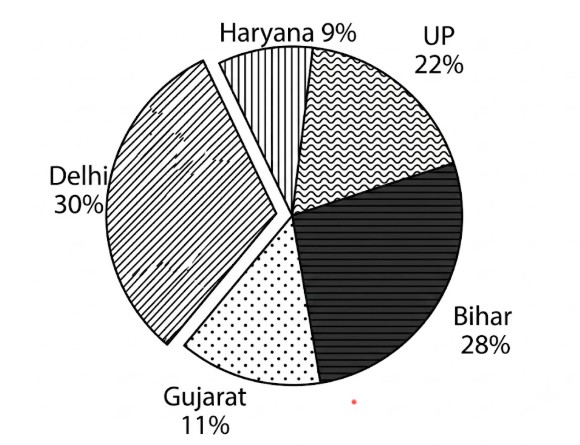
What is the central angle of the sector corresponding to the number of people migrating from Delhi?
To find the central angle of the sector representing Delhi, we need to use the formula for calculating the central angle in a pie chart, which is based on the percentage of the total circle (360°).
Correct Option: A) 108°
The question asks about the number of development and welfare subjects transferred from the state list to Panchayati Raj Institutions (PRIs) through constitutional amendments. This refers specifically to the 73rd Constitutional Amendment Act of 1992, which added the Eleventh Schedule to the Constitution.
C) 29. The Eleventh Schedule, added by the 73rd Constitutional Amendment Act, 1992, contains 29 functional items that have been placed within the purview of Panchayats.