
This problem involves calculating displacement based on a series of movements and turns. We can visualize Jaya's path by breaking down each movement into its components and then determining the net displacement from the starting point (A) to the final point (B).
Jaya walks 349 m South and then 349 m North. These movements cancel each other out.
\[ \text{Net North-South displacement} = N_1 - S_1 = 349 \text{ m (North)} - 349 \text{ m (South)} = 0 \text{ m} \]Jaya walks 129 m East and then 94 m East.
\[ \text{Net East-West displacement} = E_1 + E_2 = 129 \text{ m (East)} + 94 \text{ m (East)} = 223 \text{ m (East)} \]From the calculations, point B is 223 m to the East of point A.
The question asks for the position of point A from point B. If B is 223 m East of A, then A must be 223 m West of B.
B) 223 m, West. As calculated, point A is 223 m to the West of point B.
This problem involves ordering individuals based on the number of votes they received. We need to deduce the complete order from the given clues and identify the person with the highest number of votes.
Identify the participants: The participants are C, J, H, Q, and W. Each got a different number of votes.
Analyze the first clue: "H got more votes than J but less than W."
This can be written as: \(J < H < W\).
Analyze the second clue: "W got less votes than only one person."
This means W is the second-highest vote-getter. There are 5 people in total. If W is second, then one person got more votes than W, and three people got fewer votes than W. So, the order looks like: \(\text{Highest} > W > \text{Person 3} > \text{Person 4} > \text{Person 5}\).
Combine clues 1 and 2:
From clue 1, we know \(J < H < W\). This means J and H are among the people who got fewer votes than W. Since W is the second-highest, and J and H are below W, the order so far is: \(\text{Highest} > W > H > J\). This leaves one person below J.
Analyze the third clue: "C got the least number of votes."
This means C is the last person in the order. So, C must be the person below J.
Form the complete order:
Combining all the information, the order from highest to lowest votes is:
Identify the remaining person: The participants are C, J, H, Q, and W. We have placed C, J, H, and W. The only person remaining is Q.
Place the remaining person: Since Q is the only person left and there is one position for the highest vote-getter, Q must have received the highest number of votes.
Final Order:
\[ Q > W > H > J > C \]Determine who got the highest number of votes: From the final order, Q got the highest number of votes.
B) Q — Based on the step-by-step deduction, Q received the highest number of votes.
The value of tan θ + \( \frac{1}{tan θ} \) is:
Study the given diagram carefully and answer the question. The numbers in different sections indicate the number of units.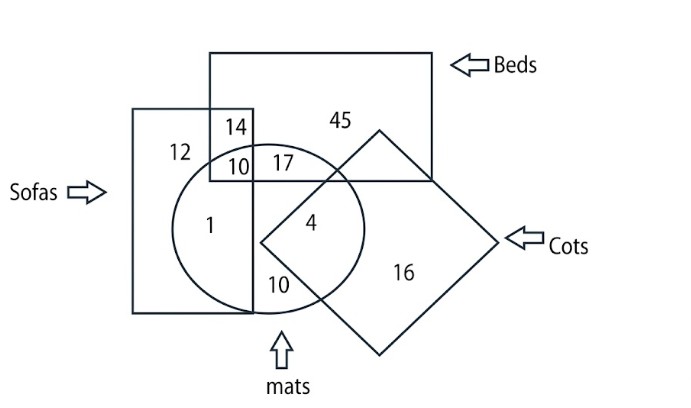
How many such sofas are there that are either beds or mats but not both?
The problem requires identifying the number of sofas that are either beds or mats but not both. This involves understanding the Venn diagram and correctly interpreting the sections.
Correct Option: A) 17
Study the given diagram carefully and answer the question. The numbers in different sections indicate the number of students enrolled in different programmes in a university.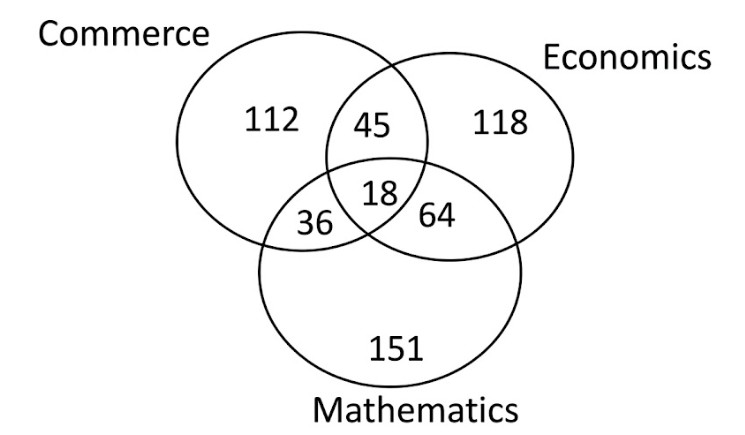
How many students are enrolled in both commerce and economics but NOT mathematics?
To find the number of students enrolled in both commerce and economics but not mathematics, we need to analyze the Venn diagram provided.
Correct Option: D) 45
This question tests the understanding of marginal utility and consumer behavior. An individual's decision to consume more of a commodity is directly linked to the additional satisfaction (utility) they derive from each successive unit consumed.
Correct Option: A) positive. As long as marginal utility is positive, each additional unit consumed adds to the total satisfaction, making the individual prefer more of that commodity.
To find the number of digits whose positions remain unchanged, we need to compare the original number with the new number formed by arranging its digits in ascending order. We will list the digits of the original number and their positions, then do the same for the sorted number, and finally identify common positions.
| Position | Original Digit | New Digit | Unchanged? |
|---|---|---|---|
| 1 | 2 | 1 | No |
| 2 | 6 | 2 | No |
| 3 | 3 | 3 | Yes |
| 4 | 9 | 4 | No |
| 5 | 7 | 5 | No |
| 6 | 1 | 6 | No |
| 7 | 4 | 7 | No |
| 8 | 5 | 9 | No |
Therefore, only 1 digit's position remains unchanged.
A) 1 is the correct answer because only one digit (3) retains its original position after the digits are arranged in ascending order.
This problem involves two trains moving towards each other. We can use the concept of relative speed and the relationship between distance, speed, and time. Since both trains travel for the same amount of time until they meet, we can relate the difference in distances covered to the difference in their speeds.
Let the speed of the first train be \(S_1 = 40 \text{ km/h}\) and the speed of the second train be \(S_2 = 30 \text{ km/h}\).
Let the time taken for the trains to meet be \(T\) hours. Since they start at the same time and meet, the time duration for both trains is the same.
The distance covered by the first train is \(D_1 = S_1 \times T = 40T \text{ km}\).
The distance covered by the second train is \(D_2 = S_2 \times T = 30T \text{ km}\).
According to the problem, the first train has covered 80 km more than the other train. So,
\[ D_1 - D_2 = 80 \]\[ 40T - 30T = 80 \]\[ 10T = 80 \]\[ T = \frac{80}{10} = 8 \text{ hours} \]Now that we have the time \(T\), we can find the individual distances covered:
Distance covered by the first train \(D_1 = 40 \text{ km/h} \times 8 \text{ h} = 320 \text{ km}\).
Distance covered by the second train \(D_2 = 30 \text{ km/h} \times 8 \text{ h} = 240 \text{ km}\).
The total distance between P and Q is the sum of the distances covered by both trains until they meet:
\[ \text{Distance between P and Q} = D_1 + D_2 \]\[ \text{Distance between P and Q} = 320 \text{ km} + 240 \text{ km} \]\[ \text{Distance between P and Q} = 560 \text{ km} \]Identify the product (P) in the following reaction:
Limestone (s) → P + CO2 (g)
The question asks to identify the product (P) formed when limestone undergoes a reaction, releasing carbon dioxide gas. This is a classic example of a thermal decomposition reaction, specifically the decomposition of calcium carbonate.
\[ \text{CaCO}_3 \text{(s)} \xrightarrow{\text{Heat}} \text{CaO (s)} + \text{CO}_2 \text{(g)} \]
D) CaO (s) is the correct product (P) formed during the thermal decomposition of limestone (calcium carbonate).
To find the volume of a sphere, we need its radius. The problem provides the diameter, so we will first calculate the radius from the given diameter. Then, we will use the standard formula for the volume of a sphere.
The diameter of the sphere is \(d = 42 \text{ m}\).
The radius (\(r\)) of a sphere is half of its diameter.
\[ r = \frac{d}{2} = \frac{42 \text{ m}}{2} = 21 \text{ m} \]The volume (\(V\)) of a sphere is given by the formula:
\[ V = \frac{4}{3} \pi r^3 \]Using \(\pi = \frac{22}{7}\) for calculation:
\[ V = \frac{4}{3} \times \frac{22}{7} \times (21 \text{ m})^3 \]\[ V = \frac{4}{3} \times \frac{22}{7} \times 21 \times 21 \times 21 \text{ m}^3 \]Cancel out common factors:
\[ V = \frac{4}{3} \times \frac{22}{7} \times (3 \times 7) \times 21 \times 21 \text{ m}^3 \]\[ V = 4 \times 22 \times 21 \times 21 \text{ m}^3 \]\[ V = 88 \times 441 \text{ m}^3 \]\[ V = 38808 \text{ m}^3 \]Correct Option: C) 38,808 m³