
The question asks to identify the individual credited with coining the term 'geography'. This is a direct factual recall question related to the history of geography.
B) Eratosthenes is widely recognized for coining the term 'geography' in the 3rd century BCE. He was a Greek polymath who made significant contributions to geography, mathematics, and astronomy, including calculating the circumference of the Earth with remarkable accuracy.
In a certain code language, ‘ADOPT’ is written as ‘CGSUZ’ and ‘AGAIN’ is written as ‘CJENT’. How will ‘BOOST’ be written in that language?
The problem asks us to decode a word based on a given coding pattern. We need to identify the rule used to transform 'ADOPT' into 'CGSUZ' and 'AGAIN' into 'CJENT', and then apply the same rule to 'BOOST'.
C) DRSXZ is the correct option, as derived from applying the \(+2, +3, +4, +5, +6\) coding pattern to each letter of 'BOOST'.
A and B can do a work alone in 30 days and 40 days, respectively. In how many days will the work be completed if they work on alternate days, starting with B on the first day?
17\( \frac{1}{3} \) days
34\( \frac{2}{3} \) days
17\( \frac{1}{7} \) days
34\( \frac{1}{3} \) days
This problem involves calculating the time taken to complete a work when two individuals work on alternate days. We will determine the individual work rates, find a common unit of work (LCM of days), calculate the work done in one cycle of alternate days, and then find the total number of days.
Calculate individual work rates:
A can do a work in 30 days. So, A's 1-day work is:
\[ \text{A's 1-day work} = \frac{1}{30} \]B can do a work in 40 days. So, B's 1-day work is:
\[ \text{B's 1-day work} = \frac{1}{40} \]Assume total work:
To avoid fractions, let's assume the total work is the Least Common Multiple (LCM) of 30 and 40.
LCM(30, 40) = 120 units.
Now, calculate the efficiency (work done per day) for A and B:
A's efficiency = \[\frac{120 \text{ units}}{30 \text{ days}} = 4 \text{ units/day}\]
B's efficiency = \[\frac{120 \text{ units}}{40 \text{ days}} = 3 \text{ units/day}\]
Calculate work done in one cycle:
They work on alternate days, starting with B.
Work done in 2 days (1 cycle) = \(3 + 4 = 7\) units.
Determine the number of cycles for most of the work:
We need to complete 120 units of work. Each cycle completes 7 units.
Number of cycles = \(\frac{120}{7} = 17\) with a remainder of 1.
So, 17 cycles will complete \(17 \times 7 = 119\) units of work.
Time taken for 17 cycles = \(17 \times 2 \text{ days} = 34 \text{ days}\).
Calculate remaining work and final day:
Remaining work = \(120 - 119 = 1\) unit.
After 17 full cycles (34 days), it's the start of a new cycle. The work started with B, so B will work on the 35th day.
B's efficiency = 3 units/day.
Time taken by B to complete the remaining 1 unit of work = \[\frac{1 \text{ unit}}{3 \text{ units/day}} = \frac{1}{3} \text{ day}\].
Total time:
Total time = Time for 17 cycles + Time for remaining work
Total time = \[34 \text{ days} + \frac{1}{3} \text{ day} = 34\frac{1}{3} \text{ days}\].
Correct Option: D) 34\( \frac{1}{3} \) days
The problem requires us to modify a given number based on specific rules for its odd and even digits, then find the average of the largest and smallest digits formed after these modifications.
Correct Option: D) 4
The question asks to identify the winner of the Indian Super League (ISL) title in March 2022. This requires knowledge of recent sports events, specifically the results of the 2021-22 ISL season.
Correct Option: B) Hyderabad FC Football Club — Hyderabad FC won the Indian Super League title in March 2022 (specifically, on March 20, 2022) by defeating Kerala Blasters FC in the final match of the 2021-22 season.
To determine the image distance and nature of the image formed by a concave mirror, we use the mirror formula and sign conventions. The mirror formula relates the object distance (\(u\)), image distance (\(v\)), and focal length (\(f\)).
A) 60 cm, real. The calculated image distance is 60 cm (the negative sign indicates its position, not magnitude), and since it's formed on the same side as the object, it is a real image.
The question asks for the definition of "Virgin Vegetation." This term refers to a specific type of plant community characterized by its natural growth and lack of human interference. We need to identify the option that accurately describes these characteristics.
D) Plant community that has grown naturally without human aid and has been left undisturbed by humans for a long time. This definition accurately captures the essence of virgin vegetation, emphasizing its natural origin and lack of human interference.
The following bar chart shows the data of production of wheat in the duration of six years. Study the bar chart and answer the question based on it.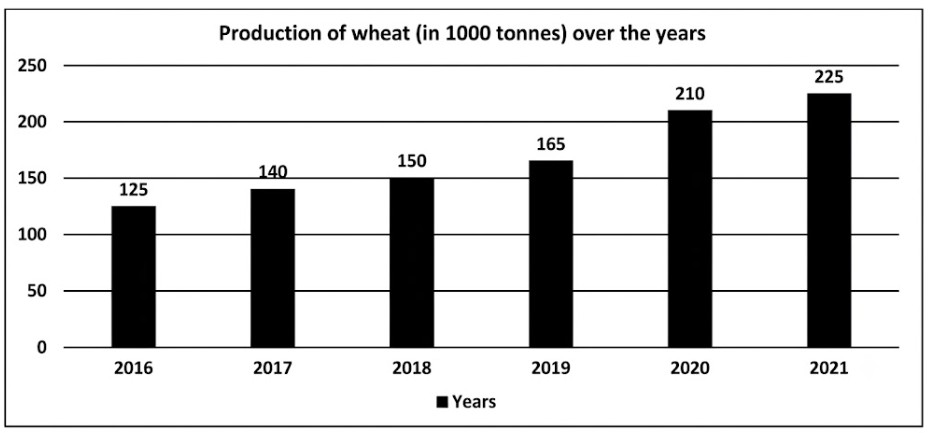
In which year there was maximum percentage increase in production as compared to the previous year?
To determine the year with the maximum percentage increase in wheat production, we need to calculate the percentage increase for each year compared to the previous year using the formula:
\[ \text{Percentage Increase} = \left( \frac{\text{Production in Current Year} - \text{Production in Previous Year}}{\text{Production in Previous Year}} \right) \times 100 \]
The maximum percentage increase occurred in 2020 with a 27.27% increase.
Correct Option: D) 2020
The question asks to identify the reasons for the decline in the number and species of wildlife. We need to evaluate each given statement to determine if it contributes to wildlife decline.
Based on this evaluation, statements a, b, and e are reasons for the decline in wildlife.
C) a, b and e. These three factors (demand for hides and meat, deforestation, and natural calamities) directly contribute to the reduction in wildlife numbers and species.
This is a logical reasoning problem involving arrangement. We need to deduce the living arrangements of five people (A, B, C, D, E) on five different floors (1 to 5) based on the given clues. We will use a systematic approach to place each person on their respective floor.