
The question asks to identify the component of xylem tissue responsible for food storage. Xylem is a complex tissue made up of different types of cells, each with specific functions. We need to recall the functions of each xylem component.
Correct Option: B) Parenchyma cells in the xylem are living cells that store food materials (like starch and fats) and also assist in the radial conduction of water.
In a certain code language, the numbers/symbols are coded using letters as per the table given below and as per the given conditions.
| Number/ Symbol | 1 | ! | 2 | @ | 3 | # | 4 | $ | 5 | % | 6 | ^ | 7 | & | 8 | * | 9 |
| Code | T | D | C | R | G | B | Y | H | N | J | P | L | Q | S | D | F | Z |
Conditions:
I. If the first element is an even number and the last is an odd number, the code for the first and last elements will be K.
II. If both the second and third elements are even numbers, the codes for these two are to be interchanged.
III. If the first element is a number and the last a symbol, the number code is to be used for the symbol also.
What will be the code for 6$8^&7?
To solve this coding problem, we need to first decode the given sequence using the provided table and then apply the given conditions in the specified order to modify the codes. The conditions are hierarchical, meaning we check them sequentially and apply the first one that matches.
6$8^&7.YHPLSD.KHPLSK.KHPLSK.A) KHDLSK is the correct answer. The initial decoding of 6$8^&7 gives YHPLSD. Applying Condition I (first is even number 6, last is odd number 7), changes the first and last codes to K, resulting in KHPLSK. Conditions II and III are not met.
GHDLSP — This option seems to use incorrect initial codes or applies conditions incorrectly. For example, 'G' is the code for '3', not '6'.PHDLSG — This option also uses incorrect initial codes. 'P' is the code for '8', not '6'.KHDLSG — This option correctly applies Condition I to the first and last elements (K), but the middle codes or the last code (G instead of K) are incorrect based on the table and conditions. The last element should be 'K' due to Condition I.The question asks about the host country for the ICC Women's International World Cup Cricket in 2025. This requires knowledge of recent announcements made by the International Cricket Council (ICC) regarding future tournament hosts.
Correct Option: D) India will host the ICC Women’s International World Cup Cricket in 2025. This decision was confirmed by the ICC in July 2022.
The question asks to identify which product among the given options is NOT qualified under AGMARK. AGMARK is a certification mark employed on agricultural products in India, assuring their quality and purity. We need to determine which item does not fall under the purview of agricultural products for AGMARK certification.
Correct Option: C) Gold jewellery is not an AGMARK qualified product. Its quality is certified by BIS Hallmark.
This problem involves analyzing syllogistic statements and conclusions. We will use Venn diagrams to represent the relationships given in the statements and then evaluate each conclusion based on these diagrams.
Let's draw a possible Venn diagram:
M (Mountains) -- partially overlaps with -- H (Hills)
H (Hills) -- partially overlaps with -- R (Rocks)
R (Rocks) -- completely inside -- B (Black)
From this, we can infer that since some hills are rocks, and all rocks are black, it implies that some hills must also be black.
Since "Some hills are rocks" and "All rocks are black", it logically follows that the part of hills that are rocks must also be black. Therefore, some black things are hills. This conclusion is definitely true.
The statement is "Some mountains are hills." This means there is at least one hill that is a mountain. It does not preclude the possibility that all hills could be mountains (i.e., the set of Hills is a subset of the set of Mountains). Since the statement "Some A are B" allows for the possibility "All A are B", this conclusion is a possibility.
We know "Some mountains are hills" and "Some hills are rocks". There is no direct or indirect definite relationship established between Rocks and Mountains. It is possible that some rocks are mountains, or no rocks are mountains, or all rocks are mountains. We cannot definitively conclude that "Some rocks are not mountains." For example, we could draw a diagram where the overlap of Hills and Rocks also overlaps with Mountains, or even where all Rocks are Mountains. Thus, this conclusion is not necessarily true.
Correct Option: D) Only conclusion I and II are true
The question asks to identify the Indian government body that signed a Statement of Intent (SoI) with UNICEF India in April 2022, focusing on Sustainable Development Goals (SDGs) for children. This requires knowledge of recent collaborations between Indian government institutions and international organizations like UNICEF.
Correct Option: D) NITI Aayog
The question asks to identify the incorrect statement(s) regarding Mendeleev's work on the periodic table. We need to evaluate each statement based on historical facts about Mendeleev's periodic table development.
B) iii is the incorrect statement because Mendeleev based his classification on atomic masses, not atomic numbers.
Study the following Venn diagram and answer the question that follows. The diagram represents the favourite channels of kids.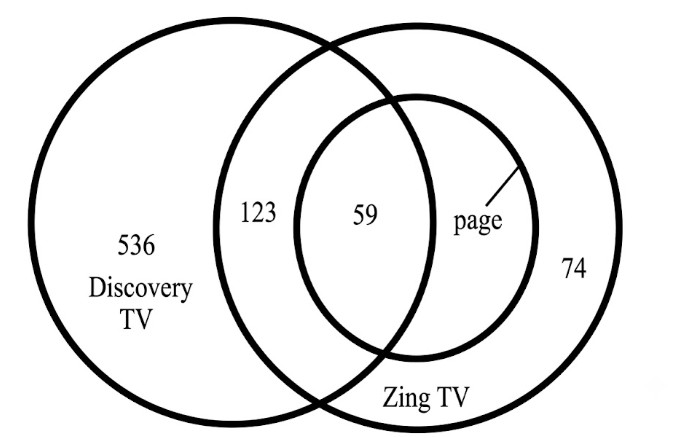
The ratio of kids who like only Discovery TV to those who like all the three is:
\(\frac{59}{123}\)
\(\frac{123}{59}\)
\(\frac{536}{59}\)
\(\frac{59}{536}\)
The problem involves analyzing a Venn diagram to find the ratio of kids who like only Discovery TV to those who like all three channels. We will interpret the diagram and calculate the required ratio.
\[ \text{Ratio} = \frac{\text{Number of kids who like only Discovery TV}}{\text{Number of kids who like all three}} = \frac{536}{59} \]
Thus, the correct answer is option C.
Correct Option: C) \(\frac{536}{59}\)
To solve this problem, we need to first arrange the letters of the given word 'CONFIRM' in alphabetical order. Then, we identify the letter that is fourth from the left and the letter that is second from the right in this new arrangement. Finally, we count the number of letters in the English alphabetical series that lie between these two identified letters.
The alphabetical order of these letters is C, F, I, M, N, O, R.
So, the new word formed is 'CFIMNOR'.
In 'CFIMNOR', the letters are:
So, the fourth letter from the left is M.
In 'CFIMNOR', the letters are:
So, the second letter from the right is O.
The English alphabetical series is A, B, C, D, E, F, G, H, I, J, K, L, M, N, O, P, Q, R, S, T, U, V, W, X, Y, Z.
Between M and O, there is only one letter, which is N.
A) 1 — As determined in the step-by-step analysis, there is only one letter (N) between M and O in the English alphabetical series.
To find the LCM (Least Common Multiple) of decimal numbers, we first convert them into fractions or whole numbers. Then, we find the LCM of the numerators and divide it by the HCF (Highest Common Factor) of the denominators (if expressed as fractions with a common denominator).
The denominators are 1, 2, and 20. The LCM of these denominators is 20. So, we express each number with a denominator of 20:
The numerators are 100, 250, and 1.
To find the LCM, we take the highest power of all prime factors involved:
\[\text{LCM}(100, 250, 1) = 2^2 \times 5^3 = 4 \times 125 = 500\]The denominators are all 20. So, \(\text{HCF}(20, 20, 20) = 20\).
The LCM of fractions is given by the formula:
\[\text{LCM}\left(\frac{a}{b}, \frac{c}{d}, \frac{e}{f}\right) = \frac{\text{LCM}(a, c, e)}{\text{HCF}(b, d, f)}\]In our case, since we made the denominators common, the formula simplifies to:
\[\text{LCM} = \frac{\text{LCM}(\text{numerators})}{\text{common denominator}}\] \[\text{LCM} = \frac{500}{20} = 25\]Correct Option: D) 25