
The question asks for the definition of Fiscal Deficit in the Indian budget context. Fiscal Deficit is a key indicator of the government's financial health, representing the total borrowing requirements of the government. It is essentially the difference between the government's total expenditure and its total receipts, excluding borrowings.
B) Total expenditure minus total receipt other than borrowing
This option accurately defines Fiscal Deficit. It represents the government's total spending exceeding its income from all sources, excluding the money it borrows. This gap is the amount the government needs to borrow to finance its operations.
This problem involves setting up a system of two linear equations based on the given age relationships at different points in time (8 years ago and 8 years hence). We will define variables for their present ages, translate the given conditions into equations, solve the system of equations to find their present ages, and then calculate the required ratio.
Define variables:
Let the present age of Raghu be \(R\) years.
Let the present age of Mohan be \(M\) years.
Formulate the first equation (8 years ago):
8 years ago, Raghu's age was \((R - 8)\) years.
8 years ago, Mohan's age was \((M - 8)\) years.
According to the problem, 8 years ago, Raghu's age was thrice Mohan's age:
Formulate the second equation (8 years hence):
8 years hence, Raghu's age will be \((R + 8)\) years.
8 years hence, Mohan's age will be \((M + 8)\) years.
According to the problem, 8 years hence, Raghu's age will be twice Mohan's age:
Solve the system of equations:
We have two equations:
Subtract Equation 1 from Equation 2:
\[ (R - 2M) - (R - 3M) = 8 - (-16) \]\[ R - 2M - R + 3M = 8 + 16 \]\[ M = 24 \]Find Raghu's present age:
Substitute the value of \(M\) into Equation 2:
Calculate the ratio of the present ages of Mohan and Raghu:
The ratio of Mohan's age to Raghu's age is \(M : R\).
Simplify the ratio:
Divide both numbers by their greatest common divisor, which is 8.
A) 3 : 7 is the correct ratio of the present ages of Mohan and Raghu.
A Pythagorean triplet consists of three positive integers \(a\), \(b\), and \(c\), such that \(a^2 + b^2 = c^2\). These triplets are typically associated with the sides of a right-angled triangle, where \(c\) is the hypotenuse (the longest side). To identify a Pythagorean triplet among the given options, we need to check if the sum of the squares of the two smaller numbers equals the square of the largest number for each option.
Correct Option: C) 20, 99, 101
If ax2−8x−8 is divided by (x+2), then the remainder is 24. Find the value of a.
This problem can be solved using the Remainder Theorem. The Remainder Theorem states that if a polynomial \(P(x)\) is divided by \((x-c)\), then the remainder is \(P(c)\). In this case, the polynomial is \(P(x) = ax^2 - 8x - 8\) and the divisor is \((x+2)\), which can be written as \((x - (-2))\). Therefore, the remainder is \(P(-2)\).
The given polynomial is \(P(x) = ax^2 - 8x - 8\).
The divisor is \((x+2)\).
According to the Remainder Theorem, if \(P(x)\) is divided by \((x+2)\), the remainder is \(P(-2)\).
\[ P(-2) = a(-2)^2 - 8(-2) - 8 \]\[ P(-2) = a(4) + 16 - 8 \]\[ P(-2) = 4a + 8 \]
We are given that the remainder is 24. So, we set \(P(-2)\) equal to 24:
\[ 4a + 8 = 24 \]
Subtract 8 from both sides:
\[ 4a = 24 - 8 \]\[ 4a = 16 \]
Divide by 4:
\[ a = \frac{16}{4} \]\[ a = 4 \]
C) The value of \(a\) is 4.
The problem involves parallel lines and angles. We need to find the measure of \(\angle AEC\) given \(\angle EAB\) and \(\angle ECD\). A common strategy for problems with a point between parallel lines is to draw an auxiliary line through that point parallel to the given parallel lines. This creates alternate interior angles that can be used to solve for the unknown angle.
Correct Option: D) \(120^\circ\)
By drawing an auxiliary line through E parallel to l and m, we can use the property of alternate interior angles to find the components of \(\angle AEC\) and sum them up.
There are three pipes A, B, and C in a tank. The first pipe A can fill the empty tank in 8 hours, the second pipe B can fill the empty tank in 10 hours, and the third pipe C can empty the completely filled tank in 20 hours. If the three pipes are opened together when the tank is completely empty, then in how many hours will the tank be completely filled?
\( \frac{25}{11} \) Hours
\( \frac{40}{7} \) Hours
\( \frac{11}{3} \) Hours
\( \frac{30}{7} \) Hours
To solve this problem, we need to determine the individual work rates of each pipe (how much of the tank they fill or empty in one hour). Then, we combine these rates to find the net filling rate when all three pipes are open simultaneously. Finally, we use the net filling rate to calculate the total time required to fill the tank.
Calculate the filling rate of Pipe A:
Pipe A fills the tank in 8 hours. So, in one hour, Pipe A fills \( \frac{1}{8} \) of the tank.
Calculate the filling rate of Pipe B:
Pipe B fills the tank in 10 hours. So, in one hour, Pipe B fills \( \frac{1}{10} \) of the tank.
Calculate the emptying rate of Pipe C:
Pipe C empties the tank in 20 hours. So, in one hour, Pipe C empties \( \frac{1}{20} \) of the tank. This rate will be subtracted from the filling rates.
Calculate the combined (net) filling rate when all three pipes are open:
When all three pipes are opened together, the net part of the tank filled in one hour will be the sum of the filling rates minus the emptying rate:
To add and subtract these fractions, find a common denominator, which is 40:
\[ \text{Net filling rate} = \frac{5}{40} + \frac{4}{40} - \frac{2}{40} \] \[ \text{Net filling rate} = \frac{5 + 4 - 2}{40} = \frac{9 - 2}{40} = \frac{7}{40} \]So, \( \frac{7}{40} \) of the tank is filled in one hour.
Calculate the total time to fill the tank:
If \( \frac{7}{40} \) of the tank is filled in 1 hour, then the total time to fill the entire tank (which is 1 unit) is the reciprocal of the net filling rate:
Correct Option: B) \( \frac{40}{7} \) Hours
To find the magnification produced by a concave mirror, we first need to determine the image distance using the mirror formula. Once the image distance is known, we can calculate the magnification using the magnification formula. Remember to use the sign conventions for concave mirrors.
C) -0.5 is the correct magnification produced. The negative sign indicates that the image is real and inverted.
This problem requires the application of the empirical relationship between the mean, median, and mode for a moderately skewed distribution. This relationship is a commonly used approximation in statistics.
A) 6 — By applying the empirical formula \(\text{Mode} = 3 \times \text{Median} - 2 \times \text{Mean}\) and substituting the given values for mean (5) and mode (8), we find the median to be 6.
This problem involves finding the individual resistances of two resistors given their effective resistance when connected in series and in parallel. We will set up two equations based on the formulas for series and parallel resistance and then solve them simultaneously.
Correct Option: D) 60 Ω and 60 Ω each
Study the given bar-graph and answer the question that follows.
The bar-graph depicts the number of applications received for two courses (BA and MA) in 2001 and 2003.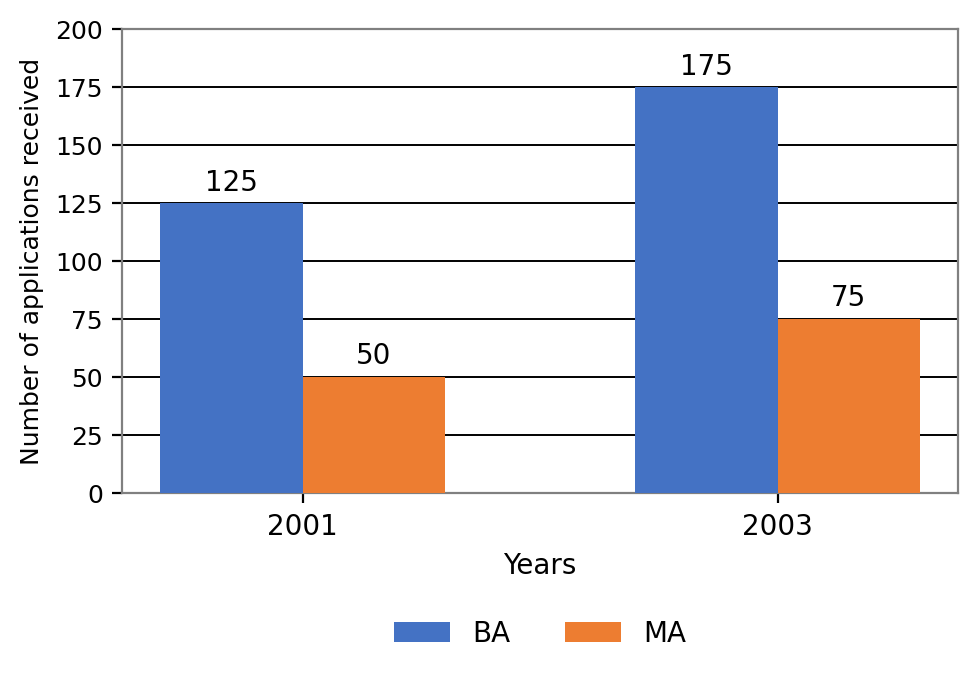
The number of applications received for BA from females in 2001 and 2003 was 73 and 101, respectively.
What was the total number of applications received for BA from males in 2001 and 2003 together?
To find the total number of applications received for BA from males in 2001 and 2003, we need to analyze the bar-graph and use the given data about female applications.
Correct Option: C) 126