
This problem involves two parts. First, we need to find the rate of simple interest using the given information that the simple interest for 6 years is one-sixth of the principal. Second, using this rate, we need to find the principal amount that will accumulate to Rs 6,000 in 3 years.
Calculate the Rate of Interest (R):
Let the Principal be \(P\). The Simple Interest (\(SI\)) for 6 years is given as one-sixth of the principal, so:
\[ SI = \frac{P}{6} \]
The time period (\(T\)) is 6 years. The formula for Simple Interest is:
\[ SI = \frac{P \times R \times T}{100} \]
Substitute the given values into the formula:
\[ \frac{P}{6} = \frac{P \times R \times 6}{100} \]
We can cancel \(P\) from both sides (assuming \(P \neq 0\)):
\[ \frac{1}{6} = \frac{R \times 6}{100} \]
Now, solve for \(R\):
\[ R = \frac{100}{6 \times 6} = \frac{100}{36} \]
\[ R = \frac{25}{9} \% \text{ per annum} \approx 2.777... \% \text{ per annum} \]
Calculate the Principal Amount for the Second Scenario:
We need to find the principal (\(P'\)) that will amount to Rs 6,000 in 3 years at the rate \(R = \frac{25}{9}\%\). Here, the Amount (\(A\)) is Rs 6,000, and the time (\(T'\)) is 3 years.
The formula for Amount is:
\[ A = P' \left(1 + \frac{R \times T'}{100}\right) \]
Substitute the known values:
\[ 6000 = P' \left(1 + \frac{\frac{25}{9} \times 3}{100}\right) \]
\[ 6000 = P' \left(1 + \frac{25 \times 3}{9 \times 100}\right) \]
\[ 6000 = P' \left(1 + \frac{75}{900}\right) \]
Simplify the fraction:
\[ \frac{75}{900} = \frac{3 \times 25}{36 \times 25} = \frac{3}{36} = \frac{1}{12} \]
So, the equation becomes:
\[ 6000 = P' \left(1 + \frac{1}{12}\right) \]
\[ 6000 = P' \left(\frac{12+1}{12}\right) \]
\[ 6000 = P' \left(\frac{13}{12}\right) \]
Now, solve for \(P'\):
\[ P' = 6000 \times \frac{12}{13} \]
\[ P' = \frac{72000}{13} \]
Calculate the numerical value:
\[ P' \approx 5538.4615... \]
Rounding to two decimal places, \(P' = 5538.46\).
Correct Option: C) 5,538.46
If the cost price of 63 articles is equal to the selling price of 54 articles, then what is the percentage gain or loss?
16\( \frac{2}{3} \)% loss
15\( \frac{1}{3} \)% loss
16\( \frac{2}{3} \)% gain
15\( \frac{1}{3} \)% gain
To find the percentage gain or loss, we need to establish a relationship between the Cost Price (CP) and Selling Price (SP) of a single article. We are given that the cost price of 63 articles is equal to the selling price of 54 articles. From this, we can find the ratio of SP to CP, determine if there is a gain or loss, and then calculate the percentage.
Let CP be the cost price of one article and SP be the selling price of one article.
According to the problem statement:
\[ 63 \times \text{CP} = 54 \times \text{SP} \]Both 63 and 54 are divisible by 9.
\[ \frac{\text{SP}}{\text{CP}} = \frac{63 \div 9}{54 \div 9} = \frac{7}{6} \]This means that if CP is 6 units, SP is 7 units. Since SP is greater than CP, there is a gain.
The percentage gain is calculated as:
\[ \text{Percentage Gain} = \left( \frac{\text{Gain}}{\text{CP}} \right) \times 100\% \] \[ \text{Percentage Gain} = \left( \frac{1}{6} \right) \times 100\% \] \[ \text{Percentage Gain} = \frac{100}{6}\% = \frac{50}{3}\% \] \[ \text{Percentage Gain} = 16\frac{2}{3}\% \]Since SP > CP, it is a gain.
Correct Option: C) 16\( \frac{2}{3} \)% gain
The problem states that when 5 is subtracted from a number \(x\), the resulting number is exactly divisible by 18, 16, 24, and 32. This means that \(x-5\) must be a common multiple of these numbers. To find the smallest value of \(x\), we need to find the least common multiple (LCM) of 18, 16, 24, and 32. Once we find the LCM, we can set \(x-5\) equal to it and solve for \(x\).
Find the prime factorization of each number:
Calculate the LCM: The LCM is found by taking the highest power of all prime factors present in the numbers.
So, \(\text{LCM}(18, 16, 24, 32) = 2^5 \times 3^2\).
Compute the value of the LCM:
\[ \text{LCM} = 32 \times 9 = 288 \]Set up the equation: According to the problem, \(x-5\) is exactly divisible by 18, 16, 24, and 32. For the smallest value of \(x\), \(x-5\) must be equal to the LCM.
\[ x - 5 = 288 \]Solve for \(x\):
\[ x = 288 + 5 \] \[ x = 293 \]Correct Option: A) 293
The question asks to identify which food item among the given options is a primary source of protein for growth. Proteins are essential macronutrients vital for building and repairing tissues, and for overall growth and development.
B) Pulses — Pulses (like lentils, beans, chickpeas) are excellent sources of plant-based protein. They are crucial for growth, muscle repair, and overall body maintenance, making them a staple in many diets, especially vegetarian ones, for fulfilling protein requirements.
Six friends L, M, N, O, P and Q live on six different floors of the same building. The lowermost floor in the building is numbered 1, the floor above it, number 2 and so on till the topmost floor is numbered 6.
Only O lives on the floor between the floors of M and Q. Only N lives on the floor between the floors of L and P. Q lives on one of the floors above the floor of L. On which floor does O live?
In the given figures (figures drawn are not to scale), by which of the following similarity criteria ΔPQR is similar to ΔXYZ, where S = side and A = Angle?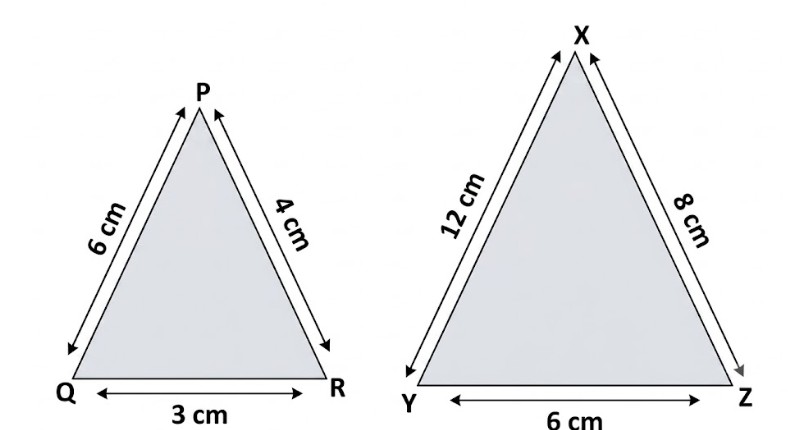
To determine the similarity between triangles \(\Delta PQR\) and \(\Delta XYZ\), we need to check the criteria based on side lengths and angles. The similarity criteria are AAS, AAA, SSS, and SAS, where S represents sides and A represents angles.
Correct Option: C) SSS
If 2 and 5 are the roots of a quadratic equation, then the quadratic equation is given by:
x2 + 3x + 7 = 0
x2 + 7x + 10 = 0
2x2 + 7x + 10 = 0
x2 - 7x + 10 = 0
A quadratic equation can be formed if its roots are known. If \(\alpha\) and \(\beta\) are the roots of a quadratic equation, then the equation can be written as \(x^2 - (\alpha + \beta)x + \alpha\beta = 0\). We will use this standard form to construct the equation.
The given roots are \(2\) and \(5\).
Let \(\alpha = 2\) and \(\beta = 5\).
Sum of roots \( = \alpha + \beta = 2 + 5 = 7\).
Product of roots \( = \alpha \beta = 2 \times 5 = 10\).
The general form of a quadratic equation with roots \(\alpha\) and \(\beta\) is:
\[x^2 - (\alpha + \beta)x + \alpha\beta = 0\]Substitute the sum and product of the roots into this equation:
\[x^2 - (7)x + (10) = 0\]\[x^2 - 7x + 10 = 0\]D) \(x^2 - 7x + 10 = 0\). This matches the equation derived from the given roots.
There are three pipes K, L and M. Pipe K can fill a tank in 45 minutes and pipe L can fill the same tank in one hour. Pipe M can empty the same tank, when filled, in 1 hour 45 minutes. If all three pipes are opened together when the tank is empty, then the tank will be filled in:
24 \( \frac{3}{37} \) minutes
34 \( \frac{2}{37} \) minutes
44 \( \frac{5}{37} \) minutes
54 \( \frac{9}{37} \) minutes
This problem involves calculating the combined work rate of three pipes: two filling pipes and one emptying pipe. We will first determine the rate of work (fraction of tank filled/emptied per minute) for each pipe. Then, we will find the net rate when all three pipes are open simultaneously. Finally, we will use the net rate to calculate the total time required to fill the tank.
Since pipes K and L are filling, their rates are positive. Pipe M is emptying, so its rate is negative.
\[ R_{\text{net}} = R_K + R_L - R_M \]\[ R_{\text{net}} = \frac{1}{45} + \frac{1}{60} - \frac{1}{105} \]The least common multiple (LCM) of 45, 60, and 105.
Time \( = \frac{1}{\text{Net Rate}} \)
\[ \text{Time} = \frac{1}{\frac{37}{1260}} = \frac{1260}{37} \text{ minutes} \]Divide 1260 by 37:
\( 1260 \div 37 \)
\( 37 \times 30 = 1110 \)
\( 1260 - 1110 = 150 \)
\( 37 \times 4 = 148 \)
\( 150 - 148 = 2 \)
So, \[\frac{1260}{37} = 34 \frac{2}{37}\] minutes.
B) The tank will be filled in \( 34 \frac{2}{37} \) minutes.
To solve this problem, we need to identify consonants that fit a specific pattern: they must be immediately preceded by a vowel and immediately followed by a vowel. We will scan the given letter series from left to right, checking each letter against this condition.
Correct Option: D) 3
The question asks for the year when the R.T.A (Road Transport Authority) issued a permit to the Municipality of Andavadi to manage 29 bus routes, establishing it as India's largest Municipal Transport Service for local conveyance. This is a factual question related to the history of municipal transport services in India.
C) 1947. While "Andavadi Municipal Transport Service" is a fictional entity, the historical context of significant municipal transport developments in India, particularly those becoming the "largest" at the time, points to the immediate post-independence era. The Madras Municipal Transport Service, for instance, had its origins and significant expansion around this period, aligning with the idea of a newly independent nation establishing essential public services.