
The resistance of a conductor depends on its material, length, and cross-sectional area. We will use the formula for resistance to determine how it changes when the length is increased while keeping the material and thickness (cross-sectional area) constant.
The resistance \(R\) of a conductor is given by the formula:
\[ R = \rho \frac{L}{A} \]where:
In this problem, the material of the conductor remains the same, so its resistivity \( \rho \) is constant. The thickness also remains the same, which means the cross-sectional area \(A\) is constant.
Let the original length be \(L_1\) and the original resistance be \(R_1\). So, the initial resistance is:
\[ R_1 = \rho \frac{L_1}{A} \]The length of the conductor is increased five times. So, the new length \(L_2\) will be:
\[ L_2 = 5 L_1 \]Now, let's calculate the new resistance \(R_2\) using the new length \(L_2\), while \( \rho \) and \(A\) remain unchanged:
\[ R_2 = \rho \frac{L_2}{A} \]Substitute \(L_2 = 5 L_1\) into the equation for \(R_2\):
\[ R_2 = \rho \frac{5 L_1}{A} \]We can rewrite this as:
\[ R_2 = 5 \left( \rho \frac{L_1}{A} \right) \]Since \(R_1 = \rho \frac{L_1}{A}\), we can substitute \(R_1\) into the equation for \(R_2\):
\[ R_2 = 5 R_1 \]This shows that the new resistance will be five times the original resistance.
C) become five times of the original. As derived, when the length is increased five times, the resistance also increases five times, assuming resistivity and cross-sectional area are constant.
A, K, G, D, H and Y are sitting in a straight row facing north. K is at one extreme end. Y is sitting third from the right of K and second to the left of A. D and H are immediate neighbours. G is sitting to the immediate left of A. D sits third to the left of G. Who is to the immediate right of K?
The question asks about the behavior of the marginal product of a variable factor as more units of it are combined with fixed factors, according to the Law of Variable Proportions. This law describes the short-run production function where at least one factor of production is fixed.
D) first increases and then declines - This accurately describes the typical behavior of the marginal product of a variable factor according to the Law of Variable Proportions. It initially rises due to increasing returns and then falls due to diminishing returns.
Study the given diagram carefully and answer the question. The numbers in different sections indicate the number of persons.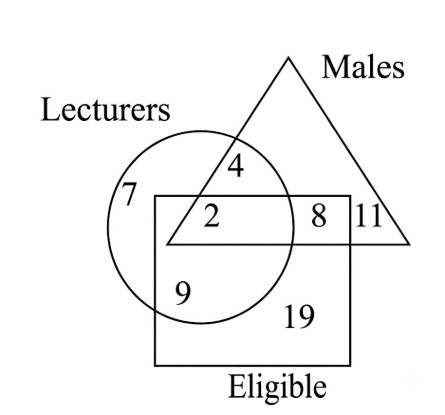
How many such male lecturers are there who are NOT eligible?
To find the number of male lecturers who are not eligible, we need to analyze the given Venn diagram, which shows the distribution of numbers across categories: Lecturers, Males, and Eligible.
Correct Option: C) 4
The question asks to identify the recipient of the Shanti Swarup Bhatnagar Award in Biological Science for the year 2021 from the given options. This requires knowledge of the awardees for that specific year and category.
Correct Option: B) Amit Singh received the Shanti Swarup Bhatnagar Award in Biological Science for the year 2021.
If 7sin2x + 3cos2x = 4, and x is an acute angle, then the value of cot x + tan x will be:
\(\frac{5}{\sqrt{3}}\)
\(\frac{2}{\sqrt{3}}\)
\(\frac{4}{\sqrt{3}}\)
\(\frac{7}{\sqrt{3}}\)
The problem requires us to find the value of \(\cot x + \tan x\) given a trigonometric equation \(7\sin^2 x + 3\cos^2 x = 4\) and that \(x\) is an acute angle. We will first solve the given equation to find the value of \(\sin x\) or \(\cos x\), then determine \(\tan x\) and \(\cot x\), and finally calculate their sum.
Simplify the given equation:
The given equation is \(7\sin^2 x + 3\cos^2 x = 4\).
We know the identity \(\sin^2 x + \cos^2 x = 1\). We can rewrite \(7\sin^2 x\) as \(4\sin^2 x + 3\sin^2 x\).
So, the equation becomes:
\[ 4\sin^2 x + 3\sin^2 x + 3\cos^2 x = 4 \]\[ 4\sin^2 x + 3(\sin^2 x + \cos^2 x) = 4 \]Substitute the identity:
Using \(\sin^2 x + \cos^2 x = 1\):
\[ 4\sin^2 x + 3(1) = 4 \]\[ 4\sin^2 x + 3 = 4 \]Solve for \(\sin^2 x\):
\[ 4\sin^2 x = 4 - 3 \]\[ 4\sin^2 x = 1 \]\[ \sin^2 x = \frac{1}{4} \]Find \(\sin x\):
Taking the square root of both sides:
\[ \sin x = \pm\sqrt{\frac{1}{4}} \]\[ \sin x = \pm\frac{1}{2} \]Since \(x\) is an acute angle, \(x\) lies in the first quadrant, where \(\sin x\) is positive. Therefore,\[ \sin x = \frac{1}{2} \]Determine the angle \(x\):
For an acute angle, if \(\sin x = \frac{1}{2}\), then \(x = 30^\circ\) or \(\frac{\pi}{6}\) radians.
Calculate \(\tan x\) and \(\cot x\):
For \(x = 30^\circ\):
\[ \tan x = \tan 30^\circ = \frac{1}{\sqrt{3}} \]\[ \cot x = \cot 30^\circ = \sqrt{3} \]Find the value of \(\cot x + \tan x\):
\[ \cot x + \tan x = \sqrt{3} + \frac{1}{\sqrt{3}} \]\[ \cot x + \tan x = \frac{\sqrt{3} \cdot \sqrt{3} + 1}{\sqrt{3}} \]\[ \cot x + \tan x = \frac{3 + 1}{\sqrt{3}} \]\[ \cot x + \tan x = \frac{4}{\sqrt{3}} \]Correct Option: C) \(\frac{4}{\sqrt{3}}\) is the calculated value for \(\cot x + \tan x\).
The question asks to identify the second most spoken language in India according to the 2011 Census of languages. This requires knowledge of the linguistic demographics of India as per official census data.
According to the 2011 Census of India:
Therefore, Bengali is the second highest spoken language.
D) Bengali is the second most spoken language in India according to the 2011 census, after Hindi.
The question asks to identify the Prime Minister under whose leadership the Third Five-Year Plan of India was launched. This requires knowledge of the timeline of India's Five-Year Plans and the Prime Ministers during those periods.
Correct Option: B) Jawaharlal Nehru was the Prime Minister of India when the Third Five-Year Plan was launched in 1961.
Who among the following became the Vice-President of India from 11th August 2022?
B. D. Mishra
Biswabhusan Harichandan
Phagu Chauhan
Jagdeep Dhankhar
The question asks to identify the individual who assumed the office of the Vice-President of India from August 11, 2022. This requires knowledge of recent political appointments and the current officeholders in India.
Correct Option: D) Jagdeep Dhankhar became the Vice-President of India from August 11, 2022. He was the former Governor of West Bengal.
The value of [(52)4 × 53] ÷ 59 is:
To solve this problem, we need to apply the rules of exponents. Specifically, we will use the power of a power rule \((a^m)^n = a^{m \times n}\), the product rule \(a^m \times a^n = a^{m+n}\), and the quotient rule \(a^m \div a^n = a^{m-n}\).
Using the power of a power rule, \((a^m)^n = a^{m \times n}\):
\[ (5^2)^4 = 5^{2 \times 4} = 5^8 \]The expression inside the brackets becomes \(5^8 \times 5^3\). Using the product rule, \(a^m \times a^n = a^{m+n}\):
\[ 5^8 \times 5^3 = 5^{8+3} = 5^{11} \]Now, the entire expression is \(5^{11} \div 5^9\). Using the quotient rule, \(a^m \div a^n = a^{m-n}\):
\[ 5^{11} \div 5^9 = 5^{11-9} = 5^2 \]Finally, calculate the value of \(5^2\):
\[ 5^2 = 5 \times 5 = 25 \]Correct Option: A) 25