
The question asks to identify the instrument used by physicians to measure blood pressure. We need to recall the primary function of each given medical instrument.
B) Sphygmomanometer is the instrument specifically designed and used by physicians to measure blood pressure.
The question asks about the law used to calculate the refractive index. We need to identify the fundamental principle that relates the angles of incidence and refraction to the refractive indices of two media.
C) Snell’s law is the fundamental law that relates the angles of incidence and refraction to the refractive indices of the two media, allowing for the calculation of the refractive index.
In the given figure, lines AB and CD are parallel to line FG. E is a point on the line FG. It is given that ∠ABE = 110°, ∠ECD = 95° and ∠BEC = x°. The value of x is: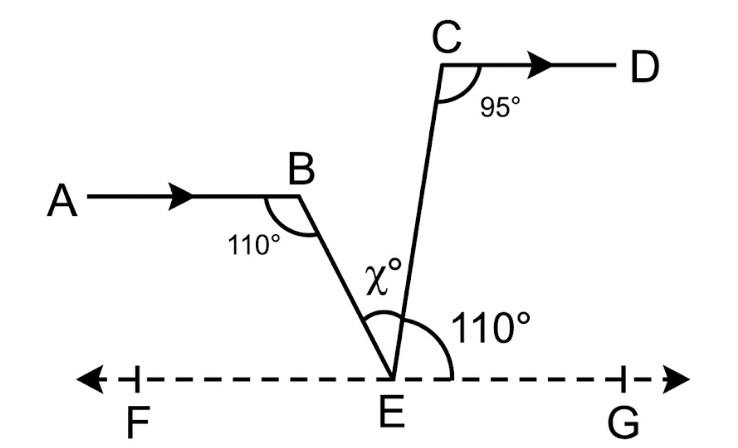
To find the value of \(x\), we will use the properties of parallel lines and angles. Since lines \(AB\) and \(CD\) are parallel to \(FG\), we can apply the concept of alternate interior angles and supplementary angles.
However, this calculation seems incorrect as per the options. Let's re-evaluate:
Rechecking the setup, \(\angle BEC = 180^\circ - 110^\circ = 70^\circ\) is indeed correct, but the diagram suggests a different approach:
Correct Option: A) 25°
This problem involves calculating the present population given a past population and a constant annual growth rate. This is a compound interest type of problem where the population grows by a certain percentage each year. We can calculate the population year by year or use the compound interest formula.
Both methods yield the same result.
C) 12,100 is the present population after a 10% annual increase for two years.
The question asks about the number of inhabited islands in the Union Territory of Lakshadweep as of March 2022. This is a factual question related to Indian geography and administration. Candidates need to recall the correct number of inhabited islands.
B) 10 is the correct number of inhabited islands in the Union Territory of Lakshadweep as of March 2022.
This problem involves calculating the overall profit percentage of a dishonest shopkeeper who uses false weights during both purchasing and selling. We will consider the effect of these false weights as percentage gains at each stage and then combine them to find the total profit.
C) 69% is the correct profit percentage, calculated by considering the successive gains on purchasing and selling.
The question asks us to evaluate two statements regarding nettle stings and their treatment. We need to determine if each statement is factually correct and if there's a relationship between them.
D) Both statements are correct. Statement II is related to Statement I.
As established, both statements are factually correct. Statement I identifies the acidic nature of the nettle sting, and Statement II provides a remedy (a base) that directly addresses this acidic nature through neutralization. Thus, Statement II is directly related to Statement I.
The sum of the angles in any triangle is always 180°. Given the ratio of the angles, we can represent each angle as a multiple of a common factor. By summing these multiples and equating them to 180°, we can find the value of the common factor and subsequently the measure of each angle.
Let the angles of the triangle \(\Delta PQR\) be \(\angle P\), \(\angle Q\), and \(\angle R\).
We are given the ratio of the angles as \(\angle P : \angle Q : \angle R = 6 : 7 : 5\).
Let the common ratio be \(x\). Then, we can express the angles as:
\[ \angle P = 6x \]\[ \angle Q = 7x \]\[ \angle R = 5x \]The sum of the angles in a triangle is \(180^\circ\). Therefore,
\[ \angle P + \angle Q + \angle R = 180^\circ \]Substitute the expressions for the angles into the sum equation:
\[ 6x + 7x + 5x = 180^\circ \]Combine the terms on the left side:
\[ (6 + 7 + 5)x = 180^\circ \]\[ 18x = 180^\circ \]Solve for \(x\):
\[ x = \frac{180^\circ}{18} \]\[ x = 10^\circ \]Now, calculate the measure of \(\angle Q\) using the value of \(x\):
\[ \angle Q = 7x \]\[ \angle Q = 7 \times 10^\circ \]\[ \angle Q = 70^\circ \]Correct Option: B) 70°
The question describes the order of five boxes stacked one over the other. We need to place the boxes using the given conditions, testing the possible positions of C, and find which box is in the middle.
Identify the given information:
Find the possible positions of C and B:
Number the positions 1 (bottom) to 5 (top). B is three places above C, so (C, B) is (1, 4) or (2, 5).
If C were at position 1, C would be at the bottom, but the bottom box must be D or E. So, C is at 2 and B is at 5.
Place E and D:
E is next to C, so E is at position 1 or 3.
If E were at 3, D would be at 1 (one box between them), and A would be at 4, directly above E. This is not allowed.
So, E is at position 1 (the bottom) and D is at position 3.
Place A and find the middle box:
The only position left is 4, so A is at position 4. A is next to D and B, not to C or E, which fits.
Final order (bottom to top): E, C, D, A, B.
The middle box (position 3) is D.
Correct Option: A) D — The boxes from bottom to top are E, C, D, A, B. D is in the middle position. Hence, Option A is the correct answer.
B) A: This is incorrect because A is kept at the fourth position from the bottom.
C) B: This is incorrect because B is kept at the top.
D) C: This is incorrect because C is kept at the second position from the bottom.
Seven people, A, B, C, D, E, F and G, are sitting in a straight row, facing north. Only three people sit between A and G. Only two people sit to the left of A. F is not an immediate neighbour of G. F sits second to the right of E. C sits to the immediate right of B. Who sits at the extreme left end of the row?
The question gives seven people A, B, C, D, E, F and G sitting in a straight row facing north, along with clues about their positions. We need to place everyone using the clues and then find who sits at the extreme left end.
Identify the given information:
Recall the direction rule:
For people facing north, their right is the right end of the row and their left is the left end. Number the positions 1 to 7 from left to right.
Place A and G:
Two people sit to the left of A, so A is at position 3. With three people between A and G, G must be at position 7 (position −1 does not exist).
Place E, F, B and C:
The free positions are 1, 2, 4, 5 and 6. F is second to the right of E, and F cannot be at 6 (next to G). So, E = 2 and F = 4 (E = 4, F = 6 is ruled out). B and C must be adjacent with C on the right, so B = 5 and C = 6.
Complete the arrangement:
The only remaining position, 1, goes to D. The final order from left to right is: D, E, A, F, B, C, G.
Correct Option: D) D — In the arrangement D, E, A, F, B, C, G, D sits at the extreme left end. Hence, Option D is the correct answer.
A) C: This is incorrect because C sits at position 6, second from the right end.
B) G: This is incorrect because G sits at the extreme right end.
C) F: This is incorrect because F sits at position 4, in the middle of the row.