
To find the least number that needs to be added to 1000 to make it exactly divisible by 15, we first divide 1000 by 15. The remainder from this division will tell us how far 1000 is from the next multiple of 15. The difference between the divisor (15) and the remainder will be the number we need to add.
    66
  ____
15|1000
   -90
   ---
    100
   -90
   ---
     10
So, \(1000 = 15 \times 66 + 10\). The remainder is 10.The remainder is 10. This means 1000 is 10 more than a multiple of 15 (\(15 \times 66 = 990\)). To reach the next multiple of 15, we need to add the difference between the divisor (15) and the remainder (10).
Number to add \( = \text{Divisor} - \text{Remainder}\)
\[ \text{Number to add} = 15 - 10 = 5 \]If we add 5 to 1000, we get \(1000 + 5 = 1005\).
Now, check if 1005 is divisible by 15:
\[ 1005 \div 15 = 67 \] Since 1005 is exactly divisible by 15, and 5 is the smallest positive integer that achieves this, our answer is correct.Correct Option: D) 5
Study the given pattern carefully and select the letter that can replace the question mark (?) in it.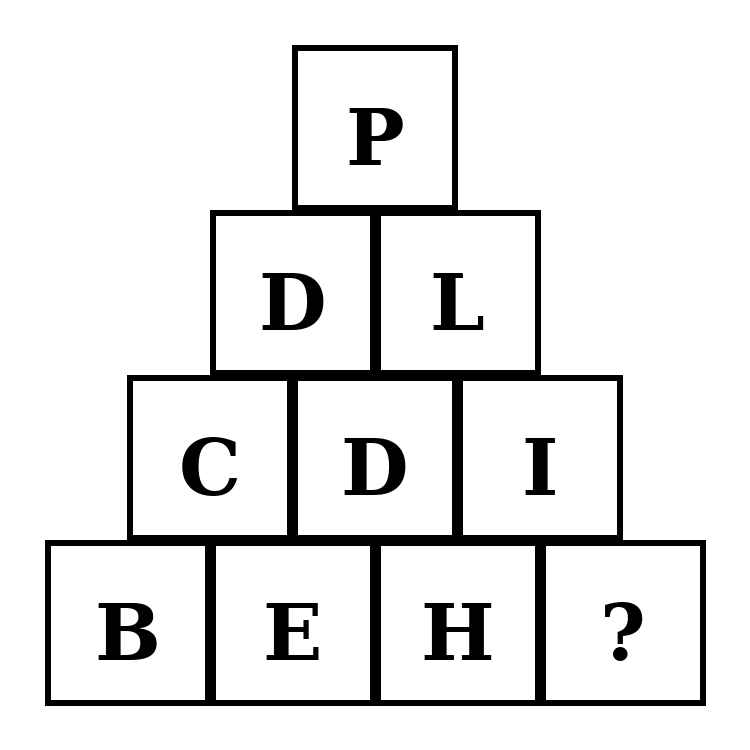
The given pattern is a pyramid of letters. Each letter seems to follow a specific sequence or pattern. We need to identify the pattern to determine the letter that replaces the question mark.
Correct Option: B) A
How many minutes will Chandu take to cover a distance of 600 m, if he runs at a speed of 30 km/h?
1 \( \frac{2}{5} \) min
1 \( \frac{1}{5} \) min
2 \( \frac{2}{5} \) min
2 \( \frac{1}{5} \) min
To find the time taken, we need to use the formula: \( \text{Time} = \frac{\text{Distance}}{\text{Speed}} \). The key is to ensure all units are consistent. The distance is given in meters, and the speed in kilometers per hour. We need to convert them to compatible units, preferably meters and seconds, or kilometers and hours, and then convert the final time to minutes as required by the options.
Identify the given values:
Convert speed to meters per second (m/s):
To convert km/h to m/s, multiply by \( \frac{5}{18} \).
\[ S = 30 \text{ km/h} \times \frac{5}{18} \frac{\text{m/s}}{\text{km/h}} = \frac{150}{18} \text{ m/s} = \frac{25}{3} \text{ m/s} \]Calculate the time taken in seconds:
Using the formula \( T = \frac{D}{S} \):
\[ T = \frac{600 \text{ m}}{\frac{25}{3} \text{ m/s}} = 600 \times \frac{3}{25} \text{ s} \]\[ T = \frac{1800}{25} \text{ s} = 72 \text{ s} \]Convert time from seconds to minutes:
There are 60 seconds in 1 minute.
\[ T = \frac{72}{60} \text{ min} = \frac{6 \times 12}{5 \times 12} \text{ min} = \frac{6}{5} \text{ min} \]Express the time as a mixed fraction:
\[ \frac{6}{5} \text{ min} = 1 \frac{1}{5} \text{ min} \]B) \( 1 \frac{1}{5} \text{ min} \) is the correct answer, as calculated.
We are given the initial ratio of alcohol to water in a mixture. When a certain amount of water is added, the ratio changes. We need to find the initial quantity of alcohol. We can set up algebraic equations based on the given ratios and solve for the unknown quantities.
Define initial quantities: Let the initial quantity of alcohol be \(5x\) litres and the initial quantity of water be \(4x\) litres, since the ratio of alcohol to water is \(5:4\).
Formulate quantities after adding water: When 9 litres of water is added, the quantity of alcohol remains \(5x\) litres, and the quantity of water becomes \((4x + 9)\) litres.
Set up the equation based on the new ratio: The new ratio of alcohol to water is given as \(4:5\). So, we can write the equation:
\[ \frac{\text{Quantity of Alcohol}}{\text{Quantity of Water}} = \frac{5x}{4x + 9} = \frac{4}{5} \]Solve the equation for \(x\): Cross-multiply to solve for \(x\):
\[ 5 \times (5x) = 4 \times (4x + 9) \] \[ 25x = 16x + 36 \] \[ 25x - 16x = 36 \] \[ 9x = 36 \] \[ x = \frac{36}{9} \] \[ x = 4 \]Calculate the quantity of alcohol: The quantity of alcohol in the mixture is \(5x\).
\[ \text{Quantity of Alcohol} = 5 \times 4 = 20 \text{ litres} \]Correct Option: A) 20 litres
What is the value of \( \frac{2}{7} \) × [2 + {2(11 + 4 − 2)}] − 2
To solve this problem, we need to follow the order of operations, often remembered by the acronym PEMDAS/BODMAS (Parentheses/Brackets, Exponents/Orders, Multiplication and Division (from left to right), Addition and Subtraction (from left to right)). We will simplify the innermost brackets first and work our way outwards.
The expression inside the innermost parentheses is \(11 + 4 - 2\).
\[ 11 + 4 - 2 = 15 - 2 = 13 \]The expression becomes:
\[ \frac{2}{7} \times [2 + \{2(13)\}] - 2 \]The expression inside the curly braces is \(2(13)\).
\[ 2 \times 13 = 26 \]The expression becomes:
\[ \frac{2}{7} \times [2 + 26] - 2 \]The expression inside the square brackets is \(2 + 26\).
\[ 2 + 26 = 28 \]The expression becomes:
\[ \frac{2}{7} \times 28 - 2 \]Now, multiply \( \frac{2}{7} \) by \(28\).
\[ \frac{2}{7} \times 28 = 2 \times \frac{28}{7} = 2 \times 4 = 8 \]Finally, subtract \(2\) from \(8\).
\[ 8 - 2 = 6 \]Thus, the value of the given expression is \(6\).
A) 6 is the correct answer, as derived by following the order of operations.
To find the ratio of height to radius, we will use the given ratio of the curved surface area to the total surface area of a right circular cylinder. We will express both areas in terms of radius (\(r\)) and height (\(h\)), set up an equation based on the given ratio, and then solve for the ratio \(h:r\).
Let \(r\) be the radius and \(h\) be the height of the right circular cylinder.
The formula for the curved surface area (CSA) of a cylinder is:
\[ \text{CSA} = 2 \pi r h \]The formula for the total surface area (TSA) of a cylinder is:
\[ \text{TSA} = 2 \pi r h + 2 \pi r^2 = 2 \pi r (h + r) \]We are given that the ratio of the curved surface area to the total surface area is 3:7. So, we can write the equation:
\[ \frac{\text{CSA}}{\text{TSA}} = \frac{3}{7} \]Substitute the formulas for CSA and TSA into the ratio equation:
\[ \frac{2 \pi r h}{2 \pi r (h + r)} = \frac{3}{7} \]Cancel out the common terms \(2 \pi r\) from the numerator and denominator:
\[ \frac{h}{h + r} = \frac{3}{7} \]Cross-multiply to solve for \(h\) and \(r\):
\[ 7h = 3(h + r) \] \[ 7h = 3h + 3r \]Rearrange the terms to find the ratio of \(h\) to \(r\):
\[ 7h - 3h = 3r \] \[ 4h = 3r \]Express the ratio \(h:r\):
\[ \frac{h}{r} = \frac{3}{4} \]So, the ratio of height to radius is 3:4.
Correct Option: D) 3 : 4
To solve this problem, we need to convert the given decimal number into a fraction, simplify it to its lowest terms, and then find the sum of its numerator and denominator.
The decimal number is \(0.36\). To convert it to a fraction, we can write it as the number divided by a power of 10. Since there are two digits after the decimal point, we divide by \(10^2 = 100\).
\[ 0.36 = \frac{36}{100} \]Now, we need to find the greatest common divisor (GCD) of the numerator (36) and the denominator (100) and divide both by it. Both 36 and 100 are divisible by 4.
So, the simplified fraction is:
\[ \frac{36}{100} = \frac{9}{25} \]The factors of 9 are 1, 3, 9. The factors of 25 are 1, 5, 25. The only common factor is 1, which means the fraction \(\frac{9}{25}\) is in its simplest form.
The numerator is 9 and the denominator is 25. Their sum is:
\[ 9 + 25 = 34 \]Correct Option: B) 34
The problem asks us to find the principal sum given the simple interest, time period, and annual interest rate. We can use the formula for simple interest to solve this problem.
The formula for simple interest (SI) is:
\[ \text{SI} = \frac{P \times R \times T}{100} \]Where:
We need to find \( P \). Rearranging the formula to solve for \( P \):
\[ P = \frac{\text{SI} \times 100}{R \times T} \]Substitute the given values into the rearranged formula:
\[ P = \frac{650 \times 100}{13 \times 5} \]First, calculate the product in the denominator:
\[ 13 \times 5 = 65 \]Now, substitute this back into the equation for \( P \):
\[ P = \frac{65000}{65} \]Perform the division:
\[ P = 1000 \]The principal sum is ₹1,000.
Correct Option: C) ₹1,000
The question asks to identify which of the given individuals is NOT a recipient of the Goldman Environmental Prize, also known as the "Green Nobel Prize." This requires knowledge of prominent environmental activists, particularly those from India, and their recognition with this specific award.
Vandana Shiva is a globally renowned Indian environmental activist, anti-globalization author, and ecofeminist. She is known for her activism against genetic engineering and corporate globalization. While she has received numerous prestigious awards for her environmental work, such as the Right Livelihood Award (1993), she has not been a recipient of the Goldman Environmental Prize. The Goldman Environmental Prize is specifically awarded to grassroots environmental heroes.
The problem is a coding-decoding question. We need to identify the pattern or rule used to transform "PIANO" into "NGYLM" and then apply the same rule to transform "DRUM". This typically involves analyzing the positional values of letters in the alphabet.
Let's write down the letters of the original word "PIANO" and its coded form "NGYLM" along with their alphabetical positions:
The consistent pattern is that each letter in the original word is shifted two positions backward in the alphabet to get its coded letter.
Now, we apply the same \(-2\) shift to each letter of "DRUM":
Combining the transformed letters, DRUM becomes BPSK.
B) BPSK is the correct coded word for DRUM, following the established pattern of shifting each letter two positions backward in the alphabet.