
A sum of ₹30,000 is invested on compound interest of 7\( \frac{1}{2} \)% p.a. What is the sum at the end of the second year?
To find the sum at the end of the second year when interest is compounded annually, we can use the compound interest formula or calculate the interest year by year. The compound interest formula is \(A = P \left(1 + \frac{R}{100}\right)^N\), where \(A\) is the amount, \(P\) is the principal, \(R\) is the rate of interest per annum, and \(N\) is the number of years.
So, the sum at the end of the second year is ₹34,668.75.
D) ₹34,668.75 is the correct amount calculated using the compound interest formula.
The ascending order of the fractions \( \frac{2}{3} \), \( \frac{1}{2} \) and \( \frac{1}{6} \) is:
\( \frac{1}{6} \), \( \frac{2}{3} \), \( \frac{1}{2} \)
\( \frac{2}{3} \), \( \frac{1}{6} \), \( \frac{1}{2} \)
\( \frac{1}{6} \), \( \frac{1}{2} \), \( \frac{2}{3} \)
\( \frac{2}{3} \), \( \frac{1}{2} \), \( \frac{1}{6} \)
To arrange fractions in ascending order, we need to compare their values. A common method is to convert all fractions to equivalent fractions with a common denominator. Once they have the same denominator, their values can be compared directly by looking at their numerators.
Correct Option: C) \( \frac{1}{6} \), \( \frac{1}{2} \), \( \frac{2}{3} \)
Study the given pattern carefully and select the number from among the given options that can replace the question mark (?) in it.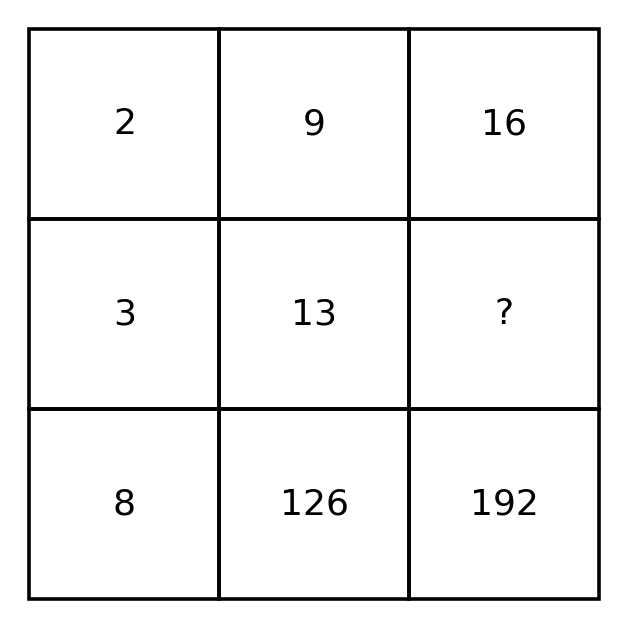
To solve this pattern-based question, observe the relationship between the numbers in the diagram. The numbers in the third row are products of the numbers in the first two rows of the same column.
Correct Option: C) 11
Study the given pattern carefully and select the number from among the given options that can replace the question mark (?) in it.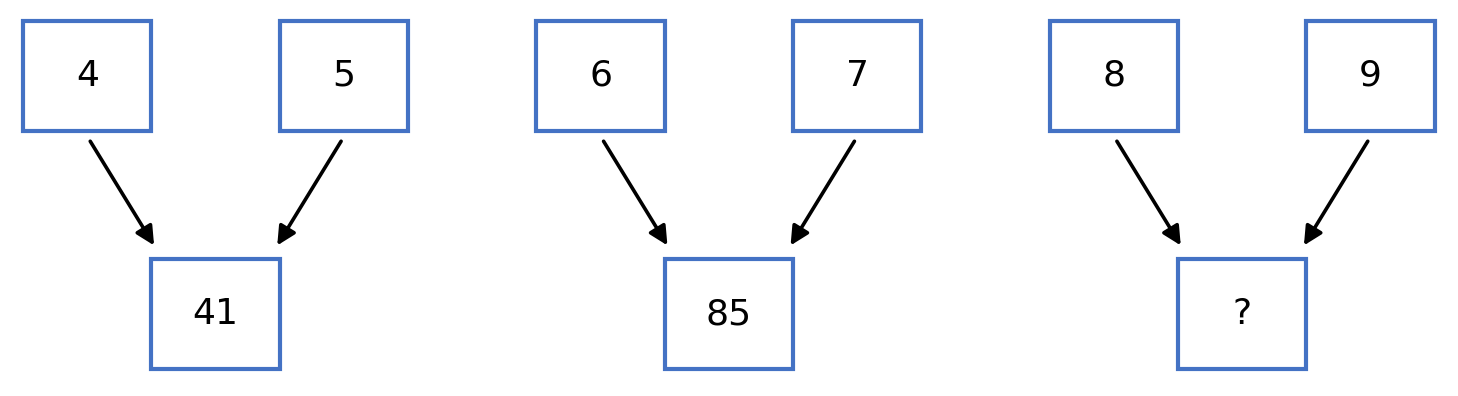
We need to identify the pattern in the given diagram and apply it to find the number that replaces the question mark.
The pattern for each number is different, but for 9, the correct calculation is \(9 \times 16 + 1 = 145\).
Correct Option: B) 145
To convert a speed from kilometers per hour (km/h) to meters per second (m/s), we need to convert kilometers to meters and hours to seconds. We know that 1 kilometer equals 1000 meters and 1 hour equals 3600 seconds. A common conversion factor can also be used.
The speed of the train is given as \(180 \text{ km/h}\).
To convert km/h to m/s, we multiply the speed by the ratio of meters per kilometer and seconds per hour:
\[ \text{Speed in m/s} = \text{Speed in km/h} \times \frac{1000 \text{ m}}{1 \text{ km}} \times \frac{1 \text{ hour}}{3600 \text{ s}} \]This simplifies to multiplying by a factor of \(\frac{1000}{3600}\), which can be reduced to \(\frac{5}{18}\).
Correct Option: B) 50 m/s
The question asks for the term describing a shared network within an organization used by its employees for communication. We need to identify the network type that is private to an organization.
Correct Option: D) intranet — An intranet is a private network accessible only to an organization's staff. It is designed for internal communication, collaboration, and sharing of information and resources among employees within that specific organization.
The question asks to identify an endocrine gland from the given options. To answer this, one must understand the difference between endocrine and exocrine glands.
Based on these evaluations, the pituitary gland is the only endocrine gland among the given options.
Correct Option: B) Pituitary — The pituitary gland is a classic example of an endocrine gland. It secretes hormones directly into the bloodstream to regulate various bodily functions and control other endocrine glands.
To find the points of intersection of a line and a circle, we need to solve their equations simultaneously. We can express one variable from the linear equation in terms of the other and substitute it into the circle's equation. This will result in a quadratic equation, whose solutions will give the coordinates of the intersection points.
Correct Option: A) (4, 2) and (−2, −6)
The question asks to identify which of the given ministries or organizations was NOT involved in organizing the Global Bio India – 2021 event. This requires knowledge of the key organizers and partners of this specific event.
The problem presents an alphanumeric series where each term consists of a letter, a number, and another letter. We need to identify the pattern for each component (first letter, number, second letter) separately to find the missing term.
The first letters are E, G, I, K, M.
Following this pattern, the next letter after M should skip 1 letter (N) and be O.
The numbers are 5, 9, 17, 29, 45.
The differences are 4, 8, 12, 16. This is an arithmetic progression with a common difference of 4. The next difference should be \(16 + 4 = 20\).
So, the next number in the sequence will be \(45 + 20 = 65\).
The second letters are A, C, E, G, I.
Following this pattern, the next letter after I should skip 1 letter (J) and be K.
The next term in the series will have:
Thus, the missing term is O65K.
C) O65K is the correct option because it follows all three established patterns for the first letter, the number, and the second letter.