
The question asks for the height of a geostationary orbit. A geostationary orbit is a special type of geosynchronous orbit directly above the Earth's equator (0° latitude), with a period matching the Earth's sidereal rotation period (one sidereal day). This allows a satellite in such an orbit to appear stationary from the ground. The height of this orbit is a standard value in space science and engineering.
D) 35,786 km — This is the internationally recognized and standard height above the Earth's surface for a geostationary orbit.
The problem involves decoding a pattern in a given code language. We need to identify the transformation rule applied to each letter of the original word to get the coded word. Once the rule is established, we apply it to the target word "ZULO" to find its coded form.
B) XRHJ is the correct answer, as derived from applying the established coding pattern.
Four different positions of the same dice are shown. Select the number that will be on the face opposite to the one having 5.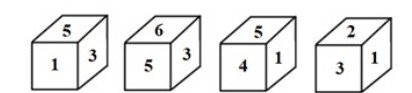
To determine which number is opposite the face with the number 5 on a dice, we need to analyze the given positions of the dice in the diagrams.
Correct Option: A) 2
The sum of the interior angles of any quadrilateral is always 360°. Given the ratio of the angles, we can represent the angles as multiples of a common factor, sum them up, and equate them to 360° to find the common factor. Once the common factor is known, we can calculate the measure of each angle, and then identify the greatest one.
Understand the property of a quadrilateral: The sum of the interior angles of any quadrilateral is \(360^\circ\).
Represent the angles: The angles are in the ratio \(1 : 2 : 3 : 4\). Let the common factor be \(x\). Then the four angles of the quadrilateral are \(1x\), \(2x\), \(3x\), and \(4x\).
Formulate the equation: Sum of the angles \(=\) \(360^\circ\).
So, \(1x + 2x + 3x + 4x = 360^\circ\).
Solve for \(x\):
\[ 1x + 2x + 3x + 4x = 360^\circ \]\[ (1 + 2 + 3 + 4)x = 360^\circ \]\[ 10x = 360^\circ \]\[ x = \frac{360^\circ}{10} \]\[ x = 36^\circ \]Calculate the measure of each angle:
Identify the greatest angle: Comparing the calculated angles (\(36^\circ, 72^\circ, 108^\circ, 144^\circ\)), the greatest angle is \(144^\circ\).
Correct Option: A) 144°
The question asks to identify the plant family of the 'Touch-me-not' plant. This requires knowledge of common plant classifications and their characteristic features.
Correct Option: A) Mimosaceae. The 'Touch-me-not' plant (Mimosa pudica) is well-known for its unique thigmonastic movements and belongs to the Mimosaceae family, which is part of the larger legume family (Fabaceae).
Which of the following is the greatest number?
\( \frac{15}{12} \)
\( \frac{25}{12} \)
\( \frac{13}{14} \)
\( \frac{7}{18} \)
To find the greatest number among the given fractions, we can convert each fraction into its decimal equivalent or find a common denominator to compare them. Converting to decimals is often simpler for a quick comparison.
Correct Option: B) \( \frac{25}{12} \)
The question asks about the criteria for a Public Sector Undertaking (PSU) to be granted 'Maharatna' status in India. This status is conferred by the Government of India to select Central Public Sector Enterprises (CPSEs) that meet specific performance and financial benchmarks, giving them greater operational and financial autonomy.
Correct Option: B) Having significant global presence/international operations
This is one of the explicit criteria for a CPSE to be considered for Maharatna status. The company must demonstrate a substantial presence in international markets or have significant global operations.
If the numerator of a fraction is increased by 80% and the denominator of the fraction is increased by 120%, then the resultant fraction is \( \frac{7}{22} \). What is the original fraction?
\( \frac{7}{18} \)
\( \frac{7}{17} \)
\( \frac{5}{17} \)
\( \frac{5}{18} \)
To find the original fraction, we will set up an equation based on the given information. We'll represent the original fraction as \( \frac{x}{y} \), apply the percentage increases to the numerator and denominator, and then equate the resulting fraction to \( \frac{7}{22} \).
Let the original fraction be \( \frac{x}{y} \).
The numerator is increased by 80%. This means the new numerator will be:
\[ x + 0.80x = x(1 + 0.80) = 1.80x \]The denominator is increased by 120%. This means the new denominator will be:
\[ y + 1.20y = y(1 + 1.20) = 2.20y \]The resultant fraction is given as \( \frac{7}{22} \). So, we can set up the equation:
\[ \frac{1.80x}{2.20y} = \frac{7}{22} \]Simplify the left side of the equation:
\[ \frac{1.80}{2.20} \cdot \frac{x}{y} = \frac{7}{22} \]Convert the decimals to fractions for easier calculation:
\[ \frac{180}{220} \cdot \frac{x}{y} = \frac{7}{22} \]Simplify the fraction \( \frac{180}{220} \) by dividing both numerator and denominator by 20:
\[ \frac{9}{11} \cdot \frac{x}{y} = \frac{7}{22} \]Now, solve for the original fraction \( \frac{x}{y} \):
\[ \frac{x}{y} = \frac{7}{22} \div \frac{9}{11} \]To divide by a fraction, multiply by its reciprocal:
\[ \frac{x}{y} = \frac{7}{22} \times \frac{11}{9} \]Perform the multiplication:
\[ \frac{x}{y} = \frac{7 \times 11}{22 \times 9} \]Simplify by canceling out common factors (11 and 22):
\[ \frac{x}{y} = \frac{7 \times 1}{2 \times 9} \]Calculate the final value:
\[ \frac{x}{y} = \frac{7}{18} \]Thus, the original fraction is \( \frac{7}{18} \).
A) \( \frac{7}{18} \) is the correct original fraction as derived from the calculations.
The question asks to identify the winner of the Man Booker Prize in November 2020. This requires knowledge of contemporary literary awards.
Correct Option: B) Douglas Stuart won the Man Booker Prize in November 2020 for his novel "Shuggie Bain".
The work done by a woman in 6 h is equal to the work done by a man in 4 h and by a boy in 8 h. Working 8 h per day, if 8 women can complete the work in 10 days, then in how many days can 10 women, 10 men and 10 boys together finish the same work working 8 h per day?
2 \( \frac{1}{13} \)
2 \( \frac{6}{13} \)
6 \( \frac{2}{13} \)
1 \( \frac{1}{13} \)
This problem involves work and time, where the efficiency of different individuals (women, men, boys) is related. We need to find the equivalent work rate of men and boys in terms of women, then calculate the total work units, and finally determine the time taken by the combined group.
Establish efficiency ratios: Given that the work done by a woman in 6 h is equal to the work done by a man in 4 h and by a boy in 8 h. Let \(W_w\), \(W_m\), \(W_b\) be the work rates of a woman, man, and boy per hour, respectively.
\[ 6 \times W_w = 4 \times W_m = 8 \times W_b \] From this, we can find the ratios of their efficiencies: \[ 6 W_w = 4 W_m \implies W_m = \frac{6}{4} W_w = \frac{3}{2} W_w \] \[ 6 W_w = 8 W_b \implies W_b = \frac{6}{8} W_w = \frac{3}{4} W_w \] So, 1 man's work rate is \(1.5\) times a woman's work rate, and 1 boy's work rate is \(0.75\) times a woman's work rate.Calculate total work units: 8 women working 8 h per day complete the work in 10 days. Total work units \( = (\text{Number of women}) \times (\text{Hours per day}) \times (\text{Number of days}) \times (\text{Work rate of one woman}) \) Let's assume the work rate of one woman is 1 unit/hour for simplicity. Then, \[ \text{Total Work} = 8 \times 8 \times 10 = 640 \text{ woman-hours} \]
Calculate the combined work rate of the new group: The new group consists of 10 women, 10 men, and 10 boys, working 8 h per day. Convert men and boys to equivalent women: 10 men \( = 10 \times \frac{3}{2} \) women \( = 15 \) women 10 boys \( = 10 \times \frac{3}{4} \) women \( = \frac{30}{4} = 7.5 \) women Total equivalent women \( = 10 \text{ (women)} + 15 \text{ (equivalent women from men)} + 7.5 \text{ (equivalent women from boys)} = 32.5 \) women.
Calculate the number of days: Let \(D\) be the number of days required for the new group to complete the work. \[ \text{Total Work} = (\text{Equivalent women}) \times (\text{Hours per day}) \times D \] \[ 640 = 32.5 \times 8 \times D \] \[ 640 = 260 \times D \] \[ D = \frac{640}{260} = \frac{64}{26} = \frac{32}{13} \] Convert the improper fraction to a mixed number: \[ D = 2 \frac{6}{13} \text{ days} \]
Correct Option: B) 2 \( \frac{6}{13} \)