
The question asks about the meaning of the "Yellow Revolution." This is a direct knowledge-based question related to various agricultural revolutions in India. To answer correctly, one needs to recall the specific agricultural sector associated with the Yellow Revolution.
Correct Option: B) Increasing the production of oil seeds
The Yellow Revolution in India is directly linked to the substantial increase in the production of oilseeds, such as mustard, groundnut, soybean, etc., to achieve self-sufficiency in edible oils.
To find the distance traveled by the train, we need to use the formula relating speed, distance, and time. The key is to ensure that all units are consistent before performing calculations. Here, the speed is given in kilometers per hour (km/h), and the time is given in minutes. We must convert the time into hours to match the speed's unit.
Since there are 60 minutes in an hour, we convert 20 minutes to hours:
\[ T = 20 \text{ minutes} \times \frac{1 \text{ hour}}{60 \text{ minutes}} = \frac{20}{60} \text{ hours} = \frac{1}{3} \text{ hours} \]The formula for distance is:
\[ \text{Distance} = \text{Speed} \times \text{Time} \]\[ D = S \times T \]The train will travel 25 km in 20 minutes.
A) 25 km is the correct distance traveled by the train.
To find the area of the square, we first need to determine the length of one side of the square. The total number of poles and the distance between consecutive poles will help us calculate the perimeter, and subsequently, the side length.
Understand the pole arrangement: When poles are fixed to fence a square, the number of poles is equal to the number of segments formed by the poles along the perimeter. For a closed shape like a square, if there are \(N\) poles, there are also \(N\) segments between them along the perimeter.
Calculate the perimeter: Given the total number of poles is 48. Given the distance between 2 poles is 5 m. Since there are 48 poles, there are 48 segments of 5 m each along the perimeter of the square.
Total perimeter \(P = \text{Number of poles} \times \text{Distance between two poles}\)
\[ P = 48 \times 5 \text{ m} \] \[ P = 240 \text{ m} \]Calculate the side length of the square: A square has 4 equal sides. Let the side length be \(s\). The perimeter of a square is given by \(P = 4s\).
\[ 240 \text{ m} = 4s \] \[ s = \frac{240}{4} \text{ m} \] \[ s = 60 \text{ m} \]Calculate the area of the square: The area of a square is given by \(A = s^2\).
\[ A = (60 \text{ m})^2 \] \[ A = 3600 \text{ m}^2 \]B) 3600 m² is the correct area of the square.
This problem involves compound interest. We are given the principal amount, the final amount, and the time period. We need to find the annual rate of compound interest. The formula for compound interest will be used to solve this problem.
The formula for the final amount (\(A\)) when interest is compounded annually is:
\[ A = P \left(1 + \frac{r}{100}\right)^n \]Divide both sides by 1000:
\[ \frac{1440}{1000} = \left(1 + \frac{r}{100}\right)^2 \]\[ 1.44 = \left(1 + \frac{r}{100}\right)^2 \]Subtract 1 from both sides:
\[ 1.2 - 1 = \frac{r}{100} \]\[ 0.2 = \frac{r}{100} \]Correct Option: B) 20% is the calculated rate of compound interest.
The following pie chart shows the total ocean cover by four oceans, Arctic, Indian, Atlantic and Pacific. 1st sector: Arctic = 4%, 2nd sector: Indian = 22%, 3rd sector Atlantic = 25% and 4th sector Pacific = 49%. Based on the pie chart, answer the given question.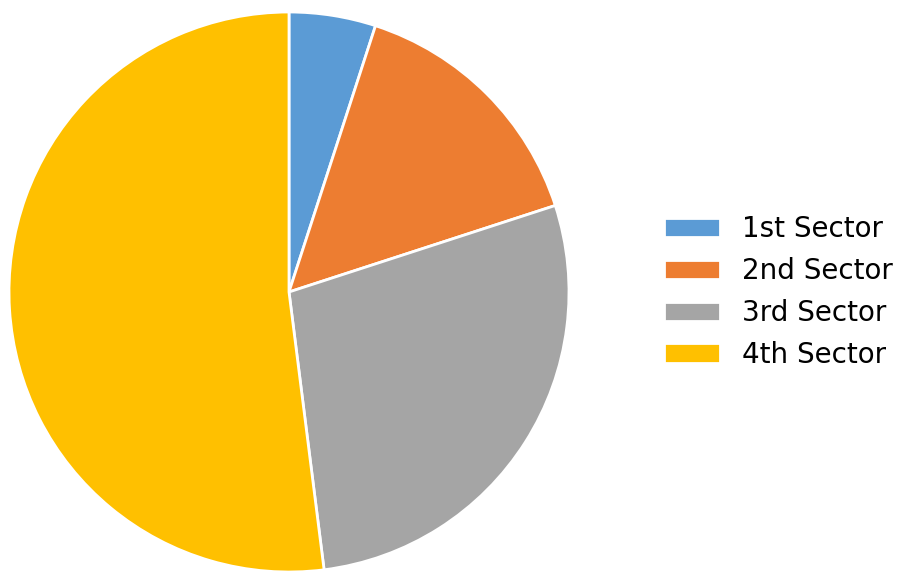
If the four oceans cover an area of almost 130 million square miles in total, then what area is covered by the Pacific Ocean?
74 million square miles
65 million square miles
63.7 million square miles
64 million square miles
The problem requires calculating the area covered by the Pacific Ocean using the given pie chart percentages and the total ocean area.
Calculate the Pacific Ocean area:
\[ \text{Pacific Ocean Area} = \frac{49}{100} \times 130 = 63.7 \text{ million square miles} \]Thus, the area covered by the Pacific Ocean is 63.7 million square miles.
Correct Option: C) 63.7 million square miles
Which country has hosted 35th ASEAN Summit in Oct-Nov 2019?
The question asks to identify the country that hosted the 35th ASEAN Summit in October-November 2019. This requires knowledge of recent international summits and their host countries.
Correct Option: A) The 35th ASEAN Summit, along with related summits, was hosted by Thailand from October 31 to November 4, 2019, in Bangkok.
The question asks to identify the country, other than India, that has Field Hockey as its national sport. This requires knowledge of the national sports of various countries.
Field Hockey is widely recognized as the national sport of both India and Pakistan. While India does not officially declare a national sport, Field Hockey is culturally considered its national game due to its historical success and popularity. Pakistan officially recognizes Field Hockey as its national sport.
B) Pakistan
Pakistan officially recognizes Field Hockey as its national sport. Both India and Pakistan have a rich history in Field Hockey, having won multiple Olympic medals and world cups in the sport.
The question asks about the visionary behind the establishment of the Tata Institute of Fundamental Research (TIFR). This requires knowledge of prominent Indian scientists and their contributions to institution building.
Correct Option: C) Dr. Homi J Bhabha
Dr. Homi J. Bhabha was the principal architect and first director of the Tata Institute of Fundamental Research (TIFR). His vision was crucial for its establishment as a center for world-class scientific research in India.
To find the average speed, we need to calculate the total distance traveled and the total time taken. Since the aeroplane flies along the sides of an equilateral triangle, each side has the same length. We will assume a convenient length for each side to simplify calculations and then use the formula for average speed: Average Speed = Total Distance / Total Time.
Let the length of each side of the equilateral triangle be \(d\) km. Since there are three sides, the total distance traveled by the aeroplane is \(3d\) km.
The speeds along the three sides are given as \(v_1 = 300 \text{ km/h}\), \(v_2 = 200 \text{ km/h}\), and \(v_3 = 240 \text{ km/h}\).
Calculate the time taken to travel each side:
Time for the first side (\(t_1\)):
\[ t_1 = \frac{\text{Distance}}{\text{Speed}_1} = \frac{d}{300} \text{ hours} \]Time for the second side (\(t_2\)):
\[ t_2 = \frac{\text{Distance}}{\text{Speed}_2} = \frac{d}{200} \text{ hours} \]Time for the third side (\(t_3\)):
\[ t_3 = \frac{\text{Distance}}{\text{Speed}_3} = \frac{d}{240} \text{ hours} \]Calculate the total time taken (\(T\)):
\[ T = t_1 + t_2 + t_3 = \frac{d}{300} + \frac{d}{200} + \frac{d}{240} \]Find a common denominator for the fractions. The least common multiple (LCM) of 300, 200, and 240 is 1200.
\[ T = d \left( \frac{1200/300}{1200} + \frac{1200/200}{1200} + \frac{1200/240}{1200} \right) \]\[ T = d \left( \frac{4}{1200} + \frac{6}{1200} + \frac{5}{1200} \right) \]\[ T = d \left( \frac{4+6+5}{1200} \right) = d \left( \frac{15}{1200} \right) \]\[ T = \frac{15d}{1200} = \frac{d}{80} \text{ hours} \]Calculate the average speed:
\[ \text{Average Speed} = \frac{\text{Total Distance}}{\text{Total Time}} = \frac{3d}{T} \]\[ \text{Average Speed} = \frac{3d}{d/80} \]\[ \text{Average Speed} = 3d \times \frac{80}{d} \]\[ \text{Average Speed} = 3 \times 80 = 240 \text{ km/h} \]Correct Option: B) 240 km/h
The question asks to identify the community in Rajasthan known for practicing block printing for the last three centuries. This requires knowledge of traditional crafts and communities in Rajasthan.
A) Chippa — The Chippa community, particularly in regions like Sanganer and Bagru in Rajasthan, has been traditionally involved in the art of block printing for centuries. They are renowned for their intricate designs and natural dyeing techniques, making them synonymous with this craft in the state.