
The question asks to identify the world's largest drainage basin. This requires knowledge of major river systems and their associated drainage areas. We need to compare the sizes of the drainage basins listed in the options.
A) Amazon Basin is the correct answer. It is globally recognized as having the largest drainage basin by area, as well as the largest discharge of water in the world.
The question asks about the meaning of the first two digits of the six-digit Postal Index Number (PIN) used by the Indian postal department. Understanding the structure of the PIN code is essential to answer this question.
D) The first two digits of the PIN code (taken together) stand for the sub region or one of the postal circles. This aligns with the structure of the PIN code system where the first two digits identify a specific postal circle or sub-region.
This problem involves deducing family relationships, genders, and professions based on given clues. We will build a family tree and identify the gender of each member to determine the group of male members.
B) BZ — This option correctly identifies B and Z as the only male members in the family.
The question asks for the year in which Guru Gobind Singh Ji founded the Khalsa Panth. This is a direct factual question related to Sikh history. Recalling the historical event and its associated date is key to answering this question.
Correct Option: D) 1699
Guru Gobind Singh Ji, the tenth Sikh Guru, formally inaugurated the Khalsa Panth on Baisakhi Day in 1699 at Anandpur Sahib. This event was a pivotal moment in Sikh history, transforming the Sikh community into a distinct, martial, and disciplined order.
The question asks for the location where the international treaty designed to protect human health and phase out mercury, signed in 2013, took place. This requires knowledge of significant environmental treaties and their signing locations.
Correct Option: B) Minamata, Japan is the correct answer. The Minamata Convention on Mercury, an international treaty to protect human health and the environment from the adverse effects of mercury, was adopted and opened for signature on October 10, 2013, in Minamata, Japan.
The question asks about the primary function of insulin in the human body. To answer this, we need to recall the role of insulin as a hormone in metabolic regulation.
Based on this understanding, we can evaluate the given options.
Correct Option: A) It regulates how the body uses and stores glucose and fat.
This statement accurately describes the multifaceted role of insulin. Insulin facilitates the uptake of glucose by cells, promoting its use for energy or storage as glycogen or fat. It also influences fat metabolism by encouraging fat storage and preventing its release from adipose tissue.
How many squares are there in the given figure?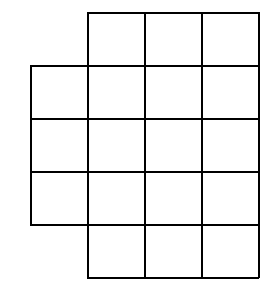
To find the total number of squares in the given figure, we need to count squares of different sizes systematically. The figure is composed of smaller squares arranged in a grid pattern, including overlapping areas.
Correct Option: C) 32
To determine which argument is strong, we need to evaluate each argument's relevance, validity, and strength in supporting or refuting the given statement. A strong argument is factual, logical, and directly addresses the core of the statement, while a weak argument is based on personal opinion, incomplete information, or is irrelevant.
Correct Option: C) Only argument (i) is strong.
The question asks about the origin of the constitutional provision for the indirect election of Rajya Sabha members in India. This is a direct factual question related to the sources of the Indian Constitution, a common topic in Indian competitive exams.
B) South Africa — The Indian Constitution adopted the method of indirect election of members to the Rajya Sabha, based on proportional representation by means of the single transferable vote, from the Constitution of South Africa. South Africa also contributed the procedure for constitutional amendment.
A box contains 6 white balls and 7 black balls. Two balls are drawn at random. What is the probability that both of them are of different colours?
\( \frac{4}{13} \)
\( \frac{2}{13} \)
\( \frac{6}{13} \)
\( \frac{7}{13} \)
To find the probability that two randomly drawn balls are of different colors, we will first calculate the total number of ways to draw two balls from the box. Then, we will calculate the number of ways to draw one white ball and one black ball. Finally, we will divide the number of favorable outcomes by the total number of outcomes.
This is a combination problem, as the order of drawing balls does not matter. The total number of ways to choose 2 balls from 13 is given by \(^{13}C_2\).
\[ ^{13}C_2 = \frac{13!}{2!(13-2)!} = \frac{13!}{2!11!} = \frac{13 \times 12}{2 \times 1} = 13 \times 6 = 78 \]This means drawing one white ball AND one black ball. The number of ways to choose 1 white ball from 6 is \(^6C_1\), and the number of ways to choose 1 black ball from 7 is \(^7C_1\).
The number of ways to draw one white and one black ball is the product of these two numbers:
\[ \text{Favorable outcomes} = ^6C_1 \times ^7C_1 = 6 \times 7 = 42 \]The probability of drawing two balls of different colors is the ratio of favorable outcomes to the total number of outcomes.
\[ P(\text{different colors}) = \frac{\text{Favorable outcomes}}{\text{Total outcomes}} = \frac{42}{78} \]Both 42 and 78 are divisible by 6.
\[ P(\text{different colors}) = \frac{42 \div 6}{78 \div 6} = \frac{7}{13} \]D) \( \frac{7}{13} \) is the correct probability, as calculated.