
The problem asks us to find the value of 'k' in an arithmetic progression (AP) given its sum. We will first identify the first term and common difference of the AP. Then, we will use the formula for the sum of an AP to find the number of terms. Finally, we will use the formula for the n-th term of an AP to find 'k'.
Identify the given values:
The given arithmetic progression is \(15 + 13 + 11 + 9 + \dots + k = -105\).
The first term is \(a = 15\).
The common difference \(d\) is calculated as the difference between consecutive terms:
\[ d = 13 - 15 = -2 \]\[ d = 11 - 13 = -2 \]\[ d = 9 - 11 = -2 \]Use the formula for the sum of an AP:
The sum of an AP is given by the formula:
\[ S_n = \frac{n}{2} [2a + (n-1)d] \] Or, alternatively, if the last term \(l\) is known: \[ S_n = \frac{n}{2} (a + l) \] We are given \(S_n = -105\), \(a = 15\), and \(d = -2\). Let the last term be \(k\).Using the first formula:
\[ -105 = \frac{n}{2} [2(15) + (n-1)(-2)] \]\[ -105 = \frac{n}{2} [30 - 2n + 2] \]\[ -105 = \frac{n}{2} [32 - 2n] \]\[ -105 = n(16 - n) \]\[ -105 = 16n - n^2 \]Rearranging the terms to form a quadratic equation:\[ n^2 - 16n - 105 = 0 \]Solve the quadratic equation for 'n':
We can solve this quadratic equation by factoring or using the quadratic formula.
By factoring, we need two numbers that multiply to \(-105\) and add to \(-16\). These numbers are \(-21\) and \(5\).
\[ (n - 21)(n + 5) = 0 \]This gives two possible values for \(n\):\[ n = 21 \quad \text{or} \quad n = -5 \]Since the number of terms cannot be negative, we take \(n = 21\).Find the value of 'k' (the 21st term):
The formula for the n-th term of an AP is:
\[ a_n = a + (n-1)d \]Here, \(a_n = k\), \(a = 15\), \(n = 21\), and \(d = -2\).\[ k = 15 + (21-1)(-2) \]\[ k = 15 + (20)(-2) \]\[ k = 15 - 40 \]\[ k = -25 \]Correct Option: C) -25
The problem asks us to analyze a given statement and determine which of the provided conclusions logically follow from it. This is a question of logical deduction, where we must stick strictly to the information given in the statement and not introduce outside knowledge or assumptions.
B) Only conclusion M follows.
Conclusion M accurately captures the core message of the statement, which is the superiority and greater impact of actions over words. The statement "A 'well done' is better than a 'well said'" directly translates to the idea that what is done (actions) is more significant than what is said (speeches).
The question asks to identify the first Indian Director of the Indian Institute of Science (IISc), Bangalore. This is a factual question related to the history of a prominent Indian scientific institution. Recalling key figures associated with IISc's leadership is essential.
D) C V Raman — Sir C.V. Raman was indeed the first Indian Director of the Indian Institute of Science, Bangalore, serving from 1933 to 1937. He was a distinguished physicist and Nobel laureate.
Study the given pattern carefully and select the number from the given options that can replace the question mark (?) in it.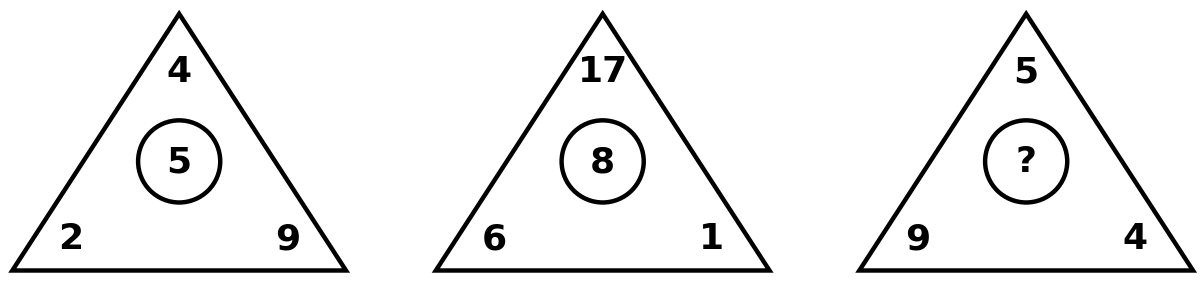
The problem involves identifying a pattern in the numbers within triangular diagrams. Each triangle has three numbers on its vertices and one number in the center. We need to find the number that fits the pattern in the third triangle.
Correct Option: C) 6
The question asks for the location of the Qila Mubarak monument. This is a factual question related to Indian history and geography, specifically concerning heritage sites.
Qila Mubarak is a historical monument located in Bathinda, Punjab, India. It is one of the oldest and most significant forts in India, with a history dating back to around 90-110 AD. It is famous for being the place where Razia Sultan, the first and only female ruler of the Delhi Sultanate, was imprisoned.
D) Punjab — The Qila Mubarak monument is indeed located in Bathinda, Punjab.
To solve this expression, we need to follow the order of operations, often remembered by the acronym BODMAS/PEMDAS. This means we perform operations in the following order: Brackets/Parentheses, Orders/Exponents, Division/Multiplication (from left to right), and Addition/Subtraction (from left to right).
A) 22 is the correct answer as derived by following the BODMAS/PEMDAS rule.
Study the given pattern carefully and select the number that can replace the question mark (?) in it.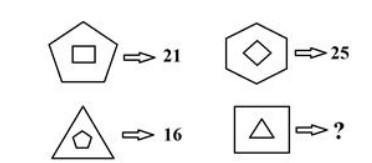
The problem involves identifying a pattern based on the shapes and their corresponding numbers. Each shape has an outer and an inner shape, and the number associated with each combination seems to follow a specific rule.
Thus, the number that replaces the question mark is 13.
Correct Option: B) 13
The problem asks for the ratio of the radius of the in-circle to that of the circumcircle for a triangle with sides 3 cm, 4 cm, and 5 cm. First, we need to identify the type of triangle. Then, we will use the formulas for the in-radius (\(r\)) and circum-radius (\(R\)) specific to that type of triangle or general formulas if necessary.
Identify the type of triangle: The sides of the triangle are 3 cm, 4 cm, and 5 cm. We check if it's a right-angled triangle using the Pythagorean theorem (\(a^2 + b^2 = c^2\)).
\[ 3^2 + 4^2 = 9 + 16 = 25 \] \[ 5^2 = 25 \]Since \(3^2 + 4^2 = 5^2\), the triangle is a right-angled triangle with the hypotenuse being 5 cm.
Calculate the in-radius (\(r\)): For a right-angled triangle with sides \(a\), \(b\), and hypotenuse \(c\), the in-radius is given by the formula:
\[ r = \frac{a + b - c}{2} \]Substituting the values \(a=3\), \(b=4\), and \(c=5\):
\[ r = \frac{3 + 4 - 5}{2} = \frac{7 - 5}{2} = \frac{2}{2} = 1 \text{ cm} \]Calculate the circum-radius (\(R\)): For a right-angled triangle, the circumcenter is the midpoint of the hypotenuse. Therefore, the circum-radius is half the length of the hypotenuse.
\[ R = \frac{c}{2} \]Substituting the value \(c=5\):
\[ R = \frac{5}{2} = 2.5 \text{ cm} \]Find the ratio of the in-radius to the circum-radius:
\[ \frac{r}{R} = \frac{1}{2.5} = \frac{1}{\frac{5}{2}} = \frac{2}{5} \]The ratio is \(2:5\).
Correct Option: C) 2 : 5
From the top and the bottom of 200 m high building, the angles of elevation of the top of a tower are 30° and 45° respectively. What is the height (in m) of the tower?
100(\(\sqrt{3}\) + 1)
300(\(\sqrt{3}\) + 1)
100\(\sqrt{3}\)(\(\sqrt{3}\) + 1)
100\(\sqrt{3}\)(\(\sqrt{3}\) − 1)
This problem involves trigonometry, specifically the concept of angles of elevation. We will use the tangent function to relate the angles of elevation, the heights, and the horizontal distance between the building and the tower. We will set up two equations based on the given angles and solve them simultaneously to find the height of the tower.
Let the height of the building be \(H = 200 \text{ m}\).
Let the height of the tower be \(h \text{ m}\).
Let the horizontal distance between the building and the tower be \(x \text{ m}\).
Consider the angle of elevation from the top of the building to the top of the tower. The height difference is \((h - H)\). The angle is \(30^\circ\).
\[ \tan(30^\circ) = \frac{h - H}{x} \]\[ \frac{1}{\sqrt{3}} = \frac{h - 200}{x} \]\[ x = \sqrt{3}(h - 200) \quad \text{(Equation 1)} \]Consider the angle of elevation from the bottom of the building to the top of the tower. The height is \(h\). The angle is \(45^\circ\).
\[ \tan(45^\circ) = \frac{h}{x} \]\[ 1 = \frac{h}{x} \]\[ x = h \quad \text{(Equation 2)} \]Now, substitute Equation 2 into Equation 1:
\[ h = \sqrt{3}(h - 200) \]Expand the equation:
\[ h = \sqrt{3}h - 200\sqrt{3} \]Rearrange the terms to solve for \(h\):
\[ 200\sqrt{3} = \sqrt{3}h - h \]\[ 200\sqrt{3} = h(\sqrt{3} - 1) \]Isolate \(h\):
\[ h = \frac{200\sqrt{3}}{\sqrt{3} - 1} \]Rationalize the denominator by multiplying the numerator and denominator by the conjugate of the denominator, which is \((\sqrt{3} + 1)\):
\[ h = \frac{200\sqrt{3}}{\sqrt{3} - 1} \times \frac{\sqrt{3} + 1}{\sqrt{3} + 1} \]\[ h = \frac{200\sqrt{3}(\sqrt{3} + 1)}{(\sqrt{3})^2 - (1)^2} \]\[ h = \frac{200\sqrt{3}(\sqrt{3} + 1)}{3 - 1} \]\[ h = \frac{200\sqrt{3}(\sqrt{3} + 1)}{2} \]\[ h = 100\sqrt{3}(\sqrt{3} + 1) \]C) \(100\sqrt{3}(\sqrt{3} + 1)\)
The question asks for the specific term used to describe friction in liquids. We need to identify the correct scientific term from the given options that refers to the resistance to flow within a fluid.
Correct Option: B) Viscosity — Viscosity is the measure of a fluid's resistance to flow. It quantifies the internal friction between adjacent layers of a fluid that are in relative motion.