
The question asks to identify the steel plant established with Russian collaboration in the Durg district of Chhattisgarh, which began production in 1959. This requires knowledge of the history and collaborations behind major Indian steel plants.
D) Bhilai Steel Plant — The Bhilai Steel Plant was indeed established with the collaboration of the Soviet Union (Russia) in the Durg district of Chhattisgarh (then Madhya Pradesh) and commenced production in 1959. It is one of the largest and most profitable integrated steel plants in India.
The given series is a sum of numbers that first increase from 1 to 31 and then decrease back to 1. This type of series is often called a "pyramid sum" or "triangular number sum" and can be solved by recognizing its symmetry or by using the formula for the sum of the first 'n' natural numbers.
Identify the structure of the series:
The series is \(1+2+3+\dots+30+31+30+29+\dots+3+2+1\).
This can be broken down into two parts:
Recognize the pattern:
The series is equivalent to the sum of the first 31 natural numbers, plus the sum of the first 30 natural numbers. Alternatively, it can be seen as the sum of the first 31 natural numbers, and then the sum of the numbers from 1 to 30 again, but without the peak number (31) being counted twice in the decreasing part.
A more elegant way to view this is that the sum of a series \(1+2+\dots+n+\dots+2+1\) is equal to \(n^2\), where \(n\) is the maximum value in the series.
Apply the formula:
In this series, the maximum value is \(n=31\).
Therefore, the sum is \(n^2\).
\[ \text{Sum} = 31^2 \]Calculate the value:
\[ 31^2 = 31 \times 31 = 961 \]A) 961 is the correct value as calculated by \(31^2\).
Study the diagram and identify the region representing teachers who are Chinese but not Indian.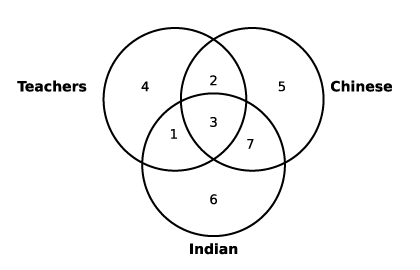
To solve this problem, we need to identify the region in the Venn diagram that represents teachers who are Chinese but not Indian.
Correct Option: A) 2 only
The question asks to identify the component in human beings that has a high affinity for oxygen. This relates to the transport of gases in the blood.
Correct Option: A) Haemoglobin has a high affinity for oxygen. It is the protein in red blood cells responsible for binding and transporting oxygen from the lungs to the body's tissues.
The problem asks us to find the Highest Common Factor (HCF) of two algebraic expressions, given their Least Common Multiple (LCM). We can use the fundamental property that for any two positive integers (or algebraic expressions), the product of their LCM and HCF is equal to the product of the numbers themselves.
Let the two given expressions be \( A \) and \( B \).
\[ A = 20x^{3}y^{2} \]\[ B = 10x^{4}y^{4} \]The given LCM of \( A \) and \( B \) is \( \text{LCM}(A, B) = 20x^{4}y^{4} \).
Let the HCF of \( A \) and \( B \) be \( \text{HCF}(A, B) \).
The fundamental relationship between LCM and HCF for two expressions is:
\[ A \times B = \text{LCM}(A, B) \times \text{HCF}(A, B) \]Substitute the given expressions and LCM into the formula:
\[ (20x^{3}y^{2}) \times (10x^{4}y^{4}) = (20x^{4}y^{4}) \times \text{HCF}(A, B) \]Simplify the left side of the equation:
\[ 20 \times 10 \times x^{3} \times x^{4} \times y^{2} \times y^{4} = 200x^{3+4}y^{2+4} = 200x^{7}y^{6} \]Now the equation becomes:
\[ 200x^{7}y^{6} = 20x^{4}y^{4} \times \text{HCF}(A, B) \]To find \( \text{HCF}(A, B) \), divide both sides by \( 20x^{4}y^{4} \):
\[ \text{HCF}(A, B) = \frac{200x^{7}y^{6}}{20x^{4}y^{4}} \]Perform the division:
For the numerical coefficients: \( \frac{200}{20} = 10 \)
For the \( x \) terms: \( \frac{x^{7}}{x^{4}} = x^{7-4} = x^{3} \)
For the \( y \) terms: \( \frac{y^{6}}{y^{4}} = y^{6-4} = y^{2} \)
Combine these results to get the HCF:
\[ \text{HCF}(A, B) = 10x^{3}y^{2} \]D) \( 10x^{3}y^{2} \) is the correct HCF calculated using the product relationship between the two expressions, their LCM, and HCF.
A) \( 10x^{2}y^{2} \) — This is incorrect because the power of \( x \) should be 3, not 2. This would be the HCF if the original expressions had \( x^2 \) as the lowest power of \( x \).
B) \( 20x^{2}y^{2} \) — This is incorrect because both the numerical coefficient (20 instead of 10) and the power of \( x \) (2 instead of 3) are wrong.
C) \( 20x^{3}y^{2} \) — This is incorrect because the numerical coefficient should be 10, not 20. The HCF of 20 and 10 is 10, not 20.
This problem involves ordering individuals based on their height. We will translate each statement into an inequality and then combine these inequalities to establish the complete height order. Finally, we will use this order to evaluate the given options.
Sohan is taller than Mohan: This can be written as:
\[ \text{Sohan} > \text{Mohan} \]Sohan is shorter than Geeta: This means Geeta is taller than Sohan:
\[ \text{Geeta} > \text{Sohan} \]Combining the first two statements, we get:
\[ \text{Geeta} > \text{Sohan} > \text{Mohan} \]Mohan is as tall as Meghna: This means their heights are equal:
\[ \text{Mohan} = \text{Meghna} \]Mohan is taller than Komal:
\[ \text{Mohan} > \text{Komal} \]Now, let's incorporate statements 4 and 5 into our combined order. Since Mohan = Meghna, we can replace Mohan with Meghna in the inequalities involving Mohan:
\[ \text{Geeta} > \text{Sohan} > \text{Mohan} \]\[ \text{Mohan} = \text{Meghna} \]\[ \text{Mohan} > \text{Komal} \]Substituting \(\text{Mohan} = \text{Meghna}\) into the main sequence and the last inequality:
\[ \text{Geeta} > \text{Sohan} > \text{Mohan} (\text{or Meghna}) > \text{Komal} \]So, the complete height order from tallest to shortest is:
\[ \text{Geeta} > \text{Sohan} > \text{Meghna} > \text{Komal} \]Now, let's evaluate the options based on this order for Meghna:
Correct Option: D) shorter than Sohan
From our derived order, \(\text{Sohan} > \text{Meghna}\), which means Meghna is shorter than Sohan.
The question asks for the term that describes a situation where a public good is made available free of direct payment, with its provision financed through the government budget. We need to identify the economic concept that best fits this description.
Correct Option: B) public provision is the term used when a public good is financed through the budget and made available free of any direct payment. This is a common way for governments to ensure access to essential public goods like national defense, street lighting, or public parks.
The question asks to identify the instrument used for measuring growth in plants. We need to recall the specific functions of the instruments listed in the options.
Correct Option: D) A crescograph is an instrument invented by Sir Jagadish Chandra Bose, specifically designed to measure the extremely slow and minute growth of plants. It can magnify the growth up to 10,000 times.
The question asks for the term that represents the sum of total fixed cost and total variable cost. This is a fundamental concept in microeconomics related to a firm's production costs.
Correct Option: D) total cost
Rohan can travel from Delhi to Kanyakumari in 30 h. If he reduces his speed by \( \frac{1}{15} \) th, he goes 10 km less in the same time. Find the speed.
This problem involves concepts of speed, distance, and time. We are given the initial time taken for a journey and a scenario where speed is reduced, leading to a shorter distance covered in the same amount of time. We can set up equations based on the formula \(\text{Distance} = \text{Speed} \times \text{Time}\) and solve for the unknown speed.
Let the original speed of Rohan be \(S\) km/h and the total distance from Delhi to Kanyakumari be \(D\) km. The time taken is given as 30 h.
Using the formula \(\text{Distance} = \text{Speed} \times \text{Time}\):
\[ D = S \times 30 \quad \text{(Equation 1)} \]Rohan reduces his speed by \(\frac{1}{15}\)th. So, the new speed \(S'\) will be:
\[ S' = S - \frac{1}{15}S = S \left(1 - \frac{1}{15}\right) = S \left(\frac{15-1}{15}\right) = \frac{14}{15}S \]In the same time (30 h), he goes 10 km less. So, the new distance \(D'\) covered is \(D - 10\) km.
Using the formula \(\text{Distance} = \text{Speed} \times \text{Time}\) for the new scenario:
\[ D - 10 = S' \times 30 \]\[ D - 10 = \left(\frac{14}{15}S\right) \times 30 \quad \text{(Equation 2)} \]Now we have a system of two equations:
Equation 1: \(D = 30S\)
Equation 2: \(D - 10 = \frac{14}{15}S \times 30\)
Substitute Equation 1 into Equation 2:
\[ 30S - 10 = \frac{14}{15}S \times 30 \]\[ 30S - 10 = 14S \times 2 \]\[ 30S - 10 = 28S \]Solve for \(S\):
\[ 30S - 28S = 10 \]\[ 2S = 10 \]\[ S = \frac{10}{2} \]\[ S = 5 \text{ km/h} \]B) 5 km/h is the correct speed.