
The question asks to identify the fibre crop commonly used for making coarse cloth, bags, sacks, and decorative items. This requires knowledge of common fibre crops and their primary applications.
C) Jute is a natural fibre primarily used for making coarse cloth, bags, sacks, and decorative items due to its strength, durability, and relatively low cost. It is often referred to as the 'golden fibre'.
To find the combined ratio A : B : C from two given ratios A : B and B : C, we need to make the common term (B in this case) equal in both ratios. This is achieved by finding the least common multiple (LCM) of the values of B in the given ratios and then adjusting the ratios accordingly.
Identify the given ratios:
Identify the common term: The common term is B.
Find the values of B in each ratio:
Calculate the LCM of the values of B:
LCM of 5 and 4 is 20.
Adjust the first ratio \(A : B = 3 : 5\) to make B equal to 20:
To change 5 to 20, multiply by \(20 / 5 = 4\). So, multiply both parts of the ratio by 4:
\[ A : B = (3 \times 4) : (5 \times 4) = 12 : 20 \]Adjust the second ratio \(B : C = 4 : 7\) to make B equal to 20:
To change 4 to 20, multiply by \(20 / 4 = 5\). So, multiply both parts of the ratio by 5:
\[ B : C = (4 \times 5) : (7 \times 5) = 20 : 35 \]Combine the adjusted ratios:
Now that the value of B is the same (20) in both adjusted ratios, we can combine them directly:
\[ A : B : C = 12 : 20 : 35 \]Correct Option: D) 12 : 20 : 35
Study the diagram and identify the region representing teachers who are Indian and Chinese.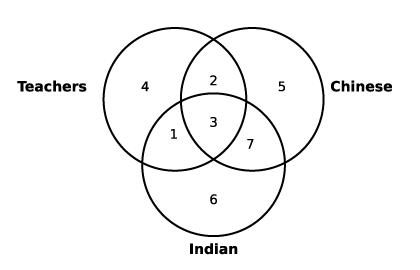
To solve this problem, we need to identify the region in the Venn diagram that represents individuals who are both teachers and are of Indian and Chinese nationality.
Correct Option: D) 3 only
The question asks to identify the international organization that replaced the League of Nations. This requires knowledge of the history of international organizations, particularly those established after major world wars.
D) United Nations. The United Nations was founded in 1945 to replace the League of Nations, which had largely failed in its mission to prevent another world war.
To solve this problem, we need to perform a series of additions and subtractions with decimal numbers. It's best to group the positive numbers and negative numbers first, then combine the sums. Alternatively, we can perform the operations sequentially from left to right.
Positive numbers: \(3.142\), \(3.61\), \(4\)
Negative numbers: \(-2.12\), \(-7.6\)
\[ 3.142 + 3.61 + 4 = 10.752 \]
\[ 2.12 + 7.6 = 9.72 \]
So, the sum of negative numbers is \(-9.72\).
Subtract the sum of negative numbers from the sum of positive numbers.
\[ 10.752 - 9.72 = 1.032 \]
Alternatively, we can solve it step-by-step from left to right:
A) \(1.032\) is the correct result of the given arithmetic expression.
The problem involves properties of a circle, specifically the relationship between the center, diameter, and points on the circumference. We will use the properties of isosceles triangles formed by radii and the angle subtended by a diameter at any point on the circumference.
Identify given information:
Analyze triangle ROP:
Determine \(\angle PRQ\):
Calculate \(\angle RQP\):
A) 51° is the correct answer. The measure of \(\angle RQP\) is \(51^\circ\).
The question asks to identify the first Indian woman scientist to be elected as a Fellow of The Royal Society, United Kingdom, in 2019. This requires knowledge of prominent Indian scientists and their achievements, specifically related to this prestigious fellowship.
D) Gagandeep Kang - Dr. Gagandeep Kang is an Indian clinical scientist and virologist. In 2019, she became the first Indian woman scientist to be elected as a Fellow of The Royal Society, United Kingdom. Her work focuses on enteric infections and vaccine development.
The question asks to identify the individual who resisted the demand for the formation of Pakistan. This requires knowledge of key figures in the Indian independence movement and their stance on the partition of India.
Khan Abdul Gaffar Khan, also known as Frontier Gandhi, was a staunch advocate of a united India and opposed the partition. He was a Pashtun independence activist who worked with Mahatma Gandhi and the Indian National Congress.
D) Khan Abdul Gaffar Khan — Khan Abdul Gaffar Khan, also known as Bacha Khan or Frontier Gandhi, was a prominent Pashtun independence activist who strongly opposed the partition of India and advocated for a united India. He was a close associate of Mahatma Gandhi and led the Khudai Khidmatgar (Servants of God) movement, which was committed to non-violent resistance against British rule and opposed the creation of Pakistan.
The question asks about the primary focus of Amnesty International. To answer this, one needs to know the core mission and activities of this well-known international non-governmental organization.
Correct Option: A) Amnesty International is an international non-governmental organization focused on human rights. It campaigns for a world where every person enjoys all of their human rights. Its work includes campaigning against torture, advocating for freedom of expression, and protecting the rights of refugees and migrants, among many other human rights issues.
To arrange words in dictionary order, we compare them letter by letter from left to right. If the first letters are the same, we move to the second letter, and so on. The word with the alphabetically earlier letter comes first.
Correct Option: B) Pigment → Pile → Pilgrim → Pillow